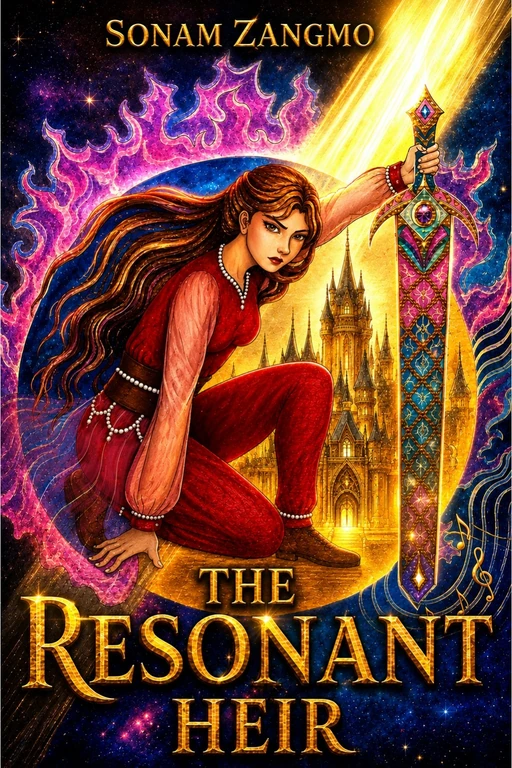
 Explore The Resonant HeirRoyal Fantasy · Hidden Magic · Female Lead · Coming-of-Age · Royal Intrigue · Fantasy Adventure
Fiction Knowledge · 01
Fantasy Books
How does a world that never existed become part of a life that did?
Fantasy begins with the unreal: impossible places, altered laws of nature, magic, creatures, and events that cannot exist in ordinary life. Yet its effects do not necessarily remain imaginary. Some fantasy books become attached to memory, identity, and the way readers understand themselves and other people.
Memory
Why do some fantasy books stay with us for years?
Reading happens within a life.
A book becomes associated with a particular age, place, relationship, or period of change, and those associations can remain long after the first reading.
This is where autobiographical memory matters. We do not remember stories in isolation; we often remember the circumstances in which they became meaningful to us.
A fantasy world encountered in childhood may later evoke much more than its characters or plot. It can reconnect a reader with the room where they read it, the people they shared it with, or the person they believed themselves to be at the time.
Nostalgia can strengthen that connection. Psychological research links nostalgia with self-continuity: the sense that our past and present selves still belong to the same life.
Rereading therefore creates an unusual experience.
The book may not have changed. The reader has.
Returning to an old story can become a comparison between who we were and who we are now.
This helps explain why people sometimes describe a book or series as “my childhood.”
They are not only remembering fiction. They are remembering part of themselves through it.
Life & identity
How can an imaginary world become part of a real life?
Stories give readers material with which to think about identity.
A character's choices can expose values we admire or reject. An unfamiliar society can make ordinary assumptions visible. A fictional life can present possibilities that a reader has never personally encountered.
Psychologists use the term possible selves for imagined versions of who we might become, hope to become, or fear becoming.
Fiction does not determine those identities. It can, however, enlarge the range of possibilities a reader is able to consider.
Fantasy is especially suited to this because it is not restricted to existing social arrangements or physical reality. It can invent new systems of power, different forms of family, altered relationships with death, entirely unfamiliar cultures, or worlds governed by impossible rules.
The distance from ordinary life can make familiar questions easier to see.
Who should have power? What do we owe other people? How much of identity is inherited? When does loyalty become obedience? What makes someone courageous?
The setting may be impossible, but the question does not have to be.
Stories also move beyond the individual reader.
Books become conversation, shared references, artwork, fan fiction, games, communities, and friendships. Sociological research on fandom increasingly treats this kind of participation as a form of community and identity rather than simply passive consumption.
An imaginary world can therefore acquire a very real social life.
The world itself may not exist. The relationships formed around it do.
And the mind is remarkably capable of building experiences from things that are not physically present. When we follow a story, we construct places, actions, intentions, and emotional states from language. Neuroscience research on fiction reading shows that reading and social cognition can recruit parts of the brain's default network involved in simulating scenes, spaces, and mental states.
The brain knows the dragon is fictional.
But the reader still has to imagine what it would mean to stand in front of one.
Fantasy does not need to convince us that the impossible is real. It only needs to make the impossible meaningful while we imagine it.
Reading & the mind
What are the benefits of reading fantasy books?
The benefits of fantasy do not come from magic itself. They come partly from what reading fiction asks the mind to do.
It engages imagination
Fantasy asks readers to construct things that experience alone cannot provide.
A new world may have unfamiliar geography, social rules, creatures, or systems of cause and effect. Readers must build and revise a mental model of how that reality works.
This does not mean fantasy automatically makes someone more creative.
But it gives imagination unusual material to work with: possibilities that do not already exist.
It encourages perspective-taking
To understand a story, readers must track what characters know, want, fear, misunderstand, and believe.
A large preregistered meta-analysis of fiction reading found small positive cognitive effects overall, with experimental effects emerging most clearly for empathy and mentalizing. These effects are modest rather than automatic.
The more basic point is still valuable.
Reading repeatedly asks us to consider: What does this situation look like from inside another mind?
Fantasy can extend that exercise beyond familiar experience by placing readers inside cultures, bodies, roles, and moral systems that do not exist in everyday life.
It creates psychological distance
Fantasy can transform human problems into unfamiliar forms.
Power becomes magic. Inherited expectation becomes prophecy. Fear becomes a monster. Social division can become conflict between invented peoples.
This distance can make difficult ideas easier to examine because readers are not encountering them in exactly the same form as ordinary life.
Fantasy does not remove the real problem. It changes the angle from which we approach it.
It can deepen reflection
The most lasting effect of a story may not occur while the book is open.
A fictional choice can remain useful because readers continue thinking about it afterwards: comparing it with their own values, experience, and decisions.
That is why the value of fantasy may lie not simply in escaping reality.
Sometimes it lies in returning to reality with a new question, image, or possibility in mind.
The definition
What is the fantasy genre?
Fantasy is a form of fiction that allows the impossible to become part of the reality of the story.
That impossibility may take the form of magic, supernatural beings, mythical creatures, invented worlds, altered laws of nature, or events that ordinary reality cannot contain.
But fantasy is not a single type of story.
High fantasy may create an entirely secondary world.
Adventure fantasy can turn movement into discovery, risk, and an experience of the unknown.
Epic fantasy may expand conflict across kingdoms, wars, or civilizations.
YA fantasy can combine the impossible with questions of adolescence and identity.
The genre can also be shaped by what a story chooses to emphasize. A female lead fantasy can place a particular character at its center; royal fantasy can explore the consequences of crowns, dynasties, and inheritance; character-driven fantasy can make personal choices the engine of the story; royal political fantasy can turn institutions and struggles for power into central forces; and coming-of-age fantasy can use the impossible to explore who a person is becoming.
That flexibility is part of fantasy's strength.
What unites these stories is not a checklist of dragons, swords, or spells. It is permission to move beyond the limits of ordinary reality.
That freedom allows fantasy to make abstract things concrete.
Power can have a physical form. Memory can become a place. Fear can have teeth. Identity can become magic.
And an impossible world can still speak very directly to a real human life.
Perhaps that is why fantasy books can remain meaningful long after the story itself is finished.
Sometimes we remember the world. Sometimes we remember who we were when we entered it.
And sometimes, a world that never existed becomes part of a life that did.
If you are trying to choose what to read next, learn how to find a fantasy book that fits the way you actually like to read.