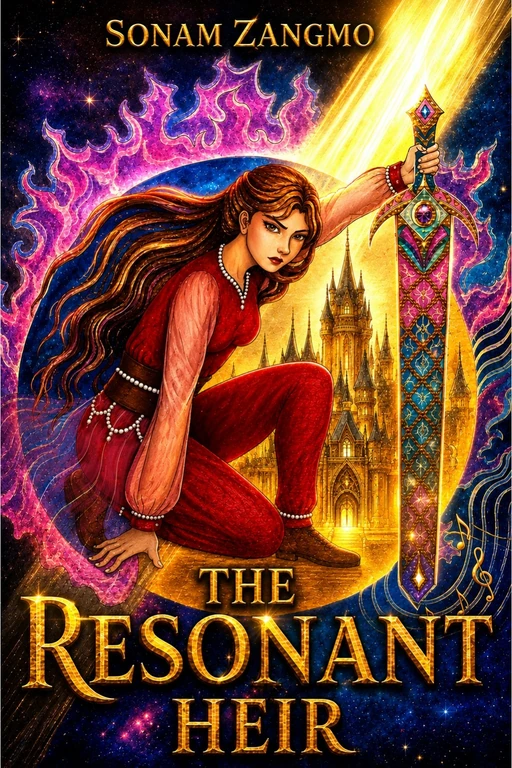
 Explore The Resonant Heir
Royal Fantasy · Hidden Magic · Female Lead · Coming-of-Age · Royal Intrigue · Fantasy Adventure
Explore The Resonant Heir
Royal Fantasy · Hidden Magic · Female Lead · Coming-of-Age · Royal Intrigue · Fantasy Adventure
Fiction Knowledge · 04
Character-Driven Fantasy Books
If the character made a different choice, would this still be the same story?
Readers looking for character-driven fantasy books are not necessarily looking for slower stories or less plot. Often, they are looking for fantasy in which the people at its center matter enough that different fears, desires and decisions would produce a different story. There may still be wars, prophecies, ancient magic and kingdoms on the edge of collapse. But those things do not decide the direction of a story by themselves. Sometimes the decisive force is what a particular person chooses to do when confronted by them.
Story direction
Why is character-driven fantasy so hard to define?
The phrase character-driven is used for many different kinds of stories. A slow novel may earn the label because it spends more time on relationships. An introspective one may be described that way because readers spend longer inside the protagonist’s thoughts. Sometimes memorable characters alone are enough.
All of those qualities can belong to character-driven fantasy, but none of them quite explains what makes a character drive a story.
The disagreement is not new. Fantasy author Patricia C. Wrede has noted that discussions of plot-driven and character-driven fiction often rely on definitions that do not agree with one another.
A novel can spend hundreds of pages inside someone’s head while its major events would unfold much the same way regardless of what that person decides. The story may be deeply interested in its characters without allowing them much influence over where it goes.
Character-focused tells us where a story spends its attention. Character-driven tells us where much of the story gets its direction.
The same distinction helps explain character depth. Backstory tells us where someone came from. Internal monologue shows us what they think. Relationships reveal sides of them we might never see alone. But eventually that knowledge has to affect something.
Fear becomes important when it changes a decision. Ambition matters when someone acts on it. Loyalty becomes difficult when keeping it has a cost. A flaw becomes more than a trait when it begins to create consequences.
Character depth is not simply how much we know about someone. It is how much meaning their choices acquire.
Choice & consequence
What actually makes a fantasy story character-driven?
A useful pattern is:
motive → choice → consequence → new situation → new choice
The world creates circumstances. A character responds, and that response changes what becomes possible next.
Imagine an enemy army approaching a kingdom. The invasion itself is an event. The story changes depending on whether the ruler negotiates, attacks first, lies to an ally or abandons part of the kingdom to save the rest.
The army is the same. The person facing it is what creates the different possibilities.
That leads to a useful question:
If the protagonist made a different choice, would the story still unfold in roughly the same way?
Not every event has to depend on the protagonist. Wars can begin, rulers can die and disasters can strike regardless of what one person wants. What matters is whether the decisions that follow alter relationships, dangers and future possibilities.
Those decisions do not have to be grand. Trusting the wrong person, refusing to forgive, keeping a promise too long or hiding one truth can redirect a story just as surely as winning a battle.
They also give plot its emotional weight. A sacrifice means more when we understand what the person making it wanted to keep. A betrayal hurts differently when we know what loyalty once meant.
We care about a decision because we understand who had to make it.
In character-driven fantasy, plot does not disappear. Plot is what character choices become.
Fantasy as pressure
Does character-driven fantasy need less plot or worldbuilding?
No. A character-driven fantasy can be fast, complicated and enormous. It can contain politics, battles, intricate magic systems and histories stretching back thousands of years.
The tension appears in reader discussions too: some readers explicitly ask whether character-driven fantasy means less worldbuilding, while others look for character-driven books with strong worldbuilding.
The more useful question is what that world asks of the people living inside it.
A law becomes important when someone has reason to obey it and an equally powerful reason to break it. A prophecy becomes interesting when belief in it changes what someone is willing to do. Magic becomes more than spectacle when power carries a price someone must decide whether to pay.
Worldbuilding does not have to compete with character. It can create the pressure that reveals character.
Even a battle can be deeply character-driven. The most important moment may not be the largest spell or the number of soldiers on the field, but the instant someone decides to fight, flee, disobey an order or save one person at the cost of something larger.
A quiet conversation can change just as much if it alters trust. Friendship can shift loyalty. Love can change risk. Resentment can distort judgment. Betrayal can close one path and open another.
Emotion becomes plot when it changes a decision.
Fantasy does not need to become smaller for its characters to matter more. A vast world can make those characters matter even more when its rules, dangers and possibilities continually force them to decide what they value.
The definition
What is character-driven fantasy?
Character-driven fantasy is fantasy in which the motivations, choices and relationships of the characters substantially shape the direction and consequences of the story.
It does not require less plot, slower pacing or simpler worldbuilding. A character-driven fantasy may contain quests, wars, mysteries, political conflicts, magic systems and ancient prophecies. The difference is that these things do not pass through the story untouched by the people experiencing them.
Characters interpret what happens. They resist it, misunderstand it, use it and sometimes make everything worse. What they choose changes what becomes possible next.
That is why two people placed in the same fantasy world should not necessarily create the same story. They may face the same law and respond differently, inherit the same power and fear different costs, or suffer the same betrayal and choose revenge, forgiveness or retreat.
Who they are changes what they do. What they do changes what happens.
That is the heart of character-driven fantasy.
The world may create the crisis. The character creates the direction.