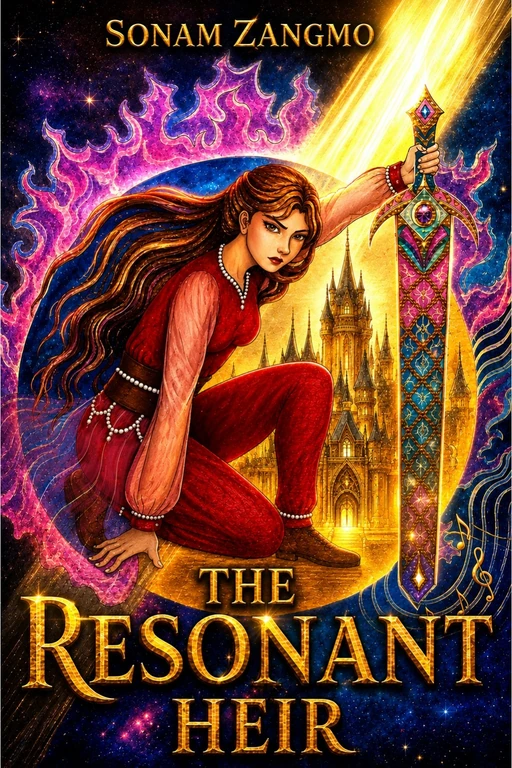
 Explore The Resonant Heir
Epic Fantasy · High Fantasy · Royal Fantasy · Adventure Fantasy · Character-Driven Fantasy · Coming-of-Age Fantasy
Explore The Resonant Heir
Epic Fantasy · High Fantasy · Royal Fantasy · Adventure Fantasy · Character-Driven Fantasy · Coming-of-Age Fantasy
Fiction Knowledge · 10
Epic Fantasy Books
How can one person's choices become large enough to change the fate of a kingdom?
The definition
What is “Epic Fantasy”?
A ruler dies.
At first, the death belongs to one family and one court. Then the succession is disputed. Factions choose sides. Alliances break. War follows. Years later, the kingdom has different rulers, different laws, perhaps even different borders.
One event has moved through an entire society.
That is how I understand Epic Fantasy.
Epic Fantasy begins when the consequences of a story move beyond the immediate lives of its characters and start changing something larger: a community, a political system, a culture, a kingdom, or the course of history.
The important word is not big.
It is consequence.
A fantasy world can contain many kingdoms, races, religions, magical systems, gods, monsters, and thousands of years of history without producing an epic story.
Those elements may be necessary, but they are not enough.
Epic scale appears when they begin affecting one another.
If magic changes political power, political power may change law.
If religion shapes law, a change in belief may destabilize an institution.
If one kingdom falls, its collapse may alter trade, migration, alliances, or the balance of power elsewhere.
The point is not that an Epic Fantasy world needs all of these systems.
The point is that when something important changes, the consequences should not disappear at the edge of the scene.
They should lead somewhere.
A story can contain battle after battle, betrayal after betrayal, and threat after threat while still creating the feeling that nothing has truly changed.
The plot is moving, but the story is not necessarily progressing.
For me, progression means that events accumulate. Because A happened, B became possible. Because B happened, C followed. And by the time the story reaches D, something larger than the characters’ original problem has changed.
The events do not need to follow any fixed pattern or order. But the major changes should connect strongly enough that the reader can understand how one state of the world became another.
Causality gives the events meaning. The reach of their consequences gives the story epic scale.
So the question I find most useful is not:
How large is this story?
It is:
If these events had never happened, how different would this world be?
Scale & meaning
How Big Is Too Big for Epic Fantasy?
Epic Fantasy becomes too big when expansion stops adding meaning.
There is no useful threshold based on pages, characters, kingdoms, or points of view. What matters is whether the growing scale still changes how the reader understands the story and its consequences.
Otherwise, the story becomes larger in quantity without becoming larger in significance.
This is where scale and weight become different things.
A story that crosses five kingdoms is larger than one confined to a single court. But if each new place adds nothing meaningful, the greater distance creates scale without adding weight. A smaller setting can carry more significance when the choices made within it continue to shape what follows.
The challenge is keeping that meaning visible as the story expands.
If an empire falls but the reader no longer cares about anyone living through that fall, the scale may be enormous but emotionally weightless.
Epic Fantasy can be very large.
It simply needs to remain meaningful at every scale.
The distinction
High Fantasy vs Epic Fantasy
High Fantasy and Epic Fantasy often appear together, which is why the terms are sometimes treated as interchangeable.
But they describe different things.
High Fantasy describes the nature of the world.
Epic Fantasy describes the reach of what happens within it.
A story can belong to one, both, or neither. A secondary world does not automatically make its story epic, just as epic scale does not depend on the size or complexity of the setting.
This is the distinction I find most useful.
A High Fantasy world may already have a long history before the story begins.
Epic Fantasy shows how the events of the story can leave a mark on that history.
So I separate the two with two questions:
High Fantasy asks: What kind of world are we entering?
Epic Fantasy asks: What will be different in that world because this story happened?
This article reflects Sonam Zangmo’s personal understanding of the genre.