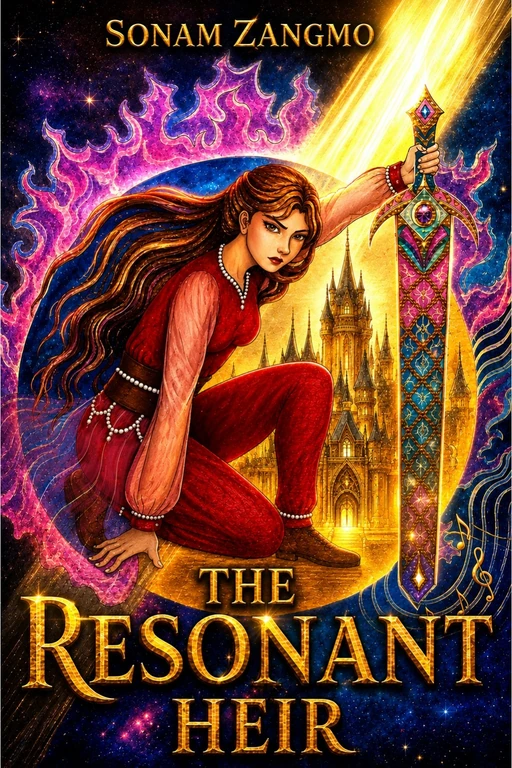
 Explore The Resonant Heir
Epic Fantasy · High Fantasy · Royal Fantasy · Adventure Fantasy · Character-Driven Fantasy · Coming-of-Age Fantasy
Explore The Resonant Heir
Epic Fantasy · High Fantasy · Royal Fantasy · Adventure Fantasy · Character-Driven Fantasy · Coming-of-Age Fantasy
Fiction Knowledge · 09
High Fantasy Books
How can we miss a place that never existed? Perhaps because the best imaginary worlds do more than give us somewhere new to look at. For a while, they give us somewhere new to live.
The definition
What is “High Fantasy”?
“High Fantasy” sounds like a simple label, but it becomes less simple the moment people try to define it.
In academic discussions, one of its strongest foundations is the idea of the secondary world: a fantasy reality that exists apart from the ordinary world we know. Oxford Academic has discussed High Fantasy through this tradition of alternative or secondary worlds, and the idea remains one of the clearest foundations for understanding the genre.
But readers and writers do not always use the term in the same way.
Some people call a story High Fantasy because it takes place in a completely invented world. Others use the term when a story contains a great deal of magic, mythical creatures, or supernatural elements. Some expect kingdoms, ancient prophecies, heroic journeys, or conflicts large enough to decide the fate of the world.
For me, these things should not all be placed under one definition.
If High Fantasy means “a lot of magic,” then it becomes difficult to separate High Fantasy from High Magic.
If High Fantasy means “a very large story,” then it becomes difficult to separate High Fantasy from Epic Fantasy.
That is why I understand High Fantasy mainly through the nature of its world.
A High Fantasy story is rooted in a secondary reality. That world may have its own geography, history, societies, beliefs, political systems, cultures, and rules. It may borrow familiar ideas from our own history, but it does not depend on the ordinary world as the place where fantasy suddenly appears.
This does not mean the world must be full of magic.
It does not need dragons.
It does not need elves.
It does not need a Chosen One, a medieval kingdom, or a war between good and evil.
Those things can exist in High Fantasy, but they are not what make it High Fantasy.
A secondary world can contain very little visible magic. Its story can be about one family, one city, or one person. What matters is that the fantasy belongs to a world of its own.
For this reason, I treat High Fantasy, High Magic, and Epic Fantasy as three separate ideas.
High Fantasy tells us what kind of world we are entering.
How much magic exists there is another question.
How large the story becomes is another question again.
The distinction
High Fantasy vs Low Fantasy
High Fantasy and Low Fantasy are often treated as opposites, but the difference between them becomes confusing because people do not always use the words in the same way.
In this Knowledge guide, I separate them mainly by where the fantasy belongs.
High Fantasy takes place in a secondary or invented world.
Low Fantasy places fantasy inside, beside, or behind a reality that is still recognizably connected to our own.
The difference is important because it has nothing to do with how much magic a story contains.
A High Fantasy world can have very little magic.
A Low Fantasy story can have magic everywhere.
This is why I do not think High Fantasy should be treated as another way of saying High Magic.
The Lord of the Rings is an easy example. Middle-earth is widely treated as a classic example of the secondary-world tradition, so The Lord of the Rings fits naturally within High Fantasy. But most people living there are not casting spells every morning. Magic is ancient, powerful, and important, but it is not an everyday skill for ordinary people.
Harry Potter creates almost the opposite situation. The story exists alongside a familiar Britain, but inside the magical community, magic is everywhere. People use it for education, transport, medicine, government, communication, sport, and daily life.
Under the framework I use here, The Lord of the Rings can therefore be seen as High Fantasy with relatively Low Magic, while Harry Potter can be understood as Low Fantasy with High Magic.
Some readers use High and Low Fantasy differently. They may call a world “high” when magic and supernatural elements are deeply integrated into everyday life, and “low” when those things are rare or mysterious.
I understand why that definition exists.
But I prefer to keep these ideas separate.
If High and Low Fantasy describe the world, and High and Low Magic describe how magic exists inside that world, the distinction becomes much easier to follow.
Readers today
What Kind of High Fantasy Do Readers Want Today?
Readers still want the thing High Fantasy has always been good at giving them: the feeling of entering another world.
They still look for deep worldbuilding, lore, politics, mystery, adventure, magic, memorable characters, and the sense that the world continues beyond the part of it they can currently see.
But I do not think readers simply want more worldbuilding.
They want worldbuilding that means something.
A fantasy world can have maps, thousands of years of history, a detailed political system, and pages of magical rules and still feel strangely empty.
For me, a world begins to feel real when two things work together: logic and emotion.
If the logic breaks, it becomes difficult to believe in the world.
If the world creates no feeling, it becomes difficult to care about it.
This is why strong worldbuilding is not only about how many details an author can invent. The details have to affect one another.
Geography should influence travel and trade.
History should leave marks on the present.
Religion should shape beliefs and laws.
Politics should affect ordinary lives.
Magic, if it exists, should change the way people live rather than simply appearing when the story needs a spectacular moment.
When these things connect, the world begins to feel as if it has a life beyond the plot.
But readers also need someone to care about inside that world.
A beautiful map cannot replace a memorable character.
A perfect magic system cannot replace emotion.
A fantasy world becomes much easier to believe in when the people living inside it want something, fear something, lose something, and make choices that matter to them.
At the same time, many readers are also looking for something High Fantasy has not shown them enough of yet.
A secondary world does not always have to look like medieval Europe.
It does not always need the same castles, taverns, feudal kingdoms, ancient prophecies, and familiar fantasy races.
An invented world can have different political systems, different forms of technology, different cities, different social structures, and completely different relationships with magic.
This does not mean traditional High Fantasy has lost its appeal.
Many readers still want kingdoms, adventure, mystery, ancient history, danger, heroism, and the feeling of disappearing into a world much larger than themselves.
What seems to be changing is that they also want to be surprised.
They want the wonder without always seeing the same pieces arranged in the same way.
They want worlds that feel familiar enough to enter, but different enough to remember.
For me, that may be the most interesting challenge for High Fantasy now.
Creating another imaginary world is not difficult.
Creating one that feels alive, makes sense, and still finds a way to touch the reader’s heart is much harder.
This article reflects Sonam Zangmo’s personal understanding of the genre.