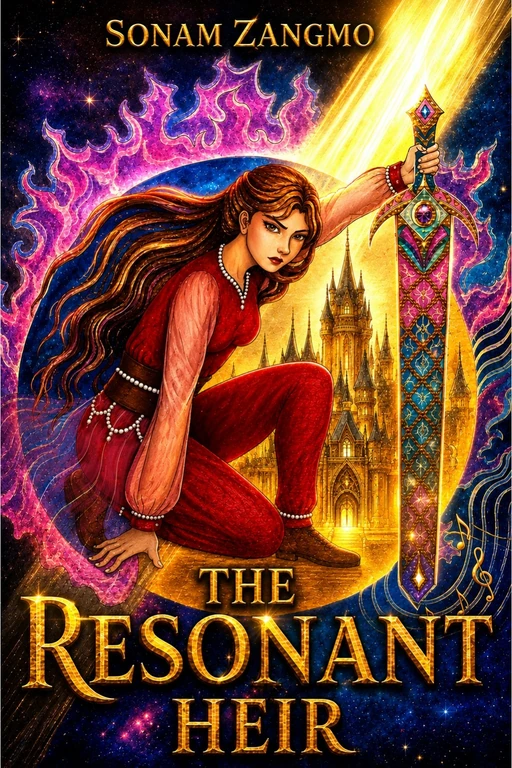
 Explore The Resonant Heir
Royal Fantasy · Hidden Magic · Female Lead · Coming-of-Age · Royal Intrigue · Fantasy Adventure
Explore The Resonant Heir
Royal Fantasy · Hidden Magic · Female Lead · Coming-of-Age · Royal Intrigue · Fantasy Adventure
Fiction Knowledge · 06
Royal Fantasy Books
What changes when a family is not only a family, but a dynasty?
In royal fantasy, love, rivalry, inheritance, and duty rarely stay private. A decision inside one family can shape the future of an entire realm.
The appeal
Why Does Royal Fantasy Still Hold Such a Strong Place in Fantasy?
After generations of stories about royal families, heirs, palaces, dynasties, and thrones, it would be easy to imagine that Royal Fantasy had exhausted its possibilities.
Yet readers continue to seek it out, and some remain deeply attached to the genre.
That persistence interests me.
With so many stories already built around royalty, why does this kind of fantasy still hold such a strong appeal?
Beauty is part of the answer.
For me, a Royal Fantasy world should be easy to imagine. I do not need to know how many buttons are sewn onto a prince’s coat, but I want enough detail to understand what makes him royal and what gives his world an identity of its own.
Architecture matters for the same reason. Palaces, halls, gardens, libraries, temples, and ceremonial spaces can make a kingdom visually distinct without requiring endless description.
But these things are only the surface.
What keeps me interested is the people living inside them.
A father may also be a king. A daughter may also be an heir. A sibling may be someone you love and someone whose existence changes your own future.
Royalty brings rules, expectations, loyalty, rivalry, duty, and restriction into relationships that would otherwise be private.
I am also drawn to stories where intelligence has something to do.
A character can become interesting through observation, judgment, deception, negotiation, knowledge, patience, or simply understanding another person well enough to anticipate what they will do.
What works
What Makes Royal Fantasy Come Alive—or Fall Flat?
Royal Fantasy begins to fall flat when royalty becomes decoration instead of something that shapes the relationships between its characters.
Family affection can exist beside succession. Loyalty can exist beside resentment. Someone can genuinely care for another person and still have reasons to oppose them.
I also want intelligence to be shown, not announced.
I rarely care about who finally sits on the throne as much as I care about how they get there—or how someone else loses it. The decisions, mistakes, observations, and strategies along the way are what make the outcome interesting.
Familiar tropes are not the problem. Lost heirs, arranged marriages, rival siblings, hidden identities, and succession struggles can still work.
What becomes tiring is predictability.
A familiar trope should create a new problem, not reveal the rest of the story.
I also lose interest when betrayal, jealousy, cruelty, and conflict exist only to produce more of the same.
Fantasy does not have to be cheerful.
But conflict should lead somewhere.
What I hope for most is that moment when a character turns the entire situation around through intelligence—something I did not see coming, but that makes perfect sense once it happens.
Romance
Does Royal Fantasy Need Romance?
No.
Romance fits Royal Fantasy naturally because royal status can make love collide with family, duty, inheritance, reputation, and expectation.
But romantic relationships are not the only relationships capable of carrying a Royal Fantasy story.
Parents and children, siblings, rulers and advisers, heirs and mentors can create just as much tension. So can mystery, magic, succession, family history, duty, or the burden of inheriting a role someone never chose.
Romance can be at the centre of the story.
What matters to me is that the royal world still has a life beyond it.
There should still be mystery, complicated relationships, a kingdom with its own beauty, magic that matters, and characters whose choices continue to shape the story.
This article reflects Sonam Zangmo’s personal understanding of the genre.