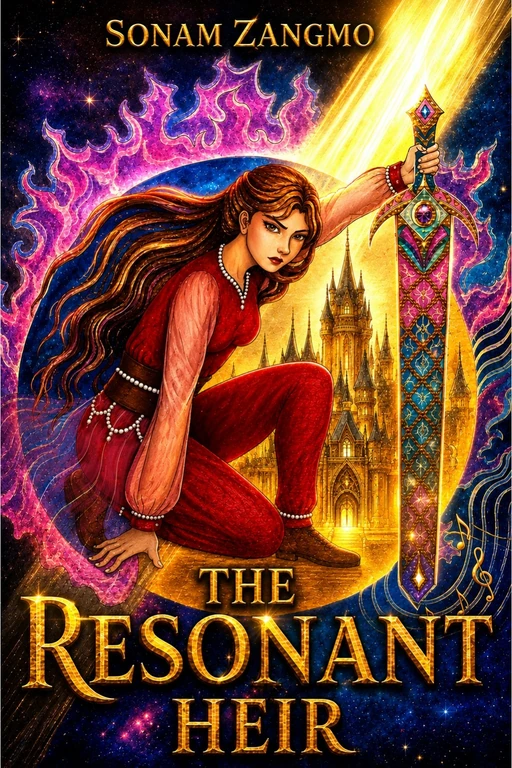
 Explore The Resonant Heir
Royal Fantasy · Hidden Magic · Female Lead · Coming-of-Age · Royal Intrigue · Fantasy Adventure
Explore The Resonant Heir
Royal Fantasy · Hidden Magic · Female Lead · Coming-of-Age · Royal Intrigue · Fantasy Adventure
Fiction Knowledge · 03
Female Lead Fantasy Books
What if she is the lead—not the love interest?
Readers looking for female lead fantasy books are not necessarily asking for romance to disappear. They may want love, friendship, magic, politics, adventure—or all of them at once. What they are often trying to find is a woman whose goals, choices and consequences remain central to the fantasy itself. That sounds simple. It is not always easy to find.
Discovery
Why are female lead fantasy books so hard to find?
Part of the difficulty may begin before a reader ever starts searching.
Stories are easier to describe when they use familiar structures. A recognizable trope gives readers a quick point of entry, while a familiar character type makes a book easier to position.
None of that is a problem by itself.
Fantasy has always reused recognizable patterns.
The problem begins when the pattern becomes more memorable than the person inside it.
A heroine may have a different name, kingdom and magic system while still occupying essentially the same narrative role.
The problem is not familiarity. It is substitution.
A trope can introduce a character.
It should not have to finish writing her.
This is why female lead can be both a useful label and an incomplete one.
Female protagonist tells us who occupies the central role. Strong female lead does not tell us what kind of strength she possesses. Genre labels may reveal magic, romance, politics or adventure without showing which of those elements actually drives the story.
In other words, publishing categories are good at describing what a book contains.
They are less precise at describing what controls its center of gravity.
That gap helps explain searches such as female lead fantasy books, fantasy books with female protagonists and strong female lead fantasy books, often narrowed further by worldbuilding, epic scale, political conflict or the desired balance of romance.
The frustration is visible in reader communities. Some readers ask for complex fantasy with a female lead where romance is not the main plot; others search specifically for competent female protagonists with agency outside a narrow set of familiar conflicts.
The books may exist.
The harder question is knowing which ones actually deliver the experience readers are trying to find.
So perhaps the most revealing question is not:
Does this story have a female protagonist?
but:
Could another fashionable heroine replace her without changing the story very much?
If so, the problem may not be representation.
It may be character individuality.
Agency
What makes a female protagonist truly central?
A protagonist does not lead a story simply by appearing on the cover, receiving the first chapter or speaking the most.
Narrative centrality is better understood through cause and consequence.
What does she want?
What does she choose?
What changes because she acts?
A protagonist is central when the story changes because she chooses.
That does not mean she must control everything around her.
Agency is not the same as freedom.
A princess bound by royal duty, a soldier following orders or a prisoner with very few choices can still possess agency. Constraints narrow what a character can do without making her decisions meaningless.
This matters because female agency can easily be confused with a particular image of independence: defiant, self-sufficient, highly competent and unwilling to need anyone.
Feminist scholarship on agency has wrestled with a similar distinction, challenging the idea that autonomy must follow one prescribed model of self-sufficiency or resistance.
But dependence does not erase agency.
Nor do love, obedience, hesitation or failure.
A character can trust the wrong person or make a disastrous choice and still be responsible for changing what happens next.
The useful question is not whether she behaves like an ideal of independence.
It is whether her desires, judgments and decisions remain part of the machinery that moves the story forward.
A female protagonist should not merely survive events created by everyone around her.
She should help create the consequences that follow.
Character complexity
Does a strong female lead have to be strong all the time?
The phrase strong female lead can hide a surprisingly difficult question:
What kind of strength?
Physical power, competence, leadership, resilience, independence and courage are different qualities. A character can possess some and lack others.
Psychological research on gender stereotypes likewise treats agency as multidimensional, separating qualities such as assertiveness, independence, competence and leadership rather than collapsing them into one trait.
That is where complexity begins.
A competent woman can make a terrible decision.
A leader can doubt herself.
A courageous person can still be frightened.
Someone powerful can also be petty, generous, insecure, ambitious or wrong.
These contradictions do not weaken characterization.
They make the character more particular.
Female complexity means range, not perfection.
The danger of the “strong female character” ideal is that strength can become another role women are expected to perform correctly.
She must be capable but never arrogant.
Independent but still likable.
Flawed, but only in acceptable ways.
At that point, strength stops expanding characterization and starts restricting it.
No single protagonist should have to represent an entire gender.
She can simply be this person, with this upbringing, this ambition, this fear, this temperament and this mistake.
And that range includes romance.
A woman does not become less central because she loves someone, nor more central merely because she rejects love.
Romance can be part of her life without becoming the explanation for all of it.
The stronger question is:
What does she want that belongs specifically to her?
If the answer remains clear, the character becomes much harder to reduce to a trope.
The definition
What does “female lead” mean in fantasy?
In fantasy, a female lead is a female protagonist whose goals, decisions, conflicts and consequences substantially shape the story.
It is better understood as a descriptive label than as a rigid genre.
A fantasy story with a female lead may also be epic, royal, political, character-driven, coming-of-age, romantic or young adult fantasy.
Its protagonist does not need to be a warrior, a ruler, a model of independence or a symbol of womanhood. Romance may be absent, secondary or important, and the story may or may not focus on gender.
What matters is whether the narrative remains meaningfully shaped by who she is.
Her goals are not decorative.
Her decisions have consequences.
Her flaws are allowed to matter.
And the person she becomes emerges from the particular pressures of her own story rather than from a generic idea of what a “strong heroine” should look like.
If her decisions substantially shape the central chain of cause and effect, she is not simply present in the story. She is leading it.
That is the difference between including an important woman and allowing a woman to truly lead a narrative.
A female lead is not defined by how powerful she looks. She is defined by how much of the story belongs to her.