
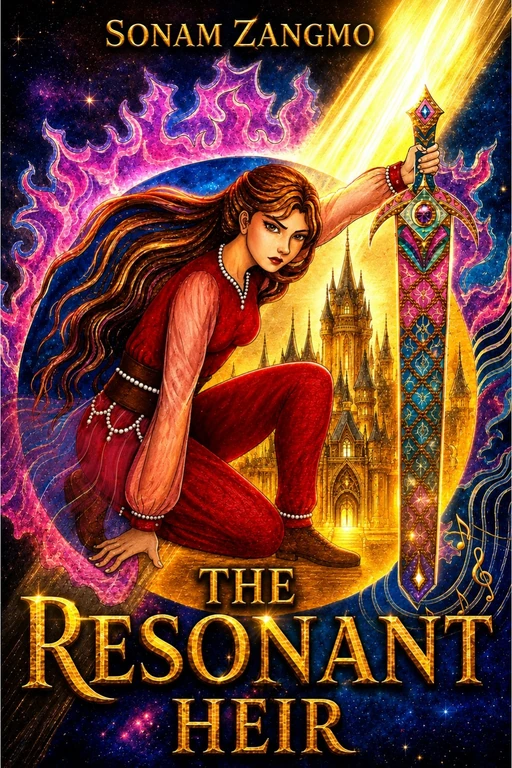
 Explore The Resonant HeirYA crossover royal fantasy · inherited magic · female heir · exile · adventure · Book I Complete
A Literary Commentary on Chapter Sixteen of The Resonant Heir
What Power Cannot Hold: A Philosophical Reading of Beyond the Crown’s Reach
On the limits of control, the fear of an inherited truth, and a father who can see his daughter but cannot bring her home.
Spoiler Notice: Contains spoilers for Chapter Sixteen.
Explore the fifteen themes in this commentary
- The Board and the Road
- One Blue Feather Among Red
- The Privilege of Treating Punishment as Optional
- The Answer Luca Does Not Quite Give
- The Chancellor’s Warning and the Shadow of Power
- A King Surrounded by People Who Do Not Know
- A Door That Opens Before It Is Asked
- The Courage to Admit Fear
- The Rot Beneath the Splendor
- The Cost of Reform and the Cost of Refusal
- When the Throne Becomes Too Large
- A Prophecy That Refuses to Become a Calendar
- To See a Daughter Is Not to Hold Her
- Two Views Across the Same Distance
- Conclusion: The Meaning of a Limit
Theme 01 · Philosophical commentary
The Board and the Road
Chapter Sixteen of Sonam Zangmo’s The Resonant Heir, Beyond the Crown’s Reach, begins with a question about permission and ends with a recognition of its limits.
Syveris demands to know who has been playing on his board without his consent. King Eryndar eventually understands that some roads cannot be held, even by a crown.
Between those two ideas of power, Princess Lyra rides away from the palace. She is almost absent from the chapter’s direct action. Nevertheless, her escape unsettles the people who believed they could shape the conditions of her life.
The symmetry is striking. Syveris sees political affairs as a board upon which moves are made. Eryndar has spent years preparing his daughter for a future he believed he could help secure. Neither man possesses complete command of what has happened.
The chapter does not suggest that authority itself is worthless. Political institutions need decisions, and families need forms of care. Its sharper concern is what happens when the ability to command is mistaken for the ability to know, preserve, or rightfully possess.
Power can arrange circumstances. It cannot guarantee that other people will remain where it has placed them.
That distinction gives the title an emotional as well as a political meaning. Lyra has traveled beyond the reach of her father’s immediate protection, but also beyond the future that he spent her childhood trying to design.
Theme 02 · Philosophical commentary
One Blue Feather Among Red
Syveris’s first action is almost inconsequential to the plot, yet difficult to forget.
He strokes a parrot with bright red plumage. Among its feathers, one is dark blue. He calls it ugly, then pulls it out. The bird cries out and escapes his hand.
The scene offers a compact portrait of discretionary power.
Nothing indicates that the blue feather has injured Syveris or endangered the bird. It violates his preference for how the creature should look. That preference is enough for him to inflict pain.
The episode does not prove that Syveris is consciously thinking about Lyra when he removes the feather. It would be too much to treat it as an encoded confession about the princess or the recent assassination attempt.
But the symbolic comparison is available. Lyra, too, has been defined by a difference that others consider unacceptable: an heir without the magic associated with her dynasty.
In both images, the conspicuous exception draws attention from someone who believes a preferred order ought to be maintained.
The danger lies in allowing aesthetic or customary preference to acquire the force of moral judgment. Something is judged defective simply because it differs, and the person with power acts as if the judgment itself provides sufficient justification.
When a ruler confuses an orderly appearance with a rightful order, another being’s pain can become an acceptable price for removing what looks out of place.
The parrot flies away. The blue feather has already been taken. There is no undoing the hurt simply because the hand that caused it is now empty.
Theme 03 · Philosophical commentary
The Privilege of Treating Punishment as Optional
Syveris next visits the residence of High Commander Derron.
Luca is reclining on a sofa, accepting grapes from servants and enjoying their attention. He is supposed to be under confinement after the disastrous wedding ceremony.
In the previous chapter, Eryndar punished both Lyra and Luca with seven days of confinement. Lyra was taken to the northern tower, where an armed intruder reached her bedside. Luca now appears in luxurious domestic surroundings, affronted that the chancellor might question him.
He asks whether Syveris thinks they are still in the palace.
The chapter does not spell out the precise regulations governing Luca’s confinement. His presence at home is therefore not by itself conclusive evidence of a particular legal violation. His attitude, however, leaves little doubt that he does not regard the sentence with Lyra’s seriousness.
The contrast questions what equality before the law means when two people receive formally similar judgments but occupy radically different positions.
A royal decree is public language. The reality of punishment is lived experience.
Luca has his father’s standing to invoke, servants to attend him, and the apparent confidence that he can dismiss an official’s scrutiny. Lyra has a cold tower, an uncertain future, and a threat to her life.
The differences do not require us to pretend the two offenses were equivalent. Indeed, Luca’s humiliation of Elena and Lyra’s intervention were morally distinct.
But they do expose the limits of ceremonial balance. Announcing equal days of punishment is not the same as ensuring equal accountability.
An institution does not establish justice merely by using the same numbers when it pronounces two sentences.
Theme 04 · Philosophical commentary
The Answer Luca Does Not Quite Give
Syveris’s most consequential question is blunt: was Luca responsible for the assassin sent to kill Lyra the previous night?
Luca does not answer with an ordinary denial. He turns away, laughs, and asks what the matter has to do with the chancellor. Then he remarks that a single man could not even finish the task.
His response is chilling.
It strongly suggests knowledge of the attempt and contempt for its failure. At the very least, the remark gives readers serious reason to suspect his involvement.
Yet suspicion is not identical to a complete account of the crime.
Luca does not explicitly state that he hired the intruder, supplied the weapon, chose the location, or issued the original order. Nor does the chapter disclose whether others planned or authorized the attempt.
The distinction matters because the novel has repeatedly examined how power depends upon managing what other people know.
Here, the reader receives a revealing fragment that King Eryndar is not shown receiving. We can see more than he can, and still lack the whole picture.
Luca’s moral character is becoming less ambiguous than the network surrounding him. His response to a near-murder does not exhibit concern for the intended victim. It sounds like derision at an unsuccessful act of violence.
But an account of his callousness is not yet the same as a proven map of every participant in the assassination.
Knowledge can become more incriminating without becoming complete.
The chapter preserves that tension rather than resolving a political mystery with a single boast.
Theme 05 · Philosophical commentary
The Chancellor’s Warning and the Shadow of Power
Syveris responds to Luca without calling guards or staging a public accusation.
He notices that Derron has been sent to Aulith and tells Luca that his father may not return soon. He then delivers an oblique warning: even eagles must consider where their shadows fall.
The image suggests that status does not make a person free from consequences. A powerful creature still leaves a trace. Influence extends beyond its immediate acts.
But the remark is deliberately indirect. Syveris does not explain what action he intends to take or whose interests he is defending.
When Luca remains defiant, the chancellor snaps his fingers. Violet flame flickers briefly. Luca recoils, and Syveris leaves with a faint smile.
It is a miniature contest over who possesses the more effective power. Luca claims the protection of his father’s office. Syveris shows that he does not need that office to unsettle the prince.
The encounter establishes Syveris’s capacity to threaten. It does not establish his moral purpose.
He may resent an attack that disrupts plans he considers his own. He may wish to keep dangerous political violence from spreading. The chapter does not settle which motive governs him, or whether the possibilities overlap.
That uncertainty is essential to the contrast with Eryndar.
Syveris responds to a loss of control by reasserting control over someone else.
The ability to restrain wrongdoing and a commitment to justice are not the same quality. A person may oppose a harmful act because it is wrong—or because it was committed without permission.
Theme 06 · Philosophical commentary
A King Surrounded by People Who Do Not Know
The narrative turns from Derron’s house to Lapis Chamber, where Eryndar sits alone.
News of Lyra’s disappearance reached him during the night. He searches for an explanation, tapping the arm of his chair while turning the recent events over in his mind.
Rogan was manipulated. Now the princess has vanished. Guards and mages cannot explain what happened. Too much has occurred without anyone seeing.
The king’s predicament is more than grief, though grief is unmistakably present.
He is discovering the difference between having authority over institutions and possessing reliable knowledge of their conduct.
Officers obey decrees. Mages perform ancient protective rites. Guards stand watch. But these arrangements did not prevent Rogan from being provoked into a disastrous command or Lyra from being attacked where the palace itself held her.
A monarch must rely on other people’s reports and judgments. That dependence is unavoidable. The danger begins when the forms of authority create an illusion that every consequential event is visible from the throne.
Eryndar now confronts events that have slipped through the structure he believed could maintain order.
There is an irony in his isolation. He occupies the highest seat in Tharion, yet the information he needs is elsewhere—in the actions of people who have moved beyond his sight.
Command is not omniscience. A ruler who forgets that distinction may not recognize the limits of a system until someone he loves has paid for them.
Theme 07 · Philosophical commentary
A Door That Opens Before It Is Asked
Eryndar finally leaves Lapis Chamber and approaches the Hall of Prophecy.
The stone doors open before he requests entry.
He stops. They have never done that.
Inside, the three Oracles are waiting. Before Eryndar asks a question, the central Oracle speaks first.
The changes appear small, but their sequence alters the entire balance of the encounter.
Kings ordinarily summon, request, and receive answers. Here the king is received without asking and questioned without first choosing the subject.
Nothing in the chapter identifies the magical reason that the doors behave differently. It does not establish that someone has altered the hall or that the Oracles are acting at an identifiable outside power’s command.
As a scene of philosophical drama, however, the reversal is precise.
Eryndar has come hoping to gain knowledge that will restore some measure of control. Instead, the first thing he encounters is an authority that refuses to operate according to his familiar expectations.
The Oracle asks whether he fears the truth.
The question does not request an order or offer an immediate solution. It demands an admission.
Truth is not always delivered at the time, or in the form, that a powerful person would prefer.
For a king accustomed to deciding which questions may be raised in court, being compelled to answer one can itself become the beginning of moral change.
Theme 08 · Philosophical commentary
The Courage to Admit Fear
The Oracle asks whether Eryndar is afraid of the truth.
He hesitates, then admits that at times he is.
The narration tells us that no lies can stand in this place. His answer therefore matters not merely as a moment of vulnerability, but as an encounter with a standard that public dignity cannot displace.
The Oracle then asks whether he still wishes to know the future. Eryndar says yes.
The exchange is revealing because wanting knowledge and welcoming what knowledge may demand are different things.
A ruler may seek prophecy in the hope that certainty will relieve anxiety. But knowledge can also make responsibility harder to avoid. To learn that a foundation is failing is to lose the comfort of pretending that it is sound.
Eryndar’s admission deserves attention. He does not claim the confidence that his title might be expected to display. For one moment, the king speaks without the protection of a public image.
Yet the chapter does not turn confession into absolution.
Acknowledging fear is not the same as repairing a harmful policy. Wanting to know the future is not the same as taking responsibility for the present.
The important question is what Eryndar will do when knowledge exposes the costs of the order he has maintained.
Humility begins when power can acknowledge its uncertainty. Justice requires something further: a willingness to act on what that uncertainty has concealed.
Theme 09 · Philosophical commentary
The Rot Beneath the Splendor
The central Oracle offers a warning about foundations: what is rotten underneath cannot continue to stand.
Eryndar’s reaction gives the statement political substance.
He has long known that Aethrador’s legacy was not entirely clean. Allies are watching for weakness. The royal bloodline has become preoccupied with its own vulnerabilities.
The novel has supplied reasons for these anxieties. Lyra’s investigation of the Soul Covenant exposed a bargain made when Aulith faced extinction. The High Lady’s objections to inherited grain tribute suggested that the dynasty’s old laws could continue burdening those least able to pay.
The current chapter does not independently resolve every historical question. It does not prove that every claim against Aethrador is true or specify every form of corruption the Oracle has in mind.
But it makes one thing newly significant: the doubts are not confined to an impulsive young princess. Eryndar himself recognizes that the dynasty’s inheritance contains matters he has avoided naming.
That recognition exposes an uncomfortable dilemma for rulers who inherit institutions rather than create them.
Continuity can protect communities from abrupt disorder. It can also perpetuate obligations whose original justification has been lost, distorted, or made irrelevant by changed circumstances.
The king may sincerely wish to protect Tharion and still protect arrangements that injure parts of it.
A kingdom cannot measure the health of its foundations solely by the fact that its walls have not yet fallen.
A glittering court is a poor answer to those who must carry the weight of its unresolved debts.
Theme 10 · Philosophical commentary
The Cost of Reform and the Cost of Refusal
Eryndar thinks through the choices before him.
If he changes course, the court will resist. If he refuses to change, the allies will not endure forever. Eventually, the order he has struggled to preserve may break.
The conflict is not presented as an easy contest between a brave reformer and a foolish traditionalist.
Political reform can provoke real instability. Courts and armies are composed of people whose cooperation cannot be assumed. Eryndar has just seen how officers can pressure the crown, and how that pressure affects his own family.
But stability is not automatically preserved by refusing change.
If old laws create enduring grievance, the apparent peace may simply accumulate the conditions of a future rupture.
The difficulty is that every course carries danger. Reform threatens familiar arrangements. Inaction threatens the trust on which alliances rest.
Earlier, Eryndar resisted the High Lady’s request to revisit a tribute law established in his father’s time. His reasoning stressed that such a law could not simply be altered.
Now he perceives the possibility that inherited continuity, rather than guaranteeing loyalty, may gradually exhaust it.
This is a difficult but necessary realization.
Doing nothing is not an escape from political responsibility. It is a choice about which consequences may continue to accumulate.
The chapter offers no reform program. It does, however, make the king’s old confidence in mere endurance harder to sustain.
Theme 11 · Philosophical commentary
When the Throne Becomes Too Large
Eryndar has been depicted as formidable: a ruler, a wielder of magic, and a father who carefully trained his daughter for her inheritance.
In the Hall of Prophecy, the throne feels too large for him for the first time.
The image reverses an ordinary fantasy of kingship. A grand throne is supposed to enlarge the person who occupies it, projecting authority beyond the human body.
Here its grandeur becomes evidence of the distance between one man’s capacity and the responsibilities he carries.
He cannot simply order the court to accept reform without risking resistance. He cannot make a compromised legacy pure through a declaration. Above all, he has failed to keep Lyra safe.
Yet the feeling of insufficiency need not mean that rulership is futile.
A king who recognizes his limitations may begin to govern with greater attention to evidence, counsel, and the needs of those who do not stand near the throne.
That possibility is not yet an accomplishment. Eryndar has not enacted the changes he fears. The chapter closes before any political repair begins.
But it is significant that he can no longer mistake the symbols of sovereignty for unlimited human capability.
Power becomes morally dangerous when its holder refuses to admit limits; it may become more responsible when those limits are finally taken seriously.
Theme 12 · Philosophical commentary
A Prophecy That Refuses to Become a Calendar
When Eryndar asks how long his reign will last, the Oracle does not give a year or a number of days.
Instead, he is told that when the seal upon the throne is broken, order will be remade.
The prophecy is conditional and opaque. The text does not identify the seal, explain the mechanism by which it might break, or say whether the resulting order will be more just.
It would also be premature to equate the throne’s seal with whatever has restricted Lyra’s magic. The recurrence of seals may carry symbolic force without establishing identical magical systems.
What interests me most is the kind of answer Eryndar receives.
He asks about duration. The Oracle speaks about transformation.
The king wants to know how long the current arrangement will remain. The reply directs him toward a condition under which the arrangement itself will change.
Such a prophecy can be read as an invitation to question a ruler’s underlying assumption: that the most important measure of success is the length of time his reign or institution continues.
A kingdom could endure for years while remaining unjust. It could also undergo upheaval without becoming better. Survival and goodness are separate questions.
The Oracle offers no guarantee that change will redeem the past.
What matters about an institution is not only whether it survives, but what its survival demands and what kind of order it makes possible.
Theme 13 · Philosophical commentary
To See a Daughter Is Not to Hold Her
The king’s questions finally move from the throne to the person he loves.
He asks what has become of Lyra. The Oracles answer that the ancient prophecy has not changed, but they do not fully explain her destiny.
When Eryndar asks where she is, the three figures join streams of light into a mirror.
He sees a white horse, a tired princess, and a journey nearly a day long. Lyra has crossed mountains and an old forest. At dusk she reaches a river beyond which a town glitters.
She names it Gemariel.
The image fades.
The king has acquired information that hours of sitting in Lapis Chamber could not supply. He knows his daughter is alive and far away. But the mirror cannot reunite them.
This scene provides the chapter’s most intimate expression of limited power.
Eryndar has access to a form of sight unavailable to ordinary parents. Yet what he needs is not a more extraordinary vantage point. It is an ordinary human presence: the opportunity to speak to Lyra, to know how she feels, and to care for her without the distance created by their political roles.
The Oracles tell him that the princess will become what she must. This need not be read as proof that every step of her future is fixed or that her suffering was necessary and therefore justified.
She has been driven from home by danger. Prophecy cannot make that loss harmless.
To know where someone is does not mean we can reach them. To see their future, or believe we can, is not the same as being present in their life.
Theme 14 · Philosophical commentary
Two Views Across the Same Distance
The final image answers the ending of Exiled by the Crown.
At the close of Chapter Fifteen, Lyra looked back from a hill at a palace still shining like a familiar star. She named the people she loved and cried because she could no longer return to them safely.
Now Eryndar looks toward Lyra through a magical mirror and feels the separation from the other side.
The two scenes do not depict a conversation. Neither character knows exactly what the other is experiencing in the moment.
But their arrangement gives the reader a fuller experience of the rupture than either viewpoint could provide alone.
Lyra can still see her home, but cannot stay there. Eryndar can still see his daughter, but cannot bring her back.
Their relationship has not been erased by a lack of love. It has been interrupted by political conflict, danger, and choices that cannot be undone through an expression of affection.
The king thinks of the years he spent shaping and preparing her to inherit the throne. Then he wishes for something different: time with Lyra, not as her sovereign, but as her father.
The simplicity of the wish is its force.
His authority enabled him to arrange much of her upbringing. It did not allow him to keep time from passing or guarantee that the course he planned would remain open.
Regret may begin a change in Eryndar. But it is not yet that change. The novel leaves his next action unwritten.
What remains is the ache of a person who has just realized that preparation for a loved one’s future is no substitute for being with them in the present.
Theme 15 · Philosophical commentary
Conclusion: The Meaning of a Limit
Syveris begins the chapter offended that others have made moves upon a board he considers his own. Eryndar ends it having learned that some roads cannot be held, even by a crown.
The contrast gives the story two distinct responses to the limits of authority.
One response is to tighten control over those who have acted independently. The other is to confront an uncomfortable truth: neither a kingdom nor a daughter can be preserved by possession alone.
The novel does not claim that accepting limitations excuses a ruler from responsibility. Eryndar remains accountable for the political compromises he has made and for what he does with his emerging knowledge of the dynasty’s compromised foundations.
Nor does it present Lyra’s forced departure as a fortunate liberation. She is exhausted, endangered, and alone. Her arrival at Gemariel is a continuation of her journey, not proof that the pain of exile was necessary for her development.
What the chapter changes is the question through which we understand power.
Earlier, Lyra was asked whether she possessed enough magic to deserve the crown. Now her father must confront whether the crown possesses the wisdom and legitimacy needed to deserve the people who live beneath it.
Syveris’s board, the anomalous feather, the palace protections, the unquiet foundations, and the mirror all circle a single truth: the ability to exercise power is never the same as a right to control every life touched by it.
The most dangerous form of power is the one that treats its limits as an insult. The more humane possibility begins when those limits are recognized as part of responsibility.
In the mirror, Eryndar can see Lyra but cannot hold her. His final wish is not for greater magic or a stronger crown. It is for more time to be her father.
Between the chancellor who demands permission and the king who wishes he had time, Lyra rides onward.
Her future remains uncertain. So does the kingdom’s.
The roads beyond the crown’s reach have not ceased to matter to Tharion. They may be where its deepest questions finally have to be answered.