 Explore The Resonant HeirYA crossover royal fantasy · inherited magic · female heir · exile · adventure · Book I Complete
A Literary Commentary on Chapter Seventeen of The Resonant Heir
The Price of Staying Alive: A Philosophical Reading of No Coin, No Crown
On hunger, the fragile freedom of those without resources, and a princess learning what it costs simply to survive.
Spoiler Notice: Contains spoilers for Chapter Seventeen.
Explore the fifteen themes in this commentary
- A Crown That Cannot Buy Bread
- What Eryndar Cannot Quite Say
- She Has Grown, but Into What?
- The Same Moon Above Unequal Lives
- Trust at the Edge of Exhaustion
- The Missing Pouch and the Limits of Certainty
- The Warm Meal She Never Had to Arrange
- Sonareth and the Fear of Becoming a Burden
- The Body Ends the Argument
- Bread with Conditions
- What Does It Mean to Buy Back Her Own Horse?
- A Princess Who Cannot Safely Say Her Name
- The Sword That Cannot Pay the Bill
- The Mine as a Choice Under Constraint
- Conclusion: The First Question Beyond the Crown
Theme 01 · Philosophical commentary
A Crown That Cannot Buy Bread
Chapter Seventeen of Sonam Zangmo’s The Resonant Heir, No Coin, No Crown, gives its heroine a problem no royal title can solve. Lyra is hungry, exhausted, and alone in Gemariel. The money prepared for her escape has vanished. The horse that carried her from the palace is no longer freely at her disposal. The person offering her breakfast also expects repayment.
After chapters of political manipulation, royal judgment, prophecy, and exile, this is a striking reduction of scale. The great question of who will inherit Tharion has not disappeared. It has simply ceased to be the question that can keep Lyra alive through the morning.
The title places two forms of power beside each other. A crown confers recognized authority within a political order. A coin secures access to ordinary necessities within an economic one. Lyra possesses a royal identity, but cannot safely reveal it. She needs food and shelter, and those needs cannot be satisfied by an inheritance she cannot use.
This does not mean money is morally superior to a crown, or that political power has ceased to matter. It means neither privilege nor destiny exempts a body from material dependence.
One may be entitled to a throne and still have no way to pay for breakfast.
The chapter asks what happens to human freedom when the things required to exercise it—money, mobility, food, rest, and trustworthy help—are suddenly unavailable.
Theme 02 · Philosophical commentary
What Eryndar Cannot Quite Say
The chapter opens not with Lyra but with Queen Velaria pacing Turquias Chamber, afraid because no message has arrived from Sonareth. The plan for her daughter’s flight appears to have failed at least in one respect: Lyra has not reached the expected destination.
Eryndar enters and reassures her that Lyra is in Gemariel. Before he offers that information, however, he speaks with unusual tenderness about what Velaria has given up.
The precise nature of that sacrifice is not revealed in this chapter. It would be tempting to fill the silence with a history of the queen’s past, but the narrative has not supplied one. What matters in the scene is the weight the king places upon the admission.
He then tells her that if the palace ever grows too small, she should return to Sonareth.
A palace is not physically small. The phrase suggests that abundance of space and status cannot guarantee room for a person to live as they need. It may be a warning, an expression of care, or a fear Eryndar is not ready to name. The text does not settle which.
This is the second chapter in which Eryndar’s thoughts have moved away from kingship toward the people he loves. Yet his tenderness remains surrounded by withholding. Velaria senses that something is wrong and chooses not to press him.
Love can be present in a conversation that still leaves important truths unspoken.
The distance between husband and wife is not the same as the distance separating them from Lyra, but both are shaped by the burdens of a palace where private affection and public responsibility cannot easily be disentangled.
Theme 03 · Philosophical commentary
She Has Grown, but Into What?
Velaria is shocked when she learns that Lyra has reached Gemariel. She had directed her daughter toward Sonareth, where family connections might provide safety.
Eryndar draws his wife close and says that Lyra has grown.
The remark is poignant, but its meaning should remain open. It may express recognition that their daughter is beginning to make choices beyond their supervision. It need not mean that choosing Gemariel was wise, or even that every part of the deviation was intentional.
A young person does not become mature simply by disobeying an itinerary. Independence can enlarge judgment; it can also expose inexperience.
What has changed is the parents’ relationship to their daughter’s movements. Velaria provided a route, a horse, money, and supplies, but could not ensure that Lyra would arrive at the destination. Eryndar saw his daughter through the Oracles’ mirror, yet could not personally secure her next night.
Their knowledge trails behind her life.
The situation also cautions against treating growth as a painless reward for separation. Lyra is being forced into decisions by mortal danger, not invited into adulthood on generous terms.
Growing beyond a parent’s reach is not the same as no longer needing help.
That insight will become painfully concrete when the narrative leaves the royal chamber and follows the hungry princess through the mining town.
Theme 04 · Philosophical commentary
The Same Moon Above Unequal Lives
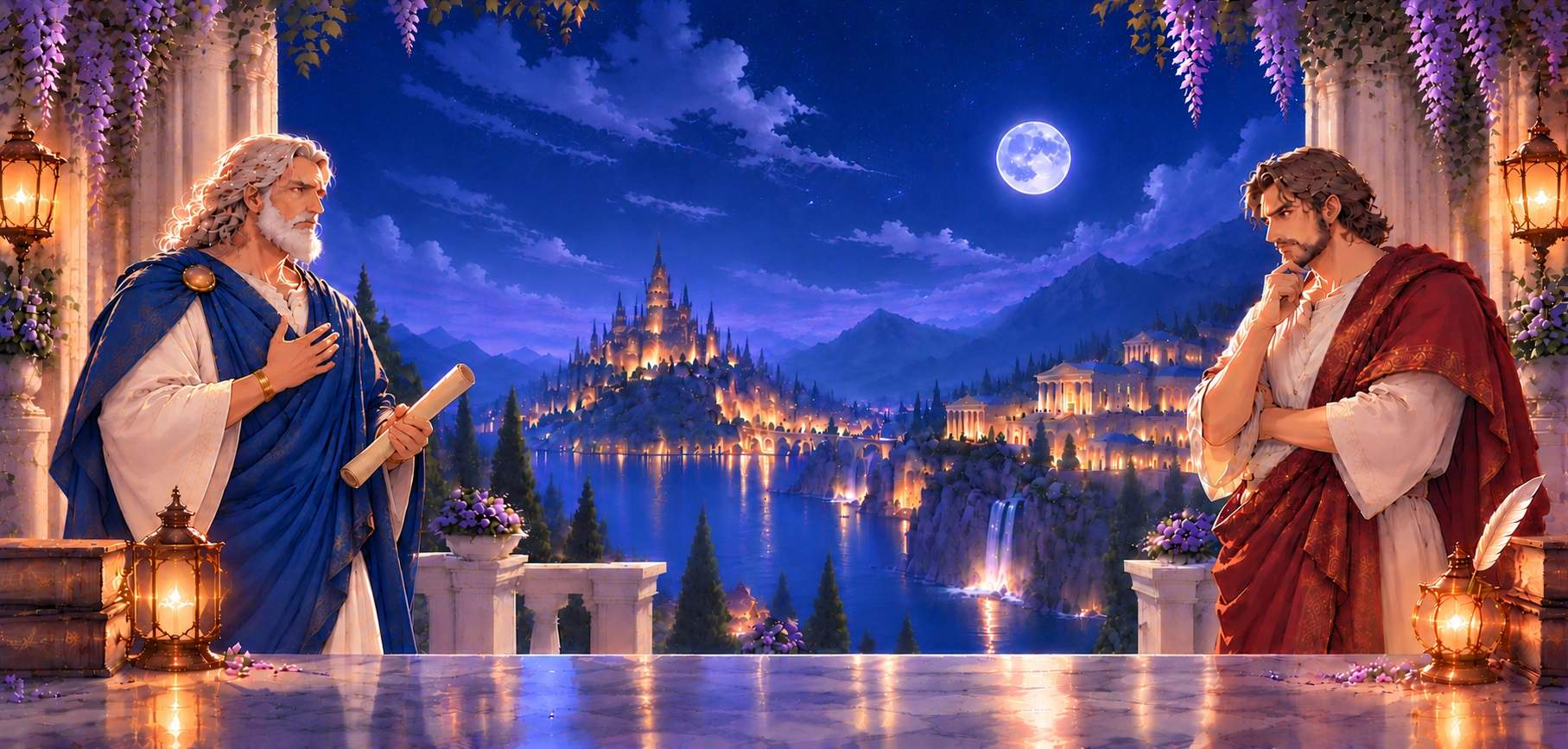
A single sentence connects the palace with Gemariel: the crescent moon above the palace is no different from the one shining over the mining town.
It is an elegant transition. Eryndar and Velaria stand together at the window, worrying about their child. Under the same night sky, that child searches for a place to sleep.
The shared moon emphasizes their emotional connection across distance. But it also makes the contrast between their conditions more visible.
The royal couple has a room in which to wait and grieve. Lyra has a horse whose reins she can barely hold, an aching stomach, and no familiar door to knock upon.
The moon is indifferent to class. Human arrangements are not.
That distinction matters because fantasies of common humanity can sometimes become too comforting. It is true that every person is vulnerable to hunger, loss, and fear. It is also true that access to food, shelter, and protection is distributed very unequally.
Lyra has lived most of her life sheltered from the uncertainty that governs her first night in Gemariel.
Her present suffering does not make the palace’s earlier comforts imaginary. It reveals their significance.
The same sky can cover lives with radically different margins of safety.
What was once an ordinary night inside the palace becomes, outside it, an urgent negotiation with necessities that do not wait for royal decisions.
Theme 05 · Philosophical commentary
Trust at the Edge of Exhaustion
A young man with loosely curling hair approaches Lyra and offers to lead her to an inn. Something about him reminds her of Orlas.
That resemblance is a small but suggestive detail. In an unfamiliar town, the faint impression of someone known can make a stranger appear less strange. The narrative does not say that the resemblance alone earns Lyra’s trust; exhaustion and the need for rest are already narrowing her choices.
The man is friendly. He takes the reins, straightens a saddlebag, and guides the horse to a brightly lit inn. Then he leaves before Lyra can thank him.
His actions appear helpful in the moment.
Only afterward does Lyra discover that the coin pouch Obewich attached to her saddle is gone.
The scene exposes a difficult feature of practical dependence. When a person urgently needs assistance, trust cannot always wait for reliable evidence of another person’s character.
Lyra might have been more cautious if she had been rested, fed, and able to compare several safe alternatives. She is none of those things.
This does not mean every stranger is dangerous, or that kindness is merely a disguise. It means the conditions under which trust is extended affect how freely it is offered.
A person can be vulnerable to deception not because she lacks intelligence, but because she cannot afford to remain unaided.
That is an important lesson for an heir who has previously regarded protection as something normally provided by the people around her.
Theme 06 · Philosophical commentary
The Missing Pouch and the Limits of Certainty
Lyra searches the saddle again and again. The pouch is gone. She concludes that the young man tricked her and took it.
The inference is strong enough to understand. He handled the reins and adjusted the saddlebag shortly before the discovery. He departed quickly. He had an opportunity to steal.
But the chapter does not directly depict the theft. We do not see him untie the pouch or hear him confess. A commentary should preserve the difference between a missing possession and proof of the person who took it.
That distinction does not lessen Lyra’s predicament. Regardless of who removed the pouch, she has lost the resources intended to sustain her escape.
The money had been prepared by Obewich, whose care accompanied her even after they were forced to part. Its disappearance therefore severs another practical thread connecting her to the safety of home.
In her distress, Lyra thinks of the pouch as the only thing keeping her alive outside the palace. Strictly speaking, she still has a sword, a horse at that moment, and whatever abilities she might be able to develop. But none of those guarantees dinner or a bed.
What matters is the sudden collapse of the arrangement on which she had been relying.
Security can seem solid until the disappearance of one small object reveals how much of it was concentrated in that object.
For someone unfamiliar with economic precarity, the discovery is terrifyingly immediate.
Theme 07 · Philosophical commentary
The Warm Meal She Never Had to Arrange
Lyra remembers what she would be doing in Moontis Palace: eating warm lamb stew and later sleeping beneath soft feather blankets.
These are not images of a throne room or a royal procession. They are images of bodily comfort.
That choice is important. Privilege often operates most effectively when its benefits feel ordinary to the people who possess them. A meal arrives. A bed is ready. Someone else has ensured that the fire is lit and the room is safe.
Lyra’s position once allowed her to experience those arrangements without directly negotiating them. Their reliability was part of the world she took for granted.
Now she is hungry in a town where she knows no one, and she does not know how to purchase what she needs.
The chapter does not insist that she was incapable of compassion before this night. She has already defended Ravok, Elena, and others whose lives were shaped by unequal power.
But compassion informed by witnessing another person’s hardship differs from the bodily knowledge of having no money when food is needed.
Neither kind of knowledge automatically produces wisdom. Both can deepen moral attention.
One of the quietest forms of privilege is the expectation that tonight’s meal and sleeping place have already been taken care of.
The loss of that expectation is not a grand magical defeat. It is a collapse of ordinary certainty, which may be far more frightening in the immediate moment.
Theme 08 · Philosophical commentary
Sonareth and the Fear of Becoming a Burden
The possibility of Sonareth returns to Lyra when her desperation becomes hardest to bear. Her grandfather is there, and her mother has already instructed her to seek that refuge.
She could attempt to return to the planned route.
But she stops herself. She believes that going to Sonareth would draw the danger pursuing her toward people she cares about.
Her concern deserves respect. It demonstrates that she no longer thinks only about whether another person can protect her. She is thinking about the consequences her presence might bring to them.
Yet the chapter does not establish that enemies would certainly attack Sonareth if she arrived. Nor does it establish that staying in Gemariel is safer for anyone.
Lyra is reasoning from limited knowledge while hungry, exhausted, and frightened.
This is where an apparent virtue can become a source of risk. The desire not to burden others may lead someone to refuse protection she desperately needs, even when the danger to those helpers remains uncertain.
There is a difference between responsible concern and believing oneself obliged to suffer alone.
Lyra’s decision may ultimately be prudent. It may also turn out to be mistaken. The narrative has not yet adjudicated it.
Independence is not proved by the refusal of every offered refuge.
Sometimes responsible agency includes knowing when accepting help is less harmful than trying to survive without it.
Theme 09 · Philosophical commentary
The Body Ends the Argument
Lyra makes her decision, but her body cannot sustain the moment.
Her limbs weaken, the ground tilts, the inn’s lights blur into scattered sparks, and she loses consciousness.
In a novel filled with swords, ancient magic, and prophecies, it is an almost ordinary physical limit that stops her.
She can insist that she will not return to Sonareth. She can try to hold herself upright. She can be determined not to endanger those she loves.
She cannot will away exhaustion or hunger.
The scene is valuable precisely because it refuses to turn endurance into an unlimited resource. Lyra does not collapse because her character is deficient. She collapses because her body has been subjected to conditions it can no longer manage.
This suggests a political as well as a personal principle.
Freedom requires more than an internal decision to be brave. It requires the material conditions in which people can remain capable of choosing and acting.
An exhausted person may have fewer useful options than someone who has slept and eaten, even if both possess the same legal freedoms.
Human agency is embodied. The ability to choose depends in part upon the ability to stay awake, nourished, and safe enough to choose.
No prophecy protects Lyra from that basic truth.
Theme 10 · Philosophical commentary
Bread with Conditions
Lyra wakes in a bed at Luminas Inn. An unfamiliar ceiling hangs above her. Her sword is still beside her.
A stout innkeeper enters carrying bread. When she admits she was robbed and cannot pay, he tells her it is all right. Such things happen often in Gemariel, he says.
For a moment, he appears to offer the unconditional help she desperately needs.
Then he explains the arrangement: she can eat, work in the mines for a few days, and pay him afterward.
Charging for lodging or food is not inherently unjust. Nor does expecting repayment automatically negate the fact that he gave her a bed when she needed one.
The ethical difficulty lies in when and how the terms are revealed.
Lyra wakes to find an arrangement forming around her after she has already lost consciousness and received shelter. She is hungry, without money, and unfamiliar with the local economy. The alternative to accepting the innkeeper’s proposal is not immediately clear.
A bargain made in those conditions is not equivalent to one negotiated by two people who can comfortably walk away.
An exchange may provide real help while still giving one participant far more power to define its terms.
The chapter does not describe mine wages, the price of the room, or the duration of the debt with enough precision to calculate whether the proposed work is fairly compensated. It invites scrutiny rather than a verdict based on invented terms.
Theme 11 · Philosophical commentary
What Does It Mean to Buy Back Her Own Horse?
The innkeeper adds one more condition: Lyra should buy back her horse.
That is the moment the apparent generosity changes shape in her mind.
The horse was provided so she could escape Moontis Palace. It carried her across mountains and ancient forest to Gemariel. It represents the ability to continue moving, not merely an expensive possession.
Lyra believes the innkeeper now has it. She is indignant that he never asked her permission. In her estimation, the horse could pay for a year of food and lodging.
The chapter does not explain the precise circumstances by which the innkeeper obtained control of the animal, or whether there has been a formal transfer of ownership. It does show that Lyra does not understand herself to have consented.
The distinction is important because the wrong, if her understanding is correct, does not consist merely in expecting payment. It consists in imposing conditions over another person’s property while that person is unable to negotiate.
The horse changes meaning in the space of a few pages. It had been an instrument of escape from royal danger. It is now an asset she may have to work to recover.
This is a second kind of dependence.
Inside the palace, her choices were narrowed by political rank and family authority. In Gemariel, they may be narrowed by lack of resources and another person’s control of what she needs to travel.
Leaving one system of power does not guarantee freedom from every other system that can limit a life.
Theme 12 · Philosophical commentary
A Princess Who Cannot Safely Say Her Name
Lyra thinks that she is no longer a princess.
Taken literally, that goes further than the story has established. The chapter does not announce a legal removal of her title or inheritance.
But the thought communicates a reality more important to her immediate situation. She cannot use her royal identity in the ordinary way.
If she reveals who she is, she fears the innkeeper may hand her over to the palace. That outcome is a possibility she considers, not a confirmed intention of the man standing before her.
An identity that once secured assistance may now expose her to danger.
This makes her predicament distinct from merely pretending to be someone else for the pleasure of adventure. She is hiding the identity through which most of her needs were once met, while having little practice meeting those needs without it.
Her education has prepared her for swordplay and the responsibilities of rule. It has not necessarily prepared her to negotiate a room, evaluate the terms of a debt, or protect her possessions in an unfamiliar mining town.
She is not without abilities. But her abilities have been developed inside circumstances that quietly solved many practical problems on her behalf.
A title can remain part of who a person is even after it ceases to be something she can safely use.
The chapter asks what remains when inherited recognition no longer supplies immediate security.
Theme 13 · Philosophical commentary
The Sword That Cannot Pay the Bill
On waking, Lyra reaches first for her sword. It is still there, and she grips its hilt.
The gesture recalls both her training and the care with which Eryndar once tended her blade. The sword also came with her through Velaria and Obewich’s hurried preparations for escape.
It is a connection to family, a source of reassurance, and a means of defense.
But it cannot feed her.
This is not because combat skill is worthless. She may still need to protect herself in a dangerous world. Rather, the threat before her is not an adversary she can defeat in a duel.
She needs a way to earn money without surrendering too much control over her time, possessions, or safety.
The sword illustrates a distinction that fantasy stories sometimes obscure. Being capable of violence is not the same as possessing the full range of capacities that make independent life possible.
Lyra can hold a weapon and still be vulnerable in an economic negotiation. She can know how to resist a physical threat and remain uncertain whether the terms offered by a smiling innkeeper are fair.
Strength is not one possession that solves every form of dependence.
For a future ruler, recognizing different kinds of vulnerability may matter more than acquiring ever more impressive forms of force.
Theme 14 · Philosophical commentary
The Mine as a Choice Under Constraint
Lyra finally stops trying to solve her whole future at once.
She decides that she must first learn how to survive. Everything else can wait.
Her hands tremble slightly, yet the narration says she is not afraid. She takes bread and eats slowly to quiet her hunger.
Then she asks the innkeeper where the mines are.
It is a striking final line because it does not promise victory. There is no revelation of hidden power, no recovery of stolen wealth, and no rescue party arriving at the door.
Nor has Lyra actually worked in the mines by the chapter’s end. She has asked where they are. The kind of labor, its dangers, and whether the innkeeper’s terms are reasonable remain unknown.
The question nevertheless marks a real change. She identifies the next practical action instead of demanding that her previous status somehow rescue her.
It would be a mistake to romanticize what follows. Poverty is not made morally good because someone finds determination within it. A person can gain skill through hardship without the hardship having been deserved or necessary.
Lyra’s decision is also not entirely free. Hunger, debt, uncertainty, and her apparent loss of the horse constrain the options she can consider.
Still, constrained agency is not the absence of all agency.
She cannot choose the circumstances she has been given. She can begin choosing how to respond within them.
That is a modest form of courage, and a more credible one than treating forced hardship as a glorious transformation.
Theme 15 · Philosophical commentary
Conclusion: The First Question Beyond the Crown
The recent chapters have progressively stripped the certainty from Lyra’s place in the world.
In The Ceremony Unmade, she defended Elena’s right to refuse a marriage supported by political interests. In Exiled by the Crown, she discovered that the palace could no longer keep her safe. In Beyond the Crown’s Reach, her father saw her traveling beyond his immediate protection.
Now, in No Coin, No Crown, political vulnerability becomes material vulnerability.
Lyra has lost access to the world that normally supplied her food, shelter, mobility, and protection. She has also discovered how quickly an apparently kind encounter or helpful arrangement can become difficult to question when one is desperate.
The chapter’s concern with bargains reaches beyond Gemariel. Aulith once bargained for protection through an ancient covenant. Elena was prepared to endure a marriage for the apparent benefit of her people. Lyra is now offered food and lodging on terms that include labor and the recovery of her own horse.
These circumstances are not identical. Their common question is whether a person who urgently needs something can meaningfully refuse the conditions attached to receiving it.
A good ruler need not personally suffer every deprivation to govern justly. But a ruler who has never understood such constraints may mistake formal choices for meaningful freedom.
Lyra’s experience does not automatically make her wiser. She might mistrust the wrong person, enter another unfair bargain, or misjudge the risks of the mines. Her learning has barely begun.
What has changed is the scale on which she must now think.
The prophecy can wait. The crown can wait. Even the question of who stole the pouch can, for a moment, wait.
Her stomach cannot.
Her first lesson beyond the palace is not that suffering makes a person worthy of rule. It is that a life without protection is governed by necessities a ruler can too easily overlook.
Lyra finishes her bread and asks where the mines are.
The crown may still be hers by birth. For now, the question that matters is where she can earn her next meal.