
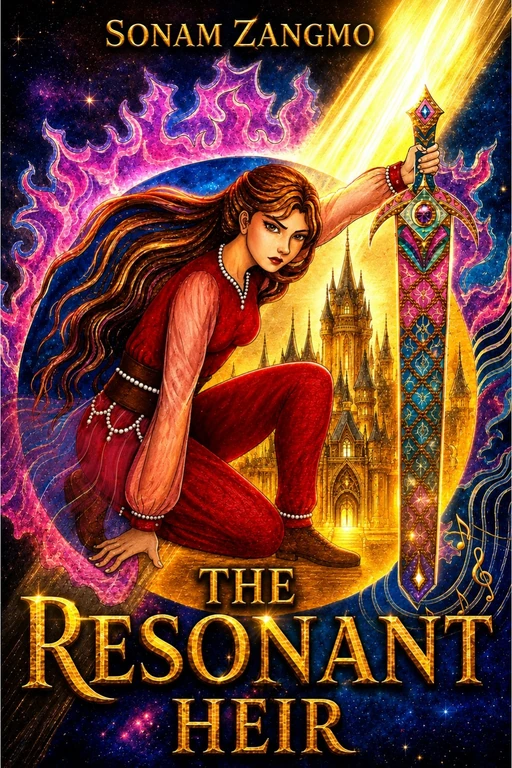
 Explore The Resonant HeirYA crossover royal fantasy · inherited magic · female heir · exile · adventure · Book I Complete
A Literary Commentary on Chapter Fifteen of The Resonant Heir
When the Crown Cannot Protect Its Heir: A Philosophical Reading of Exiled by the Crown
On the fragility of political belonging, the difference between protecting a throne and protecting a person, and the loss of a home that still stands.
Spoiler Notice: Contains spoilers for Chapter Fifteen.
Explore the fourteen themes in this commentary
- The Exile No King Pronounces
- A Veil That Closes Half a Beat Too Late
- From a Humiliated Prince to an Unfit Heir
- When the Army Places Conditions on the Throne
- Seven Days for the Image of the Throne
- The Father's Two Duties
- The Crown Set Down Without a Farewell
- Accepting Consequences Is Not Confessing Wrongdoing
- The Prison That Cannot Keep Her Safe
- Velaria's Unofficial Duty
- A Rescue Performed as a Panic
- When Fear Makes One Enemy of Many Unknowns
- The Star That Used to Be Home
- Conclusion: A Kingdom Worth Belonging To
Theme 01 · Philosophical commentary
The Exile No King Pronounces
The title of Chapter Fifteen of Sonam Zangmo's The Resonant Heir, Exiled by the Crown, appears at first to promise a formal judgment: a princess expelled by her father's decree. What the chapter actually depicts is more unsettling.
King Eryndar sentences Lyra to seven days of confinement in the northern tower. He does not officially exile her. The expulsion becomes a fact of her life only after an armed intruder reaches her bedroom, her mother rushes her through a secret passage, and she rides out into the night because the palace is no longer safe.
The distinction is essential. The king's order is a punishment; the flight is an emergency response to a threat whose author remains unknown. Nothing in the chapter proves that Eryndar ordered the attack or wished his daughter dead.
Yet the title remains justified in a deeper sense. Lyra is a princess, the heir of the dynasty, and still a person who can no longer live safely within the institution that defines her place in the world.
A state need not formally declare someone an exile for its failures and power struggles to make home inaccessible.
The chapter therefore asks what belonging means when law still recognizes your position but cannot secure your life. A royal title remains; the right to remain has become dangerously fragile.
Lyra is not stripped of her inheritance by decree. She is driven from the home in which that inheritance was supposed to protect her.
Theme 02 · Philosophical commentary
A Veil That Closes Half a Beat Too Late
The chapter begins with an almost imperceptible failure.
Two Royal Mages raise their staffs behind Eryndar's throne, weaving the veil of protection first established in Aethrador's age. For the briefest instant, the light closes half a beat too slowly. The mages exchange a look. The veil then settles flawlessly.
The narrative never explains the delay. We cannot identify sabotage, a failing spell, or a culprit from this detail alone.
Its literary placement, however, is suggestive.
The court retains every outward sign of stability. A king sits on his throne. Officials stand in the proper places. A venerable defensive rite appears to function. Yet those who know its normal rhythm notice that something has slipped.
This is an effective image for an institution whose surface remains intact while its relationships of trust are weakening.
The veil exists to protect the throne. By nightfall, the heir will be attacked within the palace's own guarded precincts. The two defenses have different scopes, and a spell around the throne was never said to protect every room. The parallel is symbolic, not a claim about magical mechanics.
Nevertheless, it directs attention to a question political institutions often prefer not to hear: what, exactly, is the system good at protecting?
The throne's protective ritual is restored to visual perfection. Lyra's safety is not.
The half-beat of delay reminds us that a structure may continue to display the appearance of strength after those closest to it have begun sensing its vulnerability.
Theme 03 · Philosophical commentary
From a Humiliated Prince to an Unfit Heir
High Commander Derron enters the throne room to accuse Lyra of violating propriety and damaging the dignity of the royal house when she interrupted Luca and Elena's wedding.
At first he appeals to the sanctity of alliance. Then he declares that the court is not there to debate ceremony. It is there to discuss magic.
The movement is politically decisive.
The previous chapter left Luca publicly challenged for his contempt toward Elena and Aulith. Elena herself refused the marriage. Derron now shifts the question away from his son's behavior and toward Lyra's lack of magic.
This does not mean that magical capacity is irrelevant to Tharion's defense. The story's battles have shown that supernatural force can determine whether soldiers survive. Concern about the abilities of a future commander is not inherently absurd.
What demands scrutiny is the use of that concern here, at this moment, to support removing an heir from court after she challenged a powerful family's conduct.
A senior mage supplies historical precedent: the recorded kings since Aethrador have possessed magic. A military officer says soldiers must trust that their ruler can defend them.
These statements mix experience, expectation, and tradition. They do not by themselves demonstrate that Lyra could never govern effectively, or that her present condition will remain unchanged.
A fact about what previous rulers possessed is not yet an argument that no future ruler may be different.
Lyra has made mistakes. She is young, impulsive, and still learning to judge danger. Those limitations deserve assessment. But an assessment of leadership is something more demanding than treating an inherited absence as sufficient to disqualify a person.
Theme 04 · Philosophical commentary
When the Army Places Conditions on the Throne
Derron's argument becomes a direct political threat when military officials state that they will not serve an heir unable to protect the battlefield.
The chapter describes their movement with chilling restraint. They do not shout or draw weapons. They shift formation.
The image recalls Rogan's soldiers moving in rhythm in the previous chapter, but the location has changed. Military coordination now appears within the audience chamber rather than at a threatened frontier.
An army exists to protect the realm. Its officers also possess knowledge that a civilian ruler may need to hear, particularly when magical warfare creates real strategic risks.
But when officers use the possibility of withholding service to determine who may inherit the crown, professional concern begins to resemble political leverage.
Eryndar sees this. The narration observes that Derron is using the army to press the crown, crossing a line the king cannot allow to pass without consequence.
The passage does not establish that every soldier supports Derron, or that a rebellion has begun. It does establish that influential officers are willing to present the king with a condition backed by military authority.
There is an irony in invoking the duty to defend the kingdom while threatening the stability of its succession.
Duty can be sincere and still be misused. The possibility of danger from a magically powerless monarch is worth examining. It cannot be allowed to settle every question of legitimacy by threat alone.
A force charged with preserving political order becomes dangerous when its own power is treated as the final source of that order's authority.
Theme 05 · Philosophical commentary
Seven Days for the Image of the Throne
Syveris enters the debate with an apparently more moderate proposal.
He says Lyra did not act with ill intent. Nevertheless, he argues, the kingdom sees the image of the throne, and that image must be preserved. He recommends seven days of confinement.
Derron has demanded that Lyra be removed until her magic is restored—an endpoint the court cannot presently define. Syveris offers a short, bounded punishment instead.
We cannot know from the proposal alone whether he means to protect Lyra, preserve Eryndar's rule, or advance another interest. The chapter does not reveal his ultimate calculation.
What it does reveal is the logic Eryndar accepts. Seven days, he believes, will steady the army and show the eight clans that the throne stands above any individual.
That is a political argument about appearances and authority, not merely a judgment on whether Lyra's conduct at the ceremony was wrongful.
The princess becomes the person through whom the institution will display its capacity to discipline even one of its own.
Such displays can serve a legitimate purpose. A ruler's relatives should not be above the law. Yet equality before the law is different from imposing a penalty primarily to reassure factions that the ruler remains strong.
The moral question is whether the punishment fits the act, or whether the act has become the occasion for a message someone in power needs to send.
A penalty may be politically useful without thereby being morally proportionate.
This distinction is especially urgent when the person punished must bear an injury that the political audience will experience only as reassurance.
Theme 06 · Philosophical commentary
The Father's Two Duties
Eryndar is neither indifferent to Lyra nor free of responsibility for what happens to her.
He sits in silence, fingers rubbing together, while he weighs the conflict. To reject the officers risks open confrontation with the military. To accept their demand casts doubt upon his daughter in her own court.
The king eventually sentences her to seven days in the northern tower.
Then he descends from the throne and confronts Derron directly. Luca, he announces, will also be confined for seven days for insulting Aulith.
This second order matters. Eryndar has not simply surrendered judgment to Derron. He uses his authority to make clear that the commander's son does not enjoy immunity.
Still, the symmetry of the sentences should not obscure differences in the acts involved. Luca humiliated the young woman he was expected to marry and demeaned her people. Lyra interrupted the ceremony and made those actions public. Equal duration does not necessarily mean equivalent culpability.
The king's decision can be understood as an attempt to keep two contending sides within his authority. Whether that attempt amounts to justice is a separate question.
Eryndar's love for Lyra has appeared elsewhere, notably when he quietly tended her sword beside the campfire. That tenderness need not be forgotten to recognize that this judgment costs his daughter something real.
We can understand why a ruler chooses a compromise without having to regard the compromise as fair.
The conflict is difficult precisely because it is not reducible to a father who loves his child and a king who does not. He is one person carrying both obligations, and his decision reveals the limits of his attempt to satisfy them together.
Theme 07 · Philosophical commentary
The Crown Set Down Without a Farewell
When the sentence is carried out, Lyra does not stage a second confrontation.
She looks toward the soldiers waiting outside Moontis Chamber and thinks about a system she now believes is built on falsehood. Those who abuse authority, she reflects, call it duty. If she cannot expose such things, she has no right to inherit the kingdom.
This is a revealing change from the princess introduced in the first chapter.
Then, she feared that her lack of magic made her unworthy of the crown. Here, she measures her worthiness less by the power she possesses than by the injustice she is willing to confront.
Her thoughts nevertheless remain thoughts, not a complete judgment supported by every fact of Tharion's history. The novel has shown grounds for suspicion about inherited institutions. It has not proved that every part of the kingdom is founded upon deliberate falsehood.
Lyra also recognizes her father's predicament. She agrees to answer for what she has done.
Then she sets her crown on the table and walks between the soldiers without looking back.
The gesture is not a formal abdication. She has not renounced her legal identity or forfeited the succession through an official act.
Symbolically, however, the act separates personal dignity from royal decoration.
She can remove the object she has spent years fearing she might not deserve. She can submit to the immediate sentence without conceding that speaking for Elena was morally wrong.
The crown is a sign of authority. It is not the source of the conscience with which Lyra must one day exercise authority.
Theme 08 · Philosophical commentary
Accepting Consequences Is Not Confessing Wrongdoing
Lyra's response recalls Rogan, the commander punished in The Line Crossed.
Rogan admitted that he had issued an unauthorized military order, a decision with grievous consequences. Lyra now says that she will answer for her conduct, even though she believes her intervention at the wedding was right.
The resemblance is revealing, but the cases are not morally interchangeable.
Rogan accepts responsibility for an action he recognizes as wrongful. Lyra accepts a penalty partly because she hopes it will help her father hold the military together.
A willingness to endure punishment does not establish that the punishment is deserved.
The distinction becomes sharper after she reaches the tower. She reviews the day, searching for an action she regrets. She finds none.
If the seven days help her father preserve the army, she decides, the sacrifice is worthwhile.
Then the narration quietly withdraws the certainty of that claim: this is what she tells herself.
The sentence suggests a young person working to make pain intelligible. She needs to believe that a loss she did not seek can serve something she loves.
Such reasoning is deeply human. But a meaningful story about suffering is not the same as evidence that the suffering was necessary.
Responsibility should not require the innocent or partly innocent to transform every unjust burden into proof of their virtue.
Lyra's acceptance reflects loyalty, but loyalty may also make her willing to carry too much. The chapter soon tests the idea that compliance will secure the peace for which she has offered herself.
Theme 09 · Philosophical commentary
The Prison That Cannot Keep Her Safe
On the first night, Lyra falls asleep against the tower's cold wall beneath a sky without stars.
A heavy impact wakes her. A masked figure has fallen beside her bed, a sword slipping from his grasp. Blood reaches her senses before she can understand the sight. A narrow shaft of light has pierced the back of his neck, and he is dead.
The intrusion strongly indicates an immediate danger to Lyra, particularly in view of her mother's urgent response. But the chapter does not identify the masked man, who sent him, or the full mechanics of his death.
It would be an error to attribute the attack to Eryndar, Syveris, or Derron as established fact. No such proof appears.
The political meaning lies elsewhere.
Lyra was confined under royal authority in the name of order. Yet someone armed reached her bedside inside that supposedly controlled space.
A government may exercise the power to detain a person without being capable of guaranteeing that person's safety in detention.
That is a profound failure if the institution claims responsibility for the conditions it imposes.
The protective veil around the throne at the opening returns as an unsettling counter-image. The seat of kingship receives a carefully maintained defense. The king's own heir must be saved through a clandestine escape.
The comparison does not mean the veil was designed to protect her tower. It exposes a disparity between the appearance of institutional protection and the vulnerability of an actual person.
An institution's ability to enforce its orders is not the same as its ability to protect those subject to them.
Theme 10 · Philosophical commentary
Velaria's Unofficial Duty
The rescuer who enters Lyra's room is not a royal procession bearing a corrected decree.
It is Queen Velaria, dressed as a small-framed soldier and carrying a faintly glowing ocarina.
Outside, the guards lie unconscious. She takes her daughter's hand and leads her through a hidden passage. Her voice reaches Lyra directly through thought.
She knew that someone would make a move, she says, and had been waiting.
The claim indicates that Velaria anticipated danger. It does not explain how she knew, which people she suspected, or whether the ocarina caused every magical effect that has occurred. The chapter leaves those matters open.
What is clear is her choice.
Eryndar has attempted to preserve public authority through a seven-day punishment. Velaria acts outside the visible procedure because her daughter cannot remain safely within it.
The contrast should not be flattened into a declaration that one parent loves Lyra and the other does not. Eryndar's conflicting duties and limited visible information matter. So does the fact that Velaria now faces a direct threat to her child's life.
Still, there is a moment when procedural obedience ceases to be the highest obligation.
The moral purpose of law includes the protection of persons. If following an order would leave someone exposed to death, disobedience may become the means by which that purpose is honored.
Velaria's rescue is not presented as a constitutional solution. It is an urgent act of preservation.
Her political sophistication lies in understanding that she must save Lyra first and explain, conceal, or manage the consequences afterward.
Theme 11 · Philosophical commentary
A Rescue Performed as a Panic
At the concealed exit, Obewich waits with a white horse, money, and Lyra's sword. Velaria orders her daughter to ride east through Grey Oak forest toward Sonareth.
There is no farewell embrace. There is scarcely time for anything except instructions.
After Lyra leaves, the queen's eyes glisten. Obewich tries to contain his tears. Then Velaria tells him that they must look panicked.
It is one of the chapter's most revealing lines.
The queen and steward are genuinely frightened for Lyra. Yet they must also perform a particular reaction for the benefit of those who will encounter them when the alarm spreads.
The story has already examined how information can be managed to influence political judgment. Syveris has used selective evidence and public appearance as instruments of power. Velaria now manages appearance too, but the immediate purpose is to preserve a vulnerable person's escape.
That does not establish that every deception offered in the name of safety is justified. It makes the reasons, targets, and foreseeable harms of concealment morally relevant.
One person hides a fact to evade accountability. Another may hide a route so a threatened child survives. The outward action of withholding knowledge cannot be judged apart from its circumstances.
Obewich's role is equally important. The breathless, fretful steward from Lyra's earliest adventure has not become fearless. He helps anyway. His loyalty is practical: he is waiting when she needs him, despite his shaking hands.
Sometimes love is expressed not in a declaration but in preparation—an exit, a saddlebag, a sword placed within reach.
Theme 12 · Philosophical commentary
When Fear Makes One Enemy of Many Unknowns
Once beyond the palace, Lyra begins to assemble the threats against her.
She remembers Ravok's warning that she did not understand what she was stepping into. She remembers Haris telling her to stay away from Luca. She thinks of her sealed magic and the person who tried to reach her in the tower.
In her mind, these events form an increasingly unified opposition: they sealed her magic, and now they want her life.
Her fear is justified. Someone has threatened her safety. The institutions around her have failed to prevent that danger.
But the pronoun they reaches beyond what she actually knows.
The narrative has not identified who sealed her magic or who sent the masked intruder. It has not established that these acts were ordered by the same people.
Lyra also imagines that she would never have been allowed to take the throne peacefully even if she had not stopped the wedding. That is a plausible fear, not a proven account of an alternative history.
The distinction is not a criticism of her emotional response. She has just fled an apparent attempt on her life. She is allowed to be terrified.
It is instead a reminder of one of the novel's continuing intellectual challenges. A person can correctly perceive danger and still misunderstand its causes.
Pain can make scattered events feel like one deliberate design before the evidence can establish who designed them.
If Lyra is to challenge power responsibly, she will need to protect herself without allowing fear to settle questions that investigation has not yet answered.
Theme 13 · Philosophical commentary
The Star That Used to Be Home
The chapter's most affecting image arrives after Lyra has escaped the palace grounds.
She slows her horse at the crest of a hill and looks back.
The palace glows in the dark like a star she recognizes but no longer belongs to.
The image draws an unexpected line through the novel's earlier use of celestial light. Stars have accompanied questions of prophecy, destiny, and the meaning of Lyra's birth. Now the familiar light belongs to a place on earth—and to the experience of losing it.
Nothing suggests that the palace has physically vanished. Her parents and Obewich remain there. Its windows are still lit. The rooms of her childhood still exist.
What has changed is her relationship to them.
A home need not disappear for someone to lose the ability to live there. Exile is not simply distance from a building. It is the rupture between a person and the place that once promised return.
Lyra names her father, her mother, and Obewich. She does not name the throne, her crown, or her claim to rule.
Only then does she realize she is crying.
That detail matters. Throughout the punishment and escape, she has been trying to act: accept, endure, run, survive. On the hill, she finally has enough stillness to experience the loss.
It would be tempting to celebrate her departure as liberation from an oppressive court. Such a reading would be premature and ungenerous to the pain on the page.
Lyra has not chosen exile as an adventure. She has been pushed into it by danger.
The future may allow her to grow outside the palace. That possibility does not make the loss of her home a gift.
Theme 14 · Philosophical commentary
Conclusion: A Kingdom Worth Belonging To
The movement from the first chapter to the fifteenth makes the ending particularly resonant.
In The Forbidden Garden, Lyra crossed a line because she wanted to discover what lay beyond the boundary. In Exiled by the Crown, she crosses beyond the palace because she cannot survive safely within it.
One journey begins with forbidden curiosity. The other begins with an order to flee.
The same girl who once worried that she might not deserve the crown now faces an institution unable to offer the protection that crown was supposed to represent.
Her father has tried to defend political order. Her mother has had to defend the daughter whom that order failed to shelter. Lyra has accepted punishment without withdrawing her belief that Elena deserved to be heard.
None of this resolves the question of who plotted against her, whether the crown can be repaired, or whether Lyra will reclaim her place. Those are questions for the story to answer later.
The philosophical shift, however, is already visible.
Lyra once understood power mainly as something she lacked: magic that might make her worthy of her inheritance. Now she is beginning to encounter power as the ability of others to set the conditions under which she can speak, remain, or survive.
When she whispers that this is what power means, she is not delivering a complete theory of kingship. She is naming the wound left by her first direct experience of political dispossession.
A kingdom has legitimate reasons to value security, law, and the continuity of its institutions. But those things are not ends that exist wholly apart from the people who must live under them.
The crown has failed Lyra not because her father formally cast her out, but because the place that recognized her as its heir became a place from which she had to flee to stay alive.
She rides east with a sword, some gold, and the names of the people she loves. Her royal title cannot shelter her there.
What remains is not proof that exile was necessary for her growth. It is a harder possibility: that she may one day have to decide what kind of kingdom would deserve the loyalty of those it asks to belong.
The central question is no longer only whether Lyra is worthy of Tharion. It is whether Tharion can become worthy of the people it claims to protect.