
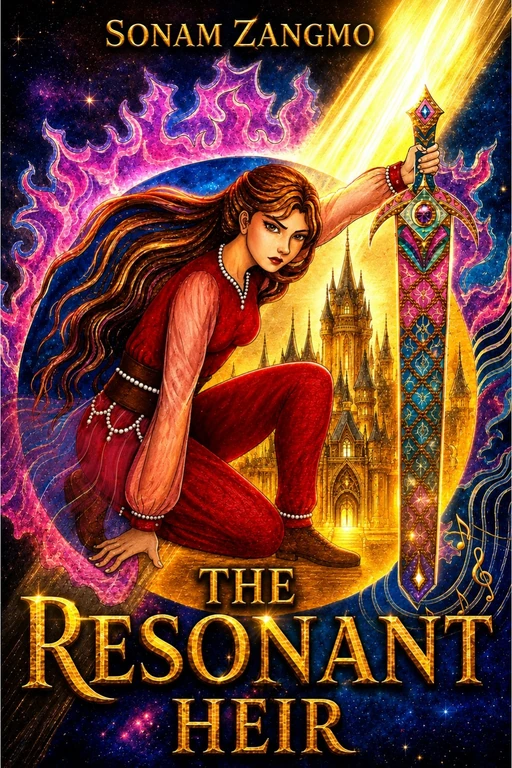
 Explore The Resonant HeirYA crossover royal fantasy · inherited magic · female heir · exile · adventure · Book I Complete
A Literary Commentary on Chapter Fourteen of The Resonant Heir
The Right to Refuse: A Philosophical Reading of The Ceremony Unmade
On the authority of ritual, the cost of loyalty, and the moment a bride claims the right to decide her own future.
Spoiler Notice: Contains spoilers for Chapter Fourteen.
Explore the thirteen themes in this commentary
- What a Ceremony Can—and Cannot—Make Official
- Another Bargain at the Fountain
- The Ability to End a Connection
- The Roses Before the Vows
- For Aulith: The Burden of Loyalty
- The Architecture of Obedience
- A Sentence Hidden in Music
- What Lyra Knows, and What She Suspects
- When Sacredness Becomes an Excuse
- The Risk Within a Rescue
- The Veil, the Bouquet, and a Voice of Her Own
- The Silence After the Refusal
- Conclusion: What Cannot Be Promised Away
Theme 01 · Philosophical commentary
What a Ceremony Can—and Cannot—Make Official
A wedding has the power to make a relationship visible to a community. It can gather witnesses, invoke tradition, and give private promises a public form. But can a ceremony make an unjust relationship just?
That is the question at the heart of Chapter Fourteen of Sonam Zangmo's The Resonant Heir, The Ceremony Unmade. The alliance between Prince Luca's house and Aulith is about to be solemnized before the king, the queen, and the assembled court. Its political value has already been discussed. Its personal cost is written across the face of its reluctant bride.
The ceremony has its own momentum. Musicians tune their instruments. Guests take their places. The eldest Royal Mage prepares to preside. The bride enters beneath a white veil, and the prince stands ready to pronounce his vows. Everything has been arranged to make the next event appear inevitable.
Then Lyra says one word: “Stop.”
Her interruption does not prove that every suspicion she has about the alliance is correct. Nor does it erase the pressure that Elena will face in deciding what happens next. It does, however, challenge a dangerous assumption: that a relationship becomes legitimate simply because powerful people have invested in its public recognition.
A ceremony can witness consent. It cannot manufacture consent where there is none.
The question is not whether tradition has authority, but whether that authority remains answerable to the dignity of the people it binds.
Theme 02 · Philosophical commentary
Another Bargain at the Fountain
Before the royal wedding, Lyra returns to the Wind-Crystal Garden to seek the imprisoned High Lord she encountered earlier. Voxath has trembled in her hands; the mark on her wrist has pulsed in response. Her longing to understand the Awakening Spring and recover her sealed magic has not diminished.
She touches the spinning gemstone, Rubiad, despite the pain, and the strange meeting begins again. This time she comes prepared to bargain.
If the High Lord tells her where the Awakening Spring is, she promises not to abandon him to his imprisonment once her magic has been restored.
Her offer is understandable. She needs knowledge that he claims to possess, while he appears to want freedom from confinement. Yet the proposed exchange is ethically precarious.
Lyra cannot presently guarantee that she will recover her magic. She has not established whether she could release the prisoner, or whether releasing him would be safe or justified. A sincere promise is not necessarily an informed one.
The High Lord, for his part, gives her only an uncertain lead. He has heard that the spring lies in Hemaliel, but cannot confirm it. A map, he says, was divided into four portions and entrusted to four of the eight fae clans. He does not know which clans hold them.
The dialogue leaves Lyra with questions rather than an answer. His admission of uncertainty does not independently establish that the rest of his account is reliable.
This encounter provides a quiet prelude to the wedding. Both scenes involve people offering or accepting something consequential in hope of gaining something they need.
A bargain becomes morally difficult when one party has not yet understood what they may be promising away.
Theme 03 · Philosophical commentary
The Ability to End a Connection
The meeting in the garden is also significant because Lyra learns something about her own limits.
The magical connection hurts. The scar on her wrist burns, and she understands that her body cannot endure the resonance indefinitely. Previously the encounter had ended when the connection collapsed on its own.
Now she asks whether she can reverse the mechanism before that happens.
She turns the gemstone counterclockwise, and the High Lord disappears as the garden resumes its ordinary form.
The chapter does not explain the entire magical process, and the incident should not be inflated into proof that Lyra has mastered the gemstone or controls the prisoner's fate. What it does show is a modest but important change: she acts to end an encounter rather than simply waiting for it to overwhelm her.
The decision belongs beside her moral development in the previous two chapters.
After discovering Cavren's betrayal, Lyra lost control and struck him. Later, confronted with Luca's abuse of a maid, she allowed Haris to stop her raised fist. In the garden she now identifies a limit and attempts to act upon it herself.
Not every boundary is an obstacle that courage must defeat. Some boundaries protect the person who observes them.
The episode prepares a useful contrast with the wedding. Lyra can end a painful magical connection for herself. Elena must decide whether to end a binding social commitment despite the desires of many other people.
These acts are not equivalent. But both raise the question of who has the authority to say that something must not continue.
Theme 04 · Philosophical commentary
The Roses Before the Vows
On the morning of the wedding, Luca flirts openly with Princess Andrel beneath a rose arch while Elena gathers white roses nearby for her bridal hair.
Elena hears him. The narration insists that this is neither an accidental misunderstanding nor something she has imagined.
Luca sees her and does not apologize.
When Lyra objects that he should show his future wife respect, he declares that Elena should be grateful to marry him and dismisses Aulith as though the clan were of no worth.
The roses fall from Elena's hands.
It is a small, carefully chosen action. Her humiliation is registered without a speech or a dramatic confrontation. She walks away quickly, trying not to let others see her face.
The scene makes visible the difference between public honor and private dignity. The same young woman about to be displayed as the symbol of an alliance is denied basic respect by the man who stands to benefit from it.
Luca's conduct is not evidence that he commands a conspiracy against the crown. His cruelty toward Elena does not prove the separate military suspicions that occupy Lyra's mind.
But the behavior is real within the scene, and its moral significance does not depend on a larger political plot.
A person should not have to discover an attempted coup before being permitted to object to humiliation in a marriage.
For Elena, the injustice is immediate: the relationship she is expected to enter is already being described by Luca in terms of superiority and gratitude owed to him.
The rose garden exposes what the ceremonial hall is prepared to conceal beneath its beauty.
Theme 05 · Philosophical commentary
For Aulith: The Burden of Loyalty
Lyra follows Elena to the waiting room and urges her not to go through with the wedding.
Elena looks into the mirror, her eyes red but her tears withheld. Her reply is brief: “Don't say anything. For Aulith.”
Those final words carry the ethical weight of the alliance.
Elena is not portrayed as ignorant of Luca's conduct. She heard him herself. She is hurt, and she understands what his contempt implies. Nevertheless, she prepares to walk down the aisle for the sake of her people.
Her willingness to endure this humiliation should not be dismissed as simple weakness. She may sincerely believe that the marriage offers Aulith something important. Loyalty to a threatened or disadvantaged community can inspire real sacrifice.
But the existence of noble motives does not settle the question of freedom.
If refusing the marriage would feel like abandoning one's people, how freely can a person choose? If duty demands silence about mistreatment, where does service to the community end and surrender of the self begin?
The chapter does not fully disclose Elena's prior negotiations, the terms of the alliance, or every possible alternative. We cannot conclude from her pain alone that others explicitly coerced her.
What we can say is that she appears to experience the ceremony as an obligation that survives her private suffering.
The tension recalls Aulith's earlier Soul Covenant: a community's search for protection may impose costs on particular bodies and lives. The legal and magical links between the two arrangements remain unconfirmed, but their moral resonance is clear.
Devotion to a people should not require its members to accept contempt as the price of belonging.
Theme 06 · Philosophical commentary
The Architecture of Obedience
Quartz Canopy Hall is arranged according to rank. The king and queen sit above the guests. High officials stand nearest the front; princes, princesses, and noble houses occupy their assigned places. Representatives of the fae clans wait at the rear.
Such an arrangement may be conventional protocol. The novel does not prove that its designers intended a deliberate insult to Aulith.
But its visual meaning is unmistakable: the people closest to established power are physically closest to the center of the ceremony.
Elena enters a space in which the course of events has already been determined by rank, music, ritual, and the expectations of hundreds of witnesses.
Lyra stands among the royal descendants, just behind Syveris. When she decides to intervene, the narration notes that she steps out of the line.
The gesture invites comparison with the previous chapter's title, The Line Crossed. There, Rogan stepped beyond his command authority under pressure and caused a disaster. Here Lyra leaves the line that ceremonial order has assigned her and challenges what that order is about to authorize.
These acts should not be equated simply because both break a rule. Disobedience does not become just through its own boldness. Its reasons, methods, and consequences still matter.
What distinguishes Lyra's intervention is her attention to specific words spoken in front of witnesses and to the bride whose dignity those words denied.
A social order needs procedures. But when procedure is used to prevent relevant moral objections from being heard, orderly appearance can become a defense of wrongdoing.
The purpose of ceremony should not be to make the people within it afraid to speak.
Theme 07 · Philosophical commentary
A Sentence Hidden in Music
The moment that changes Lyra's sense of the wedding arrives in a few quiet words.
As the ceremonial music rises, Syveris leans toward High Commander Derron and says that command of the army will soon be his.
Lyra hears him.
She remembers the vanishing letter from the previous chapter: its reference to a ritual, a transfer of command, delayed supplies for the northern camp, and the merging of forces. She also remembers Luca's threats about what will change after his marriage.
For a moment, the fragments appear to fit together.
Her mind races toward the possibility that the alliance will give Derron and Aulith control over military supplies and forces, perhaps threatening the throne itself.
The possibility is alarming, but it remains her interpretation.
Syveris's words suggest an impending transfer of authority. They do not by themselves establish an illegal transfer, identify the author of the disappearing letter, or prove Derron intends to seize the crown.
The narration even leaves open whether Syveris's quiet statement was meant for another listener. That possibility deserves notice, not promotion into certainty.
There is a familiar danger here: when evidence suddenly forms a persuasive pattern, the person who discovers it may feel that further inquiry is unnecessary.
Lyra has good reason to be cautious. The novel has shown how true information can be used to produce misleading conclusions.
The important development comes not from how rapidly she forms a theory, but from what she chooses to say aloud after forming it.
Theme 08 · Philosophical commentary
What Lyra Knows, and What She Suspects
Lyra faces a choice as the bride approaches.
She could accuse Derron of plotting to control the army. She could publicly implicate Syveris or turn the vanished letter into an accusation before the court.
She does none of those things.
Instead, she describes Luca's conduct in the rose garden. She repeats his contemptuous words about Elena and Aulith, and she identifies people who were present, including Princess Andrel.
This distinction is central to the chapter's ethical achievement.
Lyra has direct knowledge of Luca's behavior. She does not possess equivalent proof of the larger military conspiracy she fears.
Rather than presenting the two as equally established, she grounds her public challenge in what can be witnessed.
Her conduct is not a perfect model of procedural fairness. She interrupts Luca and later declares that he has no right to speak there. Even people accused of wrongdoing should have an opportunity to respond, and the public nature of the confrontation creates pressures of its own.
Yet she avoids a more dangerous failure: using uncertain suspicions as though they were proven facts.
There is an important difference between believing that intervention is necessary and claiming to know the complete hidden design behind an event.
Moral courage does not relieve a person of the obligation to distinguish testimony from conjecture.
Lyra's growing capacity for that distinction is especially consequential for a future ruler, whose accusations may one day carry the force of law.
Theme 09 · Philosophical commentary
When Sacredness Becomes an Excuse
Derron attempts to dismiss the rose-garden incident as mere polite conversation, hardly grounds for disrupting a sacred ceremony.
Lyra's response turns his defense against him: when did the royal court begin calling the humiliation of an ally good manners?
The disagreement is not merely about etiquette.
Derron treats the sanctity of the ceremony as a reason to minimize conduct that might undermine it. Lyra questions whether a ceremony deserves such deference when its participants have already failed to honor the relationship it is supposed to establish.
Her strongest line comes when she says that she is preventing a spectacle from being made official.
The remark recognizes that institutions do more than record private conduct. They grant it public legitimacy.
A marriage ceremony can formalize a union. It cannot supply respect on behalf of someone who refuses to give it.
This does not mean marriages require perfect partners or that every pre-wedding offense justifies a public interruption. The issue here is the combination of Luca's openly contemptuous attitude, Elena's evident distress, and the political pressure to proceed regardless.
The court's reverence for ritual risks becoming reverence for appearance.
A tradition worth preserving must be able to survive honest questions about whether it is being practiced in a way consistent with its professed values.
The sacredness of a vow depends partly on the freedom and dignity of the people expected to keep it.
Theme 10 · Philosophical commentary
The Risk Within a Rescue
Lyra finally turns from the prince and his father toward Elena.
If Elena wishes to proceed, Lyra says, she will remain silent. She asks the bride to step forward only if she is certain Luca sees her as a blessing rather than something to be taken.
This moment gives Elena a form of recognition she has largely lacked during the political arrangements surrounding her marriage.
She is addressed as the person whose future is at stake.
Yet it would be too easy to call the situation an uncomplicated restoration of freedom.
Lyra has halted the ceremony publicly. The king, the queen, the noble houses, and the fae envoys are all watching. Elena must respond under extraordinary pressure, with the consequences of either choice unfolding before the court.
An invitation to choose does not automatically remove the pressures surrounding the choice.
Lyra herself holds royal status and has shaped the moment in which Elena must decide. Her intervention is different in purpose and character from Luca's attempts to dominate the bride, but it is still an exercise of power affecting someone else's life.
This complication should not erase Lyra's achievement. Silence would have allowed the ceremony to proceed while Elena struggled to endure humiliation for Aulith's sake.
But it reminds us that assistance can become another form of control when the helper assumes authority over the final decision.
The better interpretation of Lyra's act is not that she has rescued a helpless bride by determining her fate. It is that she has interrupted a process sufficiently for the bride's own refusal to be heard.
Elena must still speak for herself.
Theme 11 · Philosophical commentary
The Veil, the Bouquet, and a Voice of Her Own
The scene reaches its decisive moment not when Lyra speaks, but when Luca reaches for Elena's veil.
Accused of disrespecting her and her people, he responds by seizing the veil and pulling it down as he shouts that the others are conspiring against him.
The gesture is revealing. He attempts to defend his reputation while treating the bride's person and ceremonial clothing as things he can handle in anger.
It does not prove that Luca is involved in the suspected military scheme. It does expose his conduct in front of the witnesses who are being asked to honor this marriage.
Elena reaches her limit.
She throws down the bouquet, and the roses strike the floor. She declares that she will not marry a man who flirts and looks down on her people.
Her voice breaks. Tears come freely.
Nothing about the moment requires her to become invulnerable. She can be hurt, frightened, and angry while still making a clear choice.
The declaration also transforms the meaning of loyalty. Earlier, Elena intended to endure the marriage “for Aulith.” Now she refuses a man who has openly insulted Aulith.
Her dignity and her people's dignity are no longer presented as opposing obligations.
The falling flowers trace that change. Roses gathered for adornment fall in the garden when she is humiliated. The bouquet is crushed in her hands during the ceremony. Finally, she throws it aside herself.
What began as an emblem of a promised union becomes an instrument of refusal.
Elena does not reject her people when she rejects Luca. She refuses to treat submission to contempt as the only way to serve them.
Theme 12 · Philosophical commentary
The Silence After the Refusal
The High Lady of Aulith challenges Derron to explain whether contempt for her people truly represents his house's position. Luca cannot readily defend himself. The commander's silence becomes, in the scene's immediate social context, a concession he cannot escape.
It would go too far to treat that silence as an admission of military conspiracy, delayed supplies, or a plot against the throne. Those questions remain unresolved.
The court has witnessed something narrower but still important: Luca's contempt, Elena's treatment, and the bride's public withdrawal from the marriage.
Syveris remains composed. The king watches without speaking; the queen steps back slightly. Their reactions invite speculation, but they do not disclose what either knows or intends.
Lyra, meanwhile, claims no victory.
She does not smile.
That restraint makes the ending more affecting than a triumphant speech would have been. Elena has reclaimed her voice, but she has suffered. The alliance has been publicly disrupted, and the consequences for Aulith and the royal household are not yet known.
Even if Lyra's fears about a larger plan prove justified, interrupting the marriage does not by itself establish that the danger has ended.
A good decision can carry uncertain consequences. It can also leave behind pain that no feeling of victory should erase.
The scene's final silence belongs not to an easy triumph over evil, but to the difficult aftermath of a necessary refusal.
Theme 13 · Philosophical commentary
Conclusion: What Cannot Be Promised Away
Across the preceding chapters, Lyra has repeatedly confronted the relationship between good intentions and the power to act.
She freed Ravok from an execution she believed unjust, without knowing every consequence. She attacked Cavren when righteous anger overcame restraint. She stopped short of striking Luca after Haris intervened. She has learned, unevenly, that protecting others demands more than courage and force.
The Ceremony Unmade advances that lesson without pretending to complete it.
In the garden, Lyra negotiates with a captive High Lord over knowledge she wants and a freedom she may not be able to grant. In the royal hall, she encounters a different kind of bargain: an alliance whose proposed benefits are inseparable from a young woman's life.
Lyra does not know the full political story. The whispered promise to Derron, the vanished letter, and the proposed transfer of command remain pieces of an unproven design.
What she does know is that Luca humiliated Elena and dismissed Aulith. She brings those facts into a room prepared to celebrate the marriage as sacred. Then, at the crucial moment, she turns toward the bride.
The response does not belong to Lyra.
It belongs to Elena.
The distinction is why the chapter's title matters. The ceremony is unmade not solely by a princess's intervention, but by the bride's refusal to participate in the union it would have sanctified.
A ceremony can make an agreement official. It cannot make that agreement just, and it cannot rightly claim another person's consent on their behalf.
Lyra enters the hall fearing that silence may make a dangerous arrangement permanent. She reaches the end without claiming victory, because the political consequences remain beyond her sight.
But something essential has happened.
A woman who believed she had to endure humiliation for her people has spoken before the entire court and refused.
The families may negotiate. The court may arrange a ceremony. A kingdom may desire an alliance. None of them can give the vow that belongs to Elena.
And that is the right at the heart of this chapter: the right to say no, even when the world has already prepared for you to say yes.