
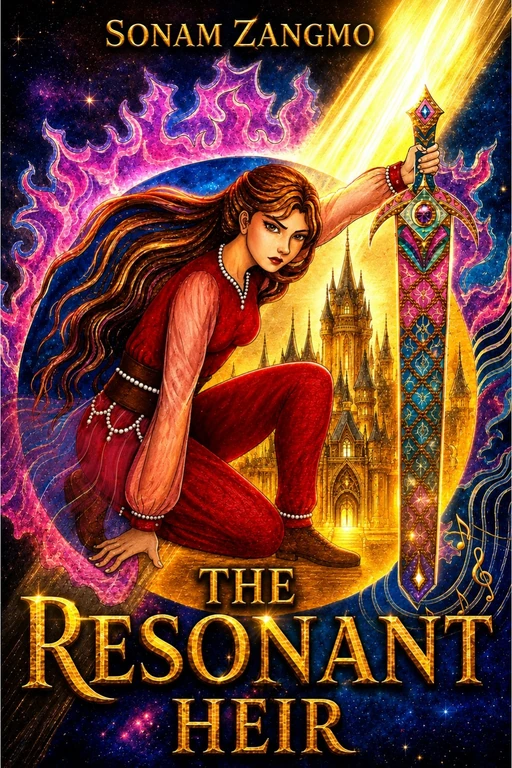
 Explore The Resonant HeirYA crossover royal fantasy · inherited magic · female heir · exile · adventure · Book I Complete
A Literary Commentary on Chapter Fifty-Five of The Resonant Heir
When the Door No Longer Knows You: Freedom, Justice, and Unfinished Promises in A Debt Without a Door
Lyra has recovered her magic and her crown. Yet an old friend cannot be commanded to forgive her, and a gemstone no longer recognizes the hand that once opened it. A Debt Without a Door asks what freedom and responsibility mean when victory cannot unlock everything.
Spoiler Notice: Contains spoilers for Chapter Fifty-Five and the conclusion of Book I, with references to earlier chapters.
Explore the 41 themes in this commentary
- The Day After Victory
- Emeralds That Suddenly Weigh More
- “Your Majesty”: Recognition as Loss
- The Sword Cannot Fight Grief
- The Girl Behind the Spirit Bird Letters
- A Record of Service and a Record of Crimes
- No Crime Inherited by a Son
- Forgiveness Is Not a Royal Privilege
- A Bow That Is Almost a Collapse
- An Open Cage Is Not Yet Freedom
- Cruel, Guilty, and Still His Father
- Truth Does Not Command Grief
- Two People Who Are Not Lighter
- “Your Majesty” Becomes a Different Sound
- An Embrace Wide Enough for Obewich
- Not as Queen, but as Daughter
- Eryndar's Chair in the Lapis Chamber
- Rejecting Aethrador's Legacy
- One Witness at a Time
- No Punishment, No Refuge in Silence
- The Wounded on Both Sides
- No House Condemned by Blood Alone
- Prisons, Sealed Chambers, Old Sentences
- Names First, Judgment After
- Decrees Are a Beginning, Not a Cure
- Letters, Gifts, and Public Recognition
- Drazhune's Courtesy Is a Veiled Threat
- The Prisoner Beneath Rubiad
- A Promise That Survives a Crown
- The Queen Crosses the Forbidden Threshold
- The Garden Has Not Waited Unchanged
- Red, Silent, Turning
- The Prenatal Seal Was Not the Later Mark
- The Warning at the Awakening Spring
- The Stone Does Not Know Her
- The Only Key the Gemstone Knew
- Orlas's Freedom and Lyra's Restoration
- Public Doors Open; One Private Door Closes
- What It Means to Owe Without Being Able
- The First Garden and the Last
- A Conclusion That Refuses Omnipotence
Theme 01 · Philosophical commentary
The Day After Victory
Chapter Fifty-Five of Sonam Zangmo's The Resonant Heir begins where an ordinary fairy-tale victory might end. The regent has fallen, a rightful heir has taken the throne, and the court has hailed its queen. Lyra dismisses that court and goes outside. The first person awaiting her is not a celebrant but Orlas, sitting in the place where his father died.
That immediate change in scale defines the final chapter of Book I. The story no longer asks whether Lyra can regain what was stolen from her. She has recovered her native resonance and been lawfully crowned. It asks instead what her victory means to other people and what obligations survive an apparently completed heroic journey.
The answer is neither cynical nor comfortably triumphant. A genuine political wrong has been corrected, but the correction has not undone every life it touched. Victory ends a struggle; it does not necessarily end the responsibilities the struggle created.
Theme 02 · Philosophical commentary
Emeralds That Suddenly Weigh More
As Lyra sees Orlas on the palace steps, the emeralds in her crown catch the light. They ought to feel bright with triumph, the narration suggests, yet the crown presses more heavily upon her head. An ornament symbolizing her right to rule becomes an almost physical burden.
The inversion is delicate. A crown answers a public question: who should occupy the throne? It cannot answer a private one: what should that person say to a son whose father died during the contest for it? Lyra has the office but cannot make the grief before her easier by invoking the office.
The weight does not negate her legitimacy. It records a more demanding beginning to legitimate rule. She is queen precisely when she must face a consequence no exercise of royal dignity can dismiss.
Theme 03 · Philosophical commentary
“Your Majesty”: Recognition as Loss
Orlas addresses her correctly, without looking up: Your Majesty. The narration remarks that this title strikes harder than an accusation. The young man does not accuse Lyra of killing his father or challenge the verdict of the court. He uses the conventional language of political recognition.
But they knew each other before these events. Lyra recalls his letters sent by Spirit Bird and momentarily wishes to speak as the girl who received them. The title now comes from a person with whom her relationship has been changed by a death that neither of them can reverse.
This is the first of the chapter's significant repetitions. The same formal title will later be uttered by Obewich in joy. Words do not carry their emotional meaning independently of those who speak them. A victory can establish a queen in law while creating an unbearable distance in a friendship.
Theme 04 · Philosophical commentary
The Sword Cannot Fight Grief
Lyra's fingers move reflexively to the hilt of her sword, and she catches herself. A queen cannot reach for steel whenever grief looks her in the face. Few lines mark the transition from warrior to ruler more efficiently.
Her weapon was indispensable against the palace ward, the guards, and Syveris's final storm. It enabled direct responses to physical threats. Orlas, however, is not attacking her. His sorrow is not a hostile force that can be struck, disarmed, or defeated. To treat it that way would reproduce the mistake of confusing power with the capacity to command every human experience.
The gesture captures a necessary change of habits. The qualities that make someone effective in battle do not automatically make that person effective in peace. Lyra's first act of restraint is to take her hand off the means by which she won.
Theme 05 · Philosophical commentary
The Girl Behind the Spirit Bird Letters
Lyra remembers the relationship that once existed through Orlas's letters. She wants to address him from that earlier position, before the throne and the death on the steps had placed different responsibilities upon them. But she knows the girl who read those messages cannot answer for what has happened now.
The recognition does not mean the girl has disappeared or that friendship was false. It means a past intimacy cannot cancel a present moral situation. Lyra now occupies an office that will judge crimes committed under Syveris, while Orlas remains the son of the man who died resisting her.
Maturity is not simply abandoning an earlier self. It means allowing a person's history to remain real while accepting that changed circumstances require a different answer. Lyra must speak with the compassion of an old friend and the restraint of a public official, without pretending those roles are always easy to combine.
Theme 06 · Philosophical commentary
A Record of Service and a Record of Crimes
Lyra tells Orlas that Syveris's service to the crown will be acknowledged and his crimes judged. The sentence resists two easy ways to rewrite the past. The first would make earlier service cancel later cruelty. The second would make later cruelty erase every earlier act that deserves to be recorded accurately.
The chapter offers no final accounting of those services or of each charge. Its claim is procedural: the history should be examined rather than reduced to a sentiment of victory. A former regent's wrongdoing is serious enough to require judgment, not merely a new sovereign's disapproval.
It is an important posture for someone who has just defeated a personal enemy. The public record should not become a mirror of the victor's anger. The new government will be judged, in part, by whether it can distinguish memory from excuse and accountability from revenge.
Theme 07 · Philosophical commentary
No Crime Inherited by a Son
The queen promises that Syveris's crimes will not be passed down to Orlas. The principle is plain: belonging to a family does not make a person responsible for every action of its members. Orlas may be frightened by his father, attached to him, or injured by his rule. None of that proves Orlas committed the same offenses.
The distinction is especially pointed in a monarchy, where descent matters to political legitimacy. Lyra inherits her lawful position through Eryndar's line, yet refuses to let blood alone decide who deserves punishment. The same relationship can have one significance for succession and a very different significance for culpability.
Her promise does not put Orlas beyond investigation if evidence of his own acts ever arose. That is not what the chapter says. It rejects a collective verdict based simply upon lineage, laying down a principle that will soon appear in the first orders of her reign.
Theme 08 · Philosophical commentary
Forgiveness Is Not a Royal Privilege
Lyra also says she will not ask Orlas to forgive her. In Chapter Fifty-Four the thought remained internal as she watched him lose his father. Now she turns it into an explicit commitment in his presence. She will not use her newly established status to request comfort from the person suffering a loss.
A morally defensible decision does not create an entitlement to be forgiven. Orlas can understand his father's guilt and still find Lyra's victory painful. Forcing the young man to reassure her would make his grief serve the emotional needs of the victor.
The restraint anticipates Lyra's broader approach to judgment. Power does not grant ownership of another person's conscience. A queen may issue orders about the conduct of government; she cannot properly decree when someone else must stop hurting.
Theme 09 · Philosophical commentary
A Bow That Is Almost a Collapse
Orlas finally looks at Lyra, his eyes red but dry. His small bow resembles his body folding under its own weight. In formal terms he acknowledges her position; emotionally the gesture records the burden of a loss he has not begun to absorb.
The difference matters. Submission to a convention, or even recognition of political right, does not tell us what a person privately feels. The court has already proclaimed the queen. The son on the steps is still living with his father's death.
Lyra inclines her head before leaving, as a queen before the first grief her reign has made. She offers no magical solution. She cannot retrieve Syveris or force Orlas to resume the friendship that preceded the conflict. The scene is strong because it lets insufficiency remain insufficient.
Theme 10 · Philosophical commentary
An Open Cage Is Not Yet Freedom
Once Lyra has gone, the narration stays with Orlas. He had long wanted to get out from beneath Syveris's voice, the watched silences, and the feeling that his life always awaited his father's permission. The man who kept him confined is gone. The cage is open.
But Orlas does not experience this as freedom. He did not necessarily want his father's death; he wanted the control to stop. A harmful family relationship may still be emotionally central, and the wish for distance does not automatically become a wish to lose the person forever.
The chapter separates release from happiness. Removing an oppressor can be a genuine change of condition without compelling the person formerly controlled to rejoice at how that change occurred. The tragedy is not that the cage remains shut. It is that the opening has come through a loss the captive cannot welcome.
Theme 11 · Philosophical commentary
Cruel, Guilty, and Still His Father
Orlas knows Lyra is the lawful heir and knows that the court saw Syveris's cruelty. He cannot honestly call his father innocent. Yet the narration lists three facts side by side: Syveris was cruel, Syveris was guilty, and Syveris was still Orlas's father.
The three claims belong to different kinds of truth. Cruelty and guilt concern Syveris's actions. Fatherhood concerns a relationship, one that can generate love and grief even when the actions deserve condemnation. No one fact logically cancels the others.
This is why the chapter does not force Orlas into an artificial choice between loyalty to the dead and loyalty to reality. He can mourn without acquitting. He can know the truth without pretending that the truth has made the person he loved dispensable.
Theme 12 · Philosophical commentary
Truth Does Not Command Grief
The narrator says truth does not make grief obedient. It is perhaps the chapter's most searching observation about human feeling. Orlas has reached the factual conclusion the story supports, but knowledge does not make bereavement submit to an order.
The line does not demean truth. Truth enables him to resist the temptation to declare his father innocent. It defines the reality to which he must respond. But grief is not an error that disappears when the correct conclusion has been entered into a ledger.
This idea answers the previous chapters' meditation on command from another direction. Syveris tried to compel bodies through terror. Lyra refuses to compel forgiveness. And now even reality itself cannot be invoked as a command to make sorrow cease. People require more than correct information in order to live through loss.
Theme 13 · Philosophical commentary
Two People Who Are Not Lighter
The same truth settles over Lyra and Orlas, leaving neither of them lighter. They occupy different moral and emotional positions: one has regained a throne after a deadly confrontation, the other has lost the father who controlled him. Yet both must carry the recognition that Syveris's actions made an uncomplicated reconciliation impossible.
The story resists a common narrative shortcut in which revealing guilt supplies emotional closure. Revealing guilt may enable justice while deepening the pain of people connected to the guilty person. Both consequences can be true.
There is something generous in allowing Lyra and Orlas to share knowledge without requiring them to share relief. Their reactions do not have to match for the facts to be established. A mature ending can let understanding and suffering coexist.
Theme 14 · Philosophical commentary
“Your Majesty” Becomes a Different Sound
In the Turquias Chamber, Obewich tries to greet Lyra with Your Highness, catches himself, and says Your Majesty instead. His voice breaks. The title Orlas used in desolation now carries the delighted disbelief of a steward who has watched over the princess since she was a child.
The placement of these two scenes is deft. The honorific has not changed its public definition; its emotional significance changes completely depending upon who speaks it. For Orlas it marks an irreversible death and estrangement. For Obewich it marks a homecoming that seemed impossible.
The queen has not become two different people. The same political victory is being experienced through two histories. Literature gains depth when it refuses to insist that a public event ought to produce a single correct feeling among everyone touched by it.
Theme 15 · Philosophical commentary
An Embrace Wide Enough for Obewich
Lyra runs into Velaria's arms, then reaches out and pulls Obewich into the embrace. He reacts with the same ungainly tenderness that has made him recognizable since the forbidden garden. His hovering hand finally settles upon Lyra's shoulder.
The inclusion matters. Obewich is not her parent by blood, but years of care and worry have made him part of the emotional home she has fought to reach. The embrace temporarily sets the hierarchy of queen, queen mother, and steward aside.
The scene does not undo the grief on the steps. It permits joy to stand alongside it. Orlas's sorrow need not make Lyra's homecoming false, and her homecoming need not make Orlas's sorrow unreasonable. The two truths are held apart without being placed in competition.
Theme 16 · Philosophical commentary
Not as Queen, but as Daughter
Lyra cries not as an heir or a queen but as a daughter who has finally found her way home. The narrator explicitly releases her from public identity for this moment, though the responsibilities of that identity will soon return.
It is a humane response to the temptation to define growing up as the permanent absence of weakness. Lyra has crossed dangerous lands, reclaimed her native magic, and survived the battle for the throne. None of those achievements has removed her need to be held by the people who love her.
Her tears do not retract her courage. They complete another aspect of it. A person who can endure public responsibility may still require private safety, and there is no contradiction in allowing both kinds of life to remain visible.
Theme 17 · Philosophical commentary
Eryndar's Chair in the Lapis Chamber
After several days close to her mother, Lyra enters the Lapis Chamber and sits in the chair once occupied by Eryndar. The polished table, the carved armrests, and the royal seal seem to retain his presence through their familiarity, even though he himself cannot return.
Inheritance becomes bodily here. She does not merely possess the title her father carried. She occupies a place where he made decisions and now must make her own. The same room can be a monument to someone she loved and a place where grief must be translated into responsibility.
The chair offers no advice. It cannot guarantee that what her father would have done is what justice presently demands. Lyra must decide what to preserve and what to change, even as she feels the emotional weight of succeeding him.
Theme 18 · Philosophical commentary
Rejecting Aethrador's Legacy
With her hand on the royal seal, Lyra rejects the idea that her government should simply continue Aethrador's legacy. She resolves to remake its foundations and not leave the order defined by what earlier power buried within it.
That thought widens the political inquiry beyond Syveris. A single regent has fallen, but locked rooms and unexamined decisions may descend from much older reigns. The structures enabling injustice can survive the death or removal of the person who last used them.
This is the difference between replacing a ruler and changing a system. It would be easy for Lyra to think a rightful crown automatically restores everything that was good. Instead she recognizes the possibility that the monarchy she has inherited contains obligations to people harmed before she had any power to intervene.
Theme 19 · Philosophical commentary
One Witness at a Time
Lyra summons Royal Mages and councilors separately. She asks what authority each exercises, which records each possesses, and which orders passed through their hands from Aethrador's reign to Syveris's regency. The inquiry is directed especially toward sealed chambers and sentences issued without witnesses.
Questioning one person at a time does not guarantee truthful answers or constitute a complete legal process. Yet it makes individual responsibility visible and gives the queen a way to compare claims rather than accept the collective silence of an institution.
The content of her questions is more important than the spectacle of summoning officials. She seeks to trace how authority travels: who orders, records, remembers, and carries out decisions. Accountability requires attention to that path, not merely the discovery of the most convenient person to punish.
Theme 20 · Philosophical commentary
No Punishment, No Refuge in Silence
Nobody is punished on the day of the inquiry, but nobody is allowed to shelter behind silence. The two statements create a balance the previous government did not consistently honor. Lyra wants answers without treating questioning itself as a finding of guilt.
The narrative is not detailed enough to certify the fairness of every future proceeding. It gives an initial principle, and the practical standards of evidence and judgment remain to be established. Nevertheless, the refusal of immediate retaliation is significant after a conflict in which Lyra has suffered profound personal loss.
Restraint need not mean passivity. A government can refuse premature punishment while also refusing to leave old abuses untouched. Justice begins when the search for responsibility is no longer indistinguishable from the desire for revenge.
Theme 21 · Philosophical commentary
The Wounded on Both Sides
Lyra's first orders require medical treatment for the wounded regardless of which side they served. The rule responds directly to the fighting on the palace grounds, where some royal soldiers were injured under Syveris's command and some had been pressured to continue through threats.
Care for injuries is not the same as absolution for wrongdoing. A guard who acted unlawfully may still face an appropriate inquiry. But the need for treatment should not depend on whether the patient fought on the winning side. The new queen separates relief of suffering from the question of punishment.
This gives concrete expression to a different kind of rule from the one Syveris defended when he declared mercy harmful to kingdoms. Lyra's mercy is neither forgetfulness nor an unwillingness to judge. It is the recognition that an injured person remains a person even after a hostile battle.
Theme 22 · Philosophical commentary
No House Condemned by Blood Alone
Lyra extends the principle offered to Orlas into a general order: no house will be condemned merely by descent. The familial relationship that gives the queen her lawful status is not to become a weapon that assigns guilt automatically to other families.
The policy matters because dynastic conflict invites collective retaliation. A new ruler may be tempted to punish the relations of an opponent as a way to secure her victory. Lyra instead makes room for an inquiry into individual acts.
The text does not exempt anyone from investigation where evidence exists. It refuses to treat a family name as sufficient proof. By making the rule general rather than a private exception for Orlas, Lyra shows how compassion toward an individual can inform a public standard of fairness.
Theme 23 · Philosophical commentary
Prisons, Sealed Chambers, Old Sentences
Every prison, sealed chamber, and old sentence is to be reviewed. The order recognizes that injustice may be preserved within a state's archives long after the people responsible for the original decisions have disappeared.
A prisoner can become an administrative fact rather than a person whose story needs attention. A sentence can acquire an aura of permanence merely because it has survived several reigns. The queen wants to examine the reasons such decisions were made, especially where no witness could speak for the person condemned.
The demand does not imply that all old judgments must be wrong. It refuses to assume they must be right. A responsible state should be able to justify the force it continues to exercise in the present rather than hiding behind the fact that an earlier ruler authorized it.
Theme 24 · Philosophical commentary
Names First, Judgment After
Names first, judgment after: two short instructions that could become the governing principle of the new reign. Lyra wants to know the people behind old sentences and locked doors before allowing the system's inherited labels to become final moral conclusions.
This echoes a moment from Chapter Fifty-Three, when the broken military formation ceased to be described as a unified fighting mechanism and only men remained. The tactical unit gave way to human beings. Now administrative categories must give way to named persons who may have been treated as disposable by the old regime.
A name alone does not prove innocence; a review needs evidence. But the person must come before the verdict in the order of moral attention. That is what the stark little sequence makes visible.
Theme 25 · Philosophical commentary
Decrees Are a Beginning, Not a Cure
The first orders are written by sunset. The chapter does not say that every prison has been opened, every conviction reviewed, or every wounded person made well by that hour. Lyra has initiated a program, not magically accomplished the full work of repair.
That distinction protects the novel from treating good intentions as guaranteed outcomes. Institutional change requires records, investigators, judgment, time, and the willingness to confront discoveries that may complicate a hopeful new beginning.
The language of old files is an apt corrective to a purely heroic model of government. A battle may turn upon one person finding a weakness at the right moment; reform demands sustained practices that outlast the emotion of victory. Lyra now has the authority to begin, not an effortless power to finish.
Theme 26 · Philosophical commentary
Letters, Gifts, and Public Recognition
News of the new queen reaches the allied fae clans. Couriers arrive bearing formal letters and costly gifts, from jeweled cups to ceremonial blades and rare cloth. Lyra reads the messages herself, and the sequence briefly suggests that the kingdom's normal diplomatic life can begin again after Syveris's defeat.
Not every letter, however, should be mistaken for goodwill simply because it arrives under the conventions of congratulation. The correspondence from Drazhune must be read against the reader's knowledge of that clan's High Lord. In Chapters Forty through Forty-Two he tormented Lyra through her grief, threatened Sion, pursued both girls with wolves and violet fire, and regarded their apparent deaths at the cliff as a disappointing end to his entertainment.
The final letter therefore interrupts more than a pleasant succession of gifts. It restores to view a hostile claimant who has not forgotten an old grievance. Public recognition of Lyra as queen has not meant that everyone who acknowledges her title accepts the security of her reign.
Theme 27 · Philosophical commentary
Drazhune's Courtesy Is a Veiled Threat
The letter's single arresting sentence reads: May Your Majesty keep Vael’Kharoth for us a while longer. In isolation it might sound like an unusually worded diplomatic request. In context it is chillingly possessive. The sender is not merely expressing interest in a magical object; he is speaking as though Vael’Kharoth remains Drazhune's property and the new queen holds it on their behalf, temporarily.
In Chapter Forty, the High Lord identified Vael’Kharoth as a relic of Drazhune. He said his father had given it to his sister as a wedding gift when she married Aethrador. Then he brought up his nephew Syveris's regency and suggested that, if Syveris secured the throne, the relic might be returned to Drazhune. His territorial claim and political expectations therefore existed well before the final congratulatory letter.
Nor had his earlier contact with Lyra been an exchange between wary but neutral rulers. He used her father's death and her own reactions to feed a creature's painful hooks. When she resisted, he held Sion by the throat and threatened to kill her. After the girls escaped the Citadel's ancestral trial, he pursued them with wolves and surrounded them with fire. Looking down from the cliff after they jumped, he anticipated broken bodies and reacted with disappointment. That history makes an innocuous reading of his final courtesy untenable.
The politeness is part of the menace. The phrase for us denies Lyra the role of rightful possessor; a while longer implies that Drazhune expects the present arrangement to end. The words can reasonably be heard as a taunt after Syveris's defeat: you may wear the crown, but our claim to Vael’Kharoth has not vanished. A future confrontation is foreshadowed beneath the surface of an official greeting.
The distinction between ominous implication and disclosed fact still matters. The chapter does not show the High Lord's exact timetable or the means by which he intends to recover the relic, and it does not establish that Vael’Kharoth, named in connection with the mark, is identical with the imprisoned High Lord of Sarrakha. The warning is credible because of demonstrated hostility and an expressly asserted claim, not because readers already know the complete plan.
Lyra's tightening fingers and immediate question about what Drazhune's High Lord is planning register her alarm. Her return to the garden follows that alarm. The letter is thus not simply an elegant reminder of an unfinished promise; it is a hostile political signal that draws the private debt beneath Rubiad into the shadow of an unresolved external threat.
Theme 28 · Philosophical commentary
The Prisoner Beneath Rubiad
Lyra remembers Rubiad hovering above the suspended fountain and the presence of the High Lord of Sarrakha waiting below. She had promised to free him when she regained her magic. At the time, the bargain belonged to a princess still searching for the Awakening Spring.
One question remains important: why was the High Lord imprisoned in the first place? The story does not settle his guilt or innocence in this chapter. A commitment to release someone does not remove the need to understand what release might mean for other people.
The threatening letter from Drazhune intensifies the urgency without answering that question. Drazhune's claim concerns the relic Vael’Kharoth; the imprisoned High Lord belongs to Sarrakha. Their histories are connected through the garden's magic and Lyra's vanished mark, but their identities and motives must not be collapsed into one. Lyra discovers the immediate obstacle before she can reach the prisoner again, leaving both her obligation and the necessary knowledge suspended.
Theme 29 · Philosophical commentary
A Promise That Survives a Crown
The narration calls the promise the first debt of Lyra's reign. Its origin predates her coronation, but it cannot simply be dismissed as something the former princess said before she understood the burden of government.
Roles change, yet commitments may persist. The queen has more authority than the girl who made the promise, but a public office does not dissolve every private responsibility. Nor does her increased power necessarily give her greater ability to fulfill this particular commitment.
This is the question that distinguishes a debt from an unfinished adventure. A debt continues to have moral significance even when the debtor has become a different kind of person. Lyra must remember the word she gave while also learning enough to decide how to honor it responsibly.
Theme 30 · Philosophical commentary
The Queen Crosses the Forbidden Threshold
Lyra walks through the palace and past people who bow to her. Nobody stops her when she enters the Wind-Crystal Garden. The contrast with Chapter One is exact enough to be moving: an eleven-year-old princess once stepped over a line she had been forbidden to cross, while Obewich struggled to follow.
Now Lyra holds the highest office in Tharion. The guards who could once have been expected to restrain her simply lower their heads. She has gained the right to go where she wishes within her own palace.
Yet legal access is only one kind of access. The queen can cross a boundary enforced by people, but she cannot compel every magical threshold to accept her. The scene transforms a childhood adventure into an adult encounter with limits.
Theme 31 · Philosophical commentary
The Garden Has Not Waited Unchanged
The once-living garden has grown strange in a quieter way. Dust dulls the crystal paths. The fountain hangs motionless. The tulips that once spoke have withered, most of them dead and the remainder bent by the wind.
The chapter does not state the precise cause of their decline, so the flowers should not be presented as evidence of an invented magical rule. Their narrative function is nevertheless clear. Lyra has returned to a place she remembers, and that place is not the same as it was.
The image carries the melancholy of any return after a long transformation. A person may change the outcome of her own life and still be unable to preserve the world exactly as she left it. The garden's decline resists the fantasy that victory restores every earlier wonder.
Theme 32 · Philosophical commentary
Red, Silent, Turning
Rubiad remains where it has always hovered above the suspended water. Its red presence seems unchanged even as the garden around it decays. Lyra approaches, but the familiar pull toward the being imprisoned far below does not come.
She looks at the skin where Vael’Kharoth's mark used to burn, presses her hand to the gem, and tries to turn it counterclockwise. Nothing moves. She tries once more. The stone stays cold.
It is a beautifully restrained climax. There is no monster to defeat, no blade to parry, and no triumphant spell waiting at the point of maximum effort. The queen's action simply fails to register. The silence of an object she once could reach becomes more devastating than an enemy's shouted refusal.
Theme 33 · Philosophical commentary
The Prenatal Seal Was Not the Later Mark
Book I's magical history matters to this ending. Lyra believed herself born without magic, but Syveris had sealed her native resonance before birth. The seal loosened through the story, allowing partial powers to emerge. At the Awakening Spring the seal was purified and her full innate resonance returned.
The Vael’Kharoth mark was a different phenomenon acquired later. It allowed the particular contact associated with Rubiad. The Spring's purification took that mark as well, removing the connection the gemstone recognized.
This is not a scene in which Lyra has lost her restored resonance again. She remains fully restored. She has lost an access key created during a different part of her history. Becoming whole in one respect has cost her a relationship that mattered in another.
Theme 34 · Philosophical commentary
The Warning at the Awakening Spring
At the Spring, the goddess warned that purification could take things Lyra had come to see as part of herself, including doors that once opened for her. Lyra drank because she needed her powers restored and because Syveris's claim to the throne was approaching its dangerous completion.
Chapter Fifty-Five gives the warning a precise consequence. The absent wrist mark means the old way of reaching the imprisoned High Lord no longer works. The restored magic was real and necessary to her victory. Its cost is real as well.
This is not a simple claim that the healing should never have occurred. One genuine good can arrive with a loss that was not fully understood when the choice was made. Restoration is not a guarantee that every connection formed along the way will survive unchanged.
Theme 35 · Philosophical commentary
The Stone Does Not Know Her
The narrator says Rubiad does not hear Lyra or know her. The human weight of those words is considerable after a chapter in which everyone from palace servants to foreign allies has recognized her new status. She has become one of the most publicly identifiable people in her world.
Yet the stone responds not to her crown, lineage, or restored greatness, but to a particular magical sign she no longer possesses. The refusal is not evidence of a moral judgment upon her worth. The object has ceased to recognize a specific condition once necessary for access.
That mechanism creates a paradox of identity. A person can be celebrated and known by an entire kingdom while becoming unrecognizable to the one doorway she needs. Public success cannot substitute for every private connection.
Theme 36 · Philosophical commentary
The Only Key the Gemstone Knew
The narration says the Spring took the only key Rubiad knew. The wording defines a present limit without proving that no alternative approach exists anywhere in the world. Lyra has lost the means of access she understands; the full range of possible future solutions remains unknown.
This precision is vital to the chapter's open ending. To call the prisoner permanently unreachable would add a certainty the narrative does not supply. To suggest Lyra can surely find another route would be equally unsupported. The story leaves her between obligation and ignorance.
The image is therefore neither a solved rescue mission nor an absolute sentence of failure. It is a debt whose familiar entrance has ceased to function, and whose repayment now demands knowledge or possibility Lyra does not yet possess.
Theme 37 · Philosophical commentary
Orlas's Freedom and Lyra's Restoration
Orlas and Lyra undergo different but structurally related kinds of release. Orlas is no longer governed by his father's will, but that release has arrived through the death of a father he still loves. Lyra is no longer governed by the seal imposed before birth, but its purification has also removed the mark linking her to another person.
The costs differ radically. Orlas faces intimate bereavement. Lyra faces the loss of a magical connection and the burden of a promise she cannot now fulfill. The chapter does not ask readers to treat their suffering as equal or interchangeable.
It asks something more subtle: why should liberation always be expected to feel like happiness? A prison can open while grief remains; a healing can be genuine while a door closes. Being released from a wrong does not mean that everything once connected to that wrong has become harmless to lose.
Theme 38 · Philosophical commentary
Public Doors Open; One Private Door Closes
There is an exact structural irony in the chapter's last movement. As queen, Lyra orders the inspection of sealed chambers and old prison sentences. She now has legal power to demand entry into spaces that earlier rulers kept hidden.
But in the garden, the prisoner beneath Rubiad remains beyond her reach. Her crown cannot command the gemstone. The power to investigate the kingdom's jails does not automatically reopen the one magical passage she used before.
This opposition gives the ending its distinctive force. Lyra has gained the ability to begin repairing wrongs committed across a state, and lost the only key she knew to a particular person who still waits. Authority has expanded in one dimension while capability has narrowed in another.
Theme 39 · Philosophical commentary
What It Means to Owe Without Being Able
Lyra remembers the promise, returns to the garden, and twice attempts to use the old mechanism. The failure is not indifference or intentional betrayal. She has not discarded the imprisoned High Lord because the crown has made her comfortable.
But the attempt also does not discharge the debt. The person remains trapped and the promised rescue remains undone. The moral situation lies between good intention and successful action, refusing the idea that either can always be substituted for the other.
Responsibility often outlives present ability. A person may have to admit that she does not know how to honor a commitment without pretending that the commitment has thereby lost its value. The chapter leaves Lyra with exactly that difficult knowledge.
Theme 40 · Philosophical commentary
The First Garden and the Last
The story began with a child crossing a forbidden line into a sentient garden. It ends with a young queen crossing the same threshold unopposed and discovering that the garden no longer answers her. The circularity is graceful but intentionally incomplete.
The first threshold was enforced by authority: the king had forbidden entry, and Obewich was afraid of what might happen there. The final threshold is a failure of magical recognition. Lyra can overcome the first by possessing the crown; the second cannot be overcome by repeating her earlier gesture.
This is a compelling version of growing up. The child dreams of freedom from commands. The adult gains that freedom and discovers limits that cannot be removed merely by having the right to act.
Theme 41 · Philosophical commentary
A Conclusion That Refuses Omnipotence
A Debt Without a Door gives Lyra the victory Book I promised. Her restored resonance is genuine, the succession is lawful, and her first orders show a queen willing to separate care from punishment and evidence from inherited accusation. The reunion with Velaria and Obewich has the emotional weight of a homecoming.
Yet the novel refuses to present her as a person for whom all difficult human experiences have become manageable. Orlas cannot be commanded to forgive. The old institutions cannot be repaired by a decree alone. The prisoner beneath the garden still waits. And Rubiad does not know its former visitor.
The final debt is therefore not an insult to her triumph. It is the measure of how her responsibility has grown. The old order ends when Lyra wins the right to rule. Her deeper adulthood begins when she recognizes a promise the crown cannot yet help her keep.