
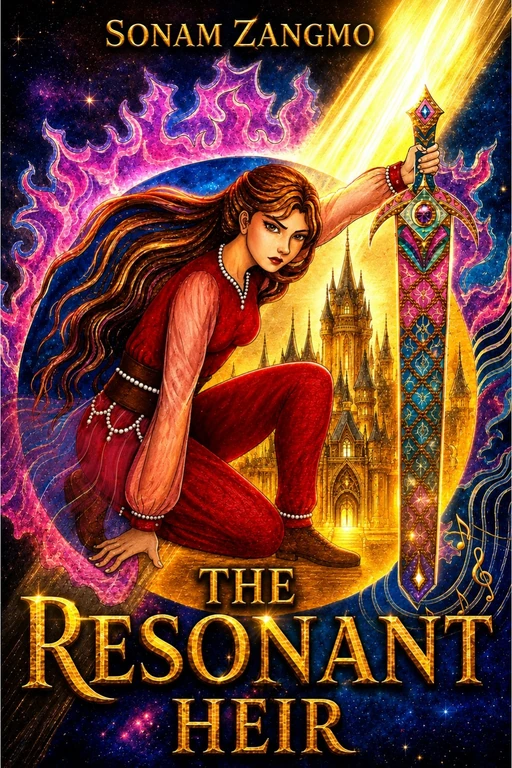
 Explore The Resonant HeirYA crossover royal fantasy · inherited magic · female heir · exile · adventure · Book I Complete
A Literary Commentary on Chapter Fifty-Four of The Resonant Heir
The Crown and the Cost of Mercy: Power, Grief, and Justice in The Old Order Ends
Lyra restores the rightful line of Tharion, but the victory leaves a young mage wounded and Orlas holding the absence of his father. The Old Order Ends asks whether ending a cruel regime can make a new one just—and what a queen owes those who bear the cost.
Spoiler Notice: Contains spoilers for Chapter Fifty-Four and earlier events in Book I.
Explore the 39 themes in this commentary
- What an Ending Cannot Repair
- The Crown Leaves Syveris's Head
- Political Authority Reduced to Personal Violence
- A Dead Father's Love Becomes Bait
- Self-Knowledge Extinguishes a Trick
- Sharpness Beyond Magical Strength
- Wind First, Fire Behind
- The Flaw Heard Before It Is Seen
- A Young Mage Becomes a Shield
- Intention and the Path of Harm
- “Is That How You Protect the Realm?”
- “Mercy Is How Kingdoms Rot”
- The Courtiers See Their Future
- The Archers Lower Their Bows
- The Last Resort of Solitary Power
- The Storm as a Concentration of Control
- Fully Restored, Still Vulnerable
- Velaria at the Harp
- The Power of Being Answered
- One Heartbeat Is Enough
- Lightning Already Inside the Enemy's Storm
- The Enemy's Force Comes Back
- Lyra's Voice After the Long Silence
- Orlas Calls Out for His Father
- Two Embraces, Two Moral Worlds
- Lyra Understands Orlas's Grief
- Necessity Is Not a Clean Conscience
- A Final Flicker and a Final Breath
- Orlas Holds the Space Where His Father Was
- The Silence After the Battle
- “Hate Me If You Must”
- Forgiveness Cannot Be Commanded
- Some Wounds Will Remain
- Haris Kneels Before the Queen
- Sonareth Is Told to Withdraw
- The Sword Answers as It Is Sheathed
- The Rite That Finally Closes
- “Long Live the Queen”
- Conclusion: The Cost Beneath the Crown
Theme 01 · Philosophical commentary
What an Ending Cannot Repair
Sonam Zangmo's The Old Order Ends brings Book I's struggle for the throne to a resolution. Syveris falls, the rightful heir receives the crown, and the magical rite closes around her where it failed around him. Yet the chapter's most enduring image may be Orlas seated on the stones, his arms still curved around the space his father occupied before turning to ash.
This is an ethically demanding way to write a victory. Syveris has harmed Lyra, her family, and the people he was meant to govern. Removing him is consequential and justifiable. But his son's sorrow remains. A political wrong may be corrected without making the damage and grief that surround its correction disappear.
The chapter therefore asks what success means when it is both necessary and incomplete. An old order can end in an instant; the work of caring for those who survived it cannot.
Theme 02 · Philosophical commentary
The Crown Leaves Syveris's Head
The first thing Syveris does is remove his crown. He places it in the hands of the old ceremonial mage and descends the steps toward Lyra. The act is not a surrender. He intends to fight, and the violence that follows proves that his desire to hold power has not diminished.
Its symbolism lies in how easily the object can be detached from its wearer. In Chapter Fifty-Two the crown was placed on Syveris's head while the magical coronation remained unfinished. Here he lays aside the outward emblem and depends instead upon the force he can exercise personally.
By the end, the same ceremonial office will place the crown on Lyra. The story draws a line between possessing the visible sign of authority and meeting the conditions for holding that authority. What matters most is not the ornament but what a ruler believes the ornament allows him to do to others.
Theme 03 · Philosophical commentary
Political Authority Reduced to Personal Violence
Syveris once commanded courtiers, royal mages, a guarded palace, and disciplined soldiers. His military system began to unravel in Chapter Fifty-Three, and the archers will soon refuse to continue the fight. Yet he himself remains dangerous. The collapse of his public command does not eliminate his private capacity to hurt.
There is realism in the distinction. Delegitimizing a tyrant is not identical with making the tyrant harmless. Someone who loses institutional support may still inflict enormous damage before giving up. The courtroom and the army may fail, while the person who built his power upon them refuses to accept that failure.
Lyra therefore cannot merely display her rightful title and expect justice to complete itself. She must survive a man whose remaining strength is concentrated in a willingness to use force without regard for those it harms.
Theme 04 · Philosophical commentary
A Dead Father's Love Becomes Bait
Syveris opens the encounter by telling Lyra that King Eryndar cared deeply for her. Said with tenderness, this could have been a true consolation. Spoken by a political enemy who has wounded her family, it is a calculated attempt to provoke her. A dark blue light strengthens in his palm when pain and anger rise in her chest.
Lyra recognizes the pattern from the creature in Drazhune, which drew power from negative reactions through magical hooks. The love between father and daughter belongs to them, but Syveris tries to turn its painful aftermath into a tool of attack.
This is manipulation rendered in fantasy terms. Its evil lies not in acknowledging grief but in attempting to appropriate grief for domination. A person's intimate memories can be genuine and vulnerable at the same time; their vulnerability is not permission for another person to exploit them.
Theme 05 · Philosophical commentary
Self-Knowledge Extinguishes a Trick
Lyra realizes what is feeding Syveris's spell and confronts him. The glow goes out. What fails is a particular mechanism of emotional exploitation that she has learned to recognize, not necessarily every possible magic involving strong feelings.
Her reaction matters because she has not stopped grieving Eryndar. The words about her father still wound her. Yet she can now distinguish the pain she actually feels from the behavior Syveris wants that pain to produce. She refuses to let him direct her inner life simply because he knows where it hurts.
Chapter Fifty's amber trial offered a related lesson: fear does not have to disappear before a person acts courageously. Here the ability to recognize manipulation keeps grief from being turned into obedience. Strength is not the absence of feeling. It can be the freedom to decide what one's feelings will serve.
Theme 06 · Philosophical commentary
Sharpness Beyond Magical Strength
Syveris acknowledges that Lyra has become sharper than he expected. The description is apt. He has seen her magical growth, but her immediate answer was perceptive rather than overpowering. She noticed the relationship between her emotion and his spell and understood its cause.
That intelligence has been prepared across the novel. She recognized the four stones at the Awakening Spring as a clock rather than a compass. She used magic dust and her grandfather's help to expose a weak connection within the palace ward. She has learned to hear the hidden structure of phenomena that seem solid.
Syveris adapts quickly too, shifting from manipulation to wind and violet fire. But changing tactics is not the same thing as reconsidering a purpose. He remains clever in the service of cruelty, while Lyra's sharpened attention is becoming a means of surviving it.
Theme 07 · Philosophical commentary
Wind First, Fire Behind
Syveris's attacks arrive in pairs. Wind cuts across the courtyard and violet fire follows, tighter and faster with each attempt. Lyra retreats and turns until the sequence forces her into a position that exposes her back. Two streams twist into a spiraling assault as the fire closes behind them.
The trap works by governing options. Syveris does not command Lyra where to move; he threatens her in ways that make a certain evasive response seem necessary. Her effort to protect herself becomes part of his design. This is an effective physical representation of coercive power.
The answer cannot be simply to dodge more quickly. Lyra must recognize that repeating a previously successful response has become dangerous because her opponent is predicting it. Her capacity to change how she understands the attack matters more than a reflex repeated without thought.
Theme 08 · Philosophical commentary
The Flaw Heard Before It Is Seen
Lyra hears a narrow gap within the scream of Syveris's wind before she sees it. She drives her sword through that weakness, splitting the spiral and sending a ripple of force toward its source. The moment is a beautiful expression of the novel's imaginative commitment to resonance.
Her restored magic is not merely more energy. It is access to a mode of attention she developed across years when the prenatal seal only partly permitted her power to emerge. She can listen to an apparently overwhelming force and discern where its structure fails.
The chapter values precision over escalation. Syveris narrows the attack to remove her freedom; Lyra hears the one opening he has overlooked. A great power need not be answered by another identical power when understanding can identify where the first is weakest.
Theme 09 · Philosophical commentary
A Young Mage Becomes a Shield
When Syveris cannot escape the returning ripple, he grabs a young mage by the collar and drags him against his chest. The ripple strikes the mage instead, and the young man falls. Syveris has turned someone under his authority into equipment for his own survival.
This recalls Chapter Fifty-Three, when he threatened to kill his guards if they would not advance. There, he treated their lives as expendable resources. Here the principle is expressed even more starkly: he physically transfers danger from himself to another body without consent.
The text does not establish that the young mage dies. There is no need to add such a claim to grasp the cruelty. The choice to make an unwilling subordinate receive a blow meant for the ruler is the moral event, whether or not the injured man eventually survives.
Theme 10 · Philosophical commentary
Intention and the Path of Harm
Lyra released the ripple, but its target was Syveris. He pulled the mage into its path. The scene asks for a distinction between the force that caused the wound and the deliberate act that changed who would be struck. Acknowledging one fact need not erase the other.
The mage's suffering remains real. It is not diminished by observing that Lyra did not select him as her target. At the same time, it would misstate the moral arrangement to assign Syveris's deliberate decision to her. Intentions, actions, and consequences are related without being identical.
This is one reason the novel's battles can sustain moral analysis beyond choosing a favored combatant. A justified struggle may harm people who were not chosen as opponents, and who deserves responsibility for a particular harm depends on more than who was holding a weapon at its origin.
Theme 11 · Philosophical commentary
“Is That How You Protect the Realm?”
Lyra asks Syveris whether sacrificing a young mage is how he protects Tharion. The question goes directly to the public justification of power. A government claims the authority to command in part because it undertakes responsibility toward the people under its protection.
Syveris has inverted that relationship. A subordinate is not protected by being part of the ruler's institution; his body is available for the ruler's private defense. A claim that the kingdom needs strong leadership becomes indistinguishable from a claim that the ruler's safety matters more than any other life.
The question is not whether service may sometimes require risk. It is whether a person who commands danger can still recognize an obligation to the people taking that risk. Syveris's action suggests that, for him, the obligation runs only one way.
Theme 12 · Philosophical commentary
“Mercy Is How Kingdoms Rot”
Syveris answers that mercy makes kingdoms decay. There is a recognizable political temptation in the statement. Protecting people may sometimes demand hard decisions, punishment, and force against those who threaten others. Sentiment by itself cannot settle every crisis.
But that narrow truth does not justify what Syveris has done. Pulling a mage into danger protects Syveris personally, not the realm. His maxim treats compassion as the problem so he need not explain why his own survival should outweigh the life of someone who serves him.
Mercy is not permission for cruelty to continue, and ruthlessness is not automatically justice. A ruler can be firm without making the pain of subordinates irrelevant. The chapter will eventually show Lyra choosing force while still recognizing the grief that follows it.
Theme 13 · Philosophical commentary
The Courtiers See Their Future
The courtiers retreat into the Throne Hall and watch from behind its doors. The narration gives their fear a specific shape: one day any of them might become the body Syveris grabs to save himself. What looked like proximity to privilege has become proximity to a man who recognizes no reliable limit upon his treatment of others.
The text does not say every courtier has now acquired an idealistic commitment to justice. Self-preservation is a real and understandable motive. But their fear still damages the regent's position. People who cannot trust that the ruler will not sacrifice them have good reason not to remain close.
Syveris's political isolation is therefore caused not simply by losing a fight. His own conduct demonstrates that loyalty to him may be rewarded with exposure to danger. The regime's claim of protection collapses under its treatment of its supporters.
Theme 14 · Philosophical commentary
The Archers Lower Their Bows
The jade flute outside the palace stops. The archers could fire. Instead they lower their bows, one after another, and the narration explicitly says no one wants to fight for Syveris any longer. This clarifies a carefully preserved ambiguity from the end of Chapter Fifty-Three.
There, the flute accompanied their sudden immobility, but its precise effect was not explained. Here the soldiers have the opportunity to attack and visibly decline to continue. The chapter does not thereby prove that every archer has pledged loyalty to Lyra. It shows a withdrawal of the willingness to defend Syveris.
The movement is individualized: bow after bow descends. The army that once responded as a single instrument to the regent's commands now ceases to be an instrument for his survival. The difference between obedience and allegiance has become practical.
Theme 15 · Philosophical commentary
The Last Resort of Solitary Power
Syveris looks up, says enough, and summons a final attack. His lips darken and color drains from his skin. Wind and violet fire circle Lyra before folding inward into a compressed gray storm. The chapter makes no explicit claim about a secret rite or magical price for the bodily transformation.
The position is significant. His armed supporters have stopped participating, but his personal power has not disappeared. He responds to lost allegiance by intensifying the force he can still wield alone. He will not abandon the struggle merely because the community around him no longer fights on his behalf.
A ruler can lose moral and political support while remaining physically formidable. The collapse of an unjust command system is not the same thing as the end of danger. Lyra must still resist what its former center can do.
Theme 16 · Philosophical commentary
The Storm as a Concentration of Control
Syveris squeezes wind and fire into a single dense point, as though power could be made decisive by drawing every force inward toward himself. The image suggests his political temperament: the wish to concentrate authority and make other things answer to one will.
This is an interpretation of the scene's imagery, not a claim that the spell is literally an allegory written into the magic system. The storm functions first as a dangerous attack. It presses into Lyra's sword, drives force through her body, and threatens to crush her against fire.
That physical danger matters. Syveris's cruel beliefs do not make his magic weak. Lyra's rightful claim does not make her invincible. Justice will require attention, effort, and assistance, not merely the announcement that the better person deserves to win.
Theme 17 · Philosophical commentary
Fully Restored, Still Vulnerable
The Awakening Spring purified Lyra's prenatal seal and restored her full native resonance. Yet Syveris pushes her backward until her shoes scrape the stones and her knee begins to give way. Above the courtyard, Queen Velaria can see that her daughter may be defeated.
Restoration is not the same as having no limits. Lyra is no longer barred from the full expression of her own magic, but her body can still be overwhelmed by an opponent's concentrated force. Her development has not ended the possibility of harm.
This is artistically important because the story refuses to turn the heroine's recovered birthright into universal self-sufficiency. She can be both truly strong and genuinely in need of other people. The next scene makes that dependence a source of strength rather than shame.
Theme 18 · Philosophical commentary
Velaria at the Harp
In the Turquias Chamber, Velaria moves away from the window and strikes her harp three times. The notes are hard and low. Beyond the palace, Sonareth's drums answer. The music joins into a force that reaches the courtyard and interrupts Syveris's pressure.
The gesture completes the movement of the mother's role across the preceding chapters. Her ocarina first made grief audible. She later restrained herself from calling Lyra's name so Syveris could not exploit the connection. Now she finds a way to help within the limits of her confinement.
Her intervention is not a substitute for her daughter's agency. It is a meaningful response from one person to another, using a language of sound shared with allies beyond the walls. Love becomes an action capable of changing the conditions of the fight.
Theme 19 · Philosophical commentary
The Power of Being Answered
The harp sounds, and Sonareth's drums respond. Their notes combine into something neither instrument is described as creating in precisely that form alone. A private decision within the palace becomes a coordinated effort across its walls.
In a novel about resonance, the musical relationship has political and emotional force. Syveris threatened soldiers until their shared rhythm collapsed in Chapter Fifty-Three. Velaria's signal is met by an answer, and their combined sound opens a possibility for Lyra.
This is not proof that every relationship outside Syveris's influence is perfectly free or equal. It is an image of effective coordination arising through mutual recognition. The distinction between giving a signal that others understand and commanding through terror has become one of the novel's central contrasts.
Theme 20 · Philosophical commentary
One Heartbeat Is Enough
The music makes Syveris hesitate for a heartbeat. His storm does not vanish, and Velaria does not personally defeat him. But the pressure on Lyra weakens just long enough for her to lift her head and see what has been happening inside the gray wind.
The modest scale of the intervention is its power. Support need not be the act of solving someone else's entire problem. It may be a brief reduction of pressure, an opportunity to think, or a chance to use the skills that were already there.
Lyra will still have to recognize the sparks, create a path, and act. Her mother's help does not diminish her victory. The victory is stronger as a story of human connection because it could not have happened in that way without the help.
Theme 21 · Philosophical commentary
Lightning Already Inside the Enemy's Storm
Lyra notices sparks forming within the compressed storm. She realizes that lightning is emerging and needs a path. Twisting the sword, she sends a ripple of resonance along the storm's inner wall and gathers the scattered sparks into a white-blue current.
The counterattack is satisfying because it is a response to conditions already present. Lyra does not suddenly develop an unexplained new magic. She discovers what Syveris's own attack is producing and uses her existing capacity to guide it.
Her method echoes the four-stone clock and the palace ward's exposed seam. The heroine's distinctive skill lies in recognizing structure. The more powerful her resonance becomes, the more important her trained perception remains. Power reaches its greatest effect when guided by knowledge of what the world is doing.
Theme 22 · Philosophical commentary
The Enemy's Force Comes Back
Lyra's voice drives the gathered lightning through Syveris's storm and into his chest. There is obvious poetic irony in the fact that his own violent construction supplies the electrical force that defeats him.
Yet there is no need to invent a cosmic judgment that makes evil automatically consume itself. The manuscript supplies a concrete chain: sparks arise from the storm; music creates a momentary opening; Lyra notices the possibility; her resonance gathers and directs the current.
That is enough. It allows the scene to work as action while supporting a broader thought: a system built to dominate may contain a flaw that becomes visible to the person who has learned to understand it. The result depends upon attention and intervention rather than fate alone.
Theme 23 · Philosophical commentary
Lyra's Voice After the Long Silence
When Lyra shouts, the vibration of her voice helps drive the lightning. Sound has carried multiple kinds of meaning across the return to the palace. In Chapter Fifty-Two she publicly declared herself the lawful heir; in Chapter Fifty-Three she questioned soldiers about their loyalty and ideals.
Here the voice becomes part of the physical operation of her restored resonance. It is an apt progression for a girl once judged because her aura could not be seen. The power that was sealed before her birth can now be expressed through her own deliberate sound.
But the moment remains collective in its conditions. Her voice becomes decisive after Velaria and Sonareth create the needed pause. The novel's most triumphant act of individual magical control is inseparable from the relationships that made it possible.
Theme 24 · Philosophical commentary
Orlas Calls Out for His Father
Syveris is flung against the steps, coughs blood, and begins to collapse. Orlas runs from the Throne Hall, catches him, and calls him father. The political struggle abruptly becomes a family's tragedy. Lyra's opponent is also a man whom his son loves.
The line does not rehabilitate Syveris. He has just used a young mage as a shield and attacked Lyra with overwhelming force. But those acts do not erase the emotional reality of the person holding him. Love for a parent is not necessarily proof of that parent's goodness.
The scene is humane precisely because it does not simplify either side. The death of a dangerous person can remove a threat to many while creating a wound in someone who did not choose that danger. Justice must be able to acknowledge the difference.
Theme 25 · Philosophical commentary
Two Embraces, Two Moral Worlds
Syveris earlier dragged a mage close to his chest so that the young man's body would absorb an attack. Orlas now draws Syveris close because his father is wounded and he cannot bear to let him fall. The physical closeness creates a striking contrast in intention.
One gesture turns a human being into a protective object. The other expresses attachment to a human being who is already slipping away. The actions are not formally presented by the narrator as a pair, but their placement invites readers to see the moral distance between them.
How one holds another person can communicate an entire attitude toward life. A person may be treated as something useful or as someone beloved. The chapter shows both possibilities within a single confrontation.
Theme 26 · Philosophical commentary
Lyra Understands Orlas's Grief
Orlas's cry makes Lyra's heart falter. She had never wanted to take another person's father away. The admission draws on her own loss of Eryndar, the very grief Syveris tried to exploit at the start of the chapter.
Lyra does not decide that he should be allowed to continue his cruelty because his son loves him. She still understands the need to end the threat. But she cannot look at Orlas without recognizing an emotional cost that victory has no power to cancel.
Her difference from Syveris is not the absence of force; it is her continued ability to perceive the pain of those affected by that force. She acts against a dangerous man while recognizing the innocence of a son's grief.
Theme 27 · Philosophical commentary
Necessity Is Not a Clean Conscience
The narration says Lyra has no choice left. Syveris has spilled too much blood and remains willing to gather magic. For her, leaving the kingdom in his hands is no longer an acceptable possibility.
The phrase recalls the soldiers Syveris threatened in the previous chapter, but the situations should not be equated. They faced direct coercion by their commander. Lyra is acting from a perception of urgent political and moral necessity. The feeling that a choice is unavoidable is different from a proof that no imaginable alternative exists.
What makes her compelling is that she does not turn necessity into emotional immunity. Even when the action seems required, she sees the sorrow it brings. Responsibility includes that sorrow rather than erasing it.
Theme 28 · Philosophical commentary
A Final Flicker and a Final Breath
Syveris tries to gather wind in his palm. The spell will not hold. A violet flicker appears, dies, and his breathing stops in Orlas's arms. The man who once made soldiers move by a snapped finger can no longer sustain the slightest response from his own magic.
The image concludes a pattern of failing control. The coronation rite did not seal; the army lost its shared rhythm; the archers refused to continue; the last storm turned against him; now even a weak flame cannot remain.
His death follows the injury inflicted by lightning. The dying magic should not be treated as proof of an unmentioned curse or supernatural verdict. Its literary force comes from the visible contrast between a life devoted to command and a death in which command is powerless.
Theme 29 · Philosophical commentary
Orlas Holds the Space Where His Father Was
Syveris dies, his body breaks apart into ash, and the wind carries it away. Orlas sits frozen with his arms still shaped around the place his father occupied. The gesture survives the presence that gave it meaning.
The image is more affecting than an immediate declaration of vengeance would have been. Orlas cannot instantly adapt his body to the fact of absence. The death has happened; the emotional capacity to live with it will require time, if it can ever be fully achieved.
It is tempting to read the wind that carries Syveris's ash as cosmic punishment because he wielded wind against Lyra. That is a possible symbolic echo, not a mechanism the narrator establishes. The verifiable human truth is that the son continues to hold emptiness.
Theme 30 · Philosophical commentary
The Silence After the Battle
The harp stops, Sonareth's drums fade, and the courtyard enters a silence so complete it seems to empty the world of sound. The narrative gives death a pause before anyone kneels for the new ruler.
This silence differs from the silence Syveris once imposed through fear. No regent has ordered everyone to be quiet. The quiet now makes room for loss. In a novel where sound carries magic, identity, and connection, the absence of sound is itself a form of attention.
The pause is ethically important. It does not require the reader to regret ending Syveris's rule. It asks the reader not to rush through a son's devastation merely because the political result is necessary.
Theme 31 · Philosophical commentary
“Hate Me If You Must”
Lyra looks at Orlas and accepts that he may hate her. She does not demand that the young man immediately recognize the legal and moral force of her cause. From her position she has stopped a dangerous ruler; from his he has watched his father die.
Those descriptions refer to one event, but do not have the same emotional meaning. Lyra's willingness to leave room for hatred does not show that she thinks all possible accusations against her are true. It shows that she respects the reality of an experience she cannot make painless.
A ruler who understands that other people may see a justified act through their own losses is better placed to resist the temptation to equate disagreement with wickedness. Lyra has learned something Syveris never seemed to learn.
Theme 32 · Philosophical commentary
Forgiveness Cannot Be Commanded
Lyra goes further in her private thoughts: Orlas need never forgive her if he cannot. She does not treat forgiveness as a tribute that the bereaved must pay to the victorious heir.
Syveris's world was one in which orders were expected to govern other people's bodies, regardless of the pain those orders caused. Lyra's acceptance of Orlas's autonomy suggests a different relation to another person's inner life. She will not dictate what he must feel in order for her victory to be valid.
Justice may require a dangerous person to be stopped; it does not make the grief of those who loved him illegitimate, and it does not entitle the victor to their absolution. This is the chapter's most mature insight about mercy.
Theme 33 · Philosophical commentary
Some Wounds Will Remain
Lyra knows some injuries cannot be mended. The statement links this victory with the Awakening Spring, where the prenatal seal was purified but the years lived under it could not be given back. The Vael’Kharoth mark also disappeared, leaving a cost whose full meaning was not yet known at the Spring.
The rightful throne can now be restored, but Eryndar remains dead, Orlas remains bereaved, a young mage has been struck, and soldiers have bled. Political repair is real without being total.
That recognition need not mean despair. Some harms can still be tended and some relationships rebuilt. The crucial point is that public victory cannot make private losses retroactively unreal. A queen must not mistake the success of a coronation for the completion of every responsibility.
Theme 34 · Philosophical commentary
Haris Kneels Before the Queen
Haris flies to Lyra's side and kneels. One soldier follows, then another, until the courtyard bows. His gesture carries a history deeper than ceremonial compliance. He knew Lyra as a child and once mocked her apparent lack of aura; he later recognized her bravery before full restoration and traveled beside her toward the Spring.
Other soldiers may kneel for different reasons, including conviction, custom, fear, or an acknowledgment that the conflict has ended. The scene does not grant access to every private motive.
This distinction prevents an easy repetition of Syveris's mistake. The visible compliance of many people is not proof of identical allegiance. Lyra receives public recognition; the quality of her future relationship with those people will need to be earned through the acts of her reign.
Theme 35 · Philosophical commentary
Sonareth Is Told to Withdraw
Lyra whistles a signal understood by Sonareth. Drums and jade flutes answer; outside the walls, the High Lord declares the task complete and orders his army to withdraw. The military force that aided Lyra does not remain to occupy the palace and replace one center of command with another.
This departure is a politically meaningful form of restraint. Sonareth helped create the opening for a lawful heir and supported her at the moment she needed it. When that purpose is achieved, the forces leave in good order.
It would be too much to infer that every future conflict between the allies is impossible. What the scene actually shows is assistance bounded by a task. Supporting another person's rightful claim does not automatically confer ownership of the institutions that claim concerns.
Theme 36 · Philosophical commentary
The Sword Answers as It Is Sheathed
Before entering the Throne Hall, Lyra sheaths her sword. A thin, deep whistle sounds from it. After the roar of the storm and the thunder of joined instruments, this quiet note returns the reader to the language of resonance.
The weapon carries a history of sacrifice, including Bramor's contribution, and the long education that made Lyra capable of wielding it. Its magic helped make the political victory possible, but force alone cannot fulfill the duties of a sovereign.
The act of sheathing marks the change of responsibilities. Lyra moves from the battlefield to the throne. The skills that kept her alive will remain important, but governing requires forms of judgment no strike of a sword can replace.
Theme 37 · Philosophical commentary
The Rite That Finally Closes
The old ceremonial mage places the crown upon Lyra's head. She sits on the throne; the two Royal Mages raise their staffs; and the veil of light closes completely. The text explicitly contrasts this result with Syveris's unfinished coronation.
The magical ritual establishes the transfer of kingship under the story's own institutional rules. Lyra has completed the accession that the regent attempted but did not finish. It is a real legal and ceremonial resolution, not merely a private conviction that the better person should win.
Still, a successful rite cannot certify every future choice. Being entitled to rule is different from ruling well. Lyra's lawful status is settled here. Whether the new government will use its power more justly remains the responsibility of its queen and those around her.
Theme 38 · Philosophical commentary
“Long Live the Queen”
Every voice in the Throne Hall rises to hail Lyra. The sound answers the music and command motifs of Chapters Fifty-Two through Fifty-Four: the imprisoned queen's ocarina, Sonareth's flutes, a regent's broken commands, and the harp that helped save the returning heir.
But the court had been kneeling with heads low, afraid to lift their eyes. The collective acclamation should not be confused with evidence that every courtier now feels the same freely chosen devotion. Ceremony can establish a new order faster than it can transform a culture of fear.
That difference is part of the new queen's challenge. If Lyra wants a realm different from Syveris's, people must eventually be able to speak beyond repeating what they believe power expects them to say.
Theme 39 · Philosophical commentary
Conclusion: The Cost Beneath the Crown
The Old Order Ends gives the reader a genuine victory. Lyra defeats a dangerous regent through restored resonance, trained perception, and the timely help of Velaria and Sonareth. The magical rite completes, the lawful heir becomes queen, and the old ruler's coercive command has no place at the center of government.
But the young mage who took a redirected blow, the soldiers wounded in the fighting, and Orlas's grief do not vanish with the regent. Lyra's most important distinction from Syveris may lie in her refusal to deny that truth. She accepts that she cannot command Orlas to forgive her.
The old order ends when the rightful heir receives the crown. A better order begins only when its bearer remembers that the lives beneath it are not hers to spend without care.