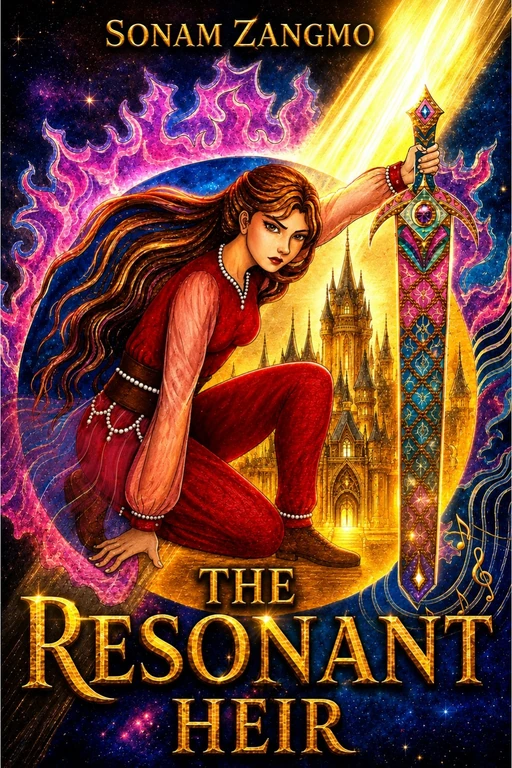
 Explore The Resonant HeirYA crossover royal fantasy · inherited magic · female heir · exile · adventure · Book I Complete
A Literary Commentary on Chapter Twenty-One of The Resonant Heir
The Fault Line Between Courage and Responsibility: A Philosophical Reading of The Broken Blade
On a life saved, a safeguard fractured, and the responsibilities that remain after an act of courage.
Spoiler Notice: Contains spoilers for Chapter Twenty-One.
Explore the nineteen themes in this commentary
- A Life Saved, a Land Put at Risk
- The Keystone Is Not a Decoration
- The Miners Beneath the Conversation
- A Debt Too Large for a Coin
- An Heir Who Cannot Command the Past
- When a Command Outlives Its Context
- When Both Steel and Magic Fail
- Listening for a Weakness Is Not Knowing Its Cost
- The Strike That Both Saves and Damages
- A Tremor Felt by People Who Were Not Asked
- An Incomplete Map and an Unfinished Claim
- “That Belongs to Gemariel.” “I Need It.”
- The Sword as a Record of a Former Self
- A Sapphire Still Shining in a Broken Hilt
- The Lord’s Attention Divides
- “Gemariel Broke Its Seal for You”
- Could She Hold an Alliance Together?
- Only Her Hands, and What She Chose
- Conclusion: Beyond the Blade
Theme 01 · Philosophical commentary
A Life Saved, a Land Put at Risk
At the center of Chapter Twenty-One of Sonam Zangmo’s The Resonant Heir, The Broken Blade, is an act that cannot be judged from only one point of view.
Lyra strikes the seam of the Ametrine while an ancient guardian threatens her and the High Lord of Gemariel. Her sword splits in two. The guardian ultimately vanishes. The High Lord survives. A strip of silk emerges from the stone and gives Lyra the first incomplete fragment of a route toward the Awakening Spring.
But the Ametrine has cracked, and it is not an ornamental treasure. According to the High Lord, it is the safeguard holding Gemariel’s extensive network of underground ore veins in stability.
The moment therefore gives the chapter three outcomes that refuse to fit comfortably together. A person is saved. A young girl moves closer to something she desperately seeks. A protective structure on which thousands may depend is damaged.
It would be easy to call Lyra heroic and end the discussion. It would be just as easy to condemn her for endangering a community whose workers never consented to the risk. Neither response is sufficient.
She acts amid immediate peril, with limited time and incomplete knowledge. Yet the potential consequences of her action extend far beyond the room where she makes it.
Courage is often measured by the danger a person faces. Responsibility also asks who else may bear the consequences of what that person does.
The chapter’s moral force lies in holding those questions together rather than choosing one to silence the other.
Theme 02 · Philosophical commentary
The Keystone Is Not a Decoration
On their carriage ride to the northeast tower, the High Lord finally explains the Ametrine’s function.
A lattice of ore veins runs beneath Gemariel. His ancestors sealed it within the tower to prevent the ground from tearing itself apart. He calls the Ametrine a keystone—the safeguard of the mining network.
That information changes the meaning of the previous chapter.
Vespergnaw’s gang attempted to steal the stone. Sion thought it might be worth an entire mine. Lyra noticed a seam between its colors and sensed something inside. None of those perspectives, taken alone, accounted for the role the object plays in the stability of the land.
The word keystone is not being used here to locate an architectural stone at the top of an arch. Its significance is established by the High Lord’s explanation of a protective role within an underground system.
The chapter is also careful about the evidence at this point. The High Lord describes the system, and Lyra takes his warning seriously; the narrative does not yet demonstrate every detail of how its magic or geology works.
Nevertheless, his explanation identifies a profound asymmetry of knowledge. One person can strike an object without realizing that other lives depend on its remaining intact.
An action can be intentional while its consequences are not, because the person acting does not understand the full structure she has touched.
That gap between local knowledge and systemic consequence will define the choice Lyra makes when the guardian appears.
Theme 03 · Philosophical commentary
The Miners Beneath the Conversation
The chapter opens over the mining valley: open shafts, turning wooden hoists, and thousands of workers pushing carts loaded with ore.
These details are not merely scenery. They supply the human scale of the High Lord’s warning.
A crack in an ancient safeguard might otherwise read as an abstract magical problem. Here the network is actively occupied. The people who work beneath the ground may be the first to suffer if the instability he fears develops into a collapse.
The reader has recently watched Lyra and Sion struggle to survive an unsupported mine shaft. Sion’s aunt died in an earlier collapse. Workers have been described as sick and coughing. The new threat expands an already established vulnerability from one tunnel to an entire network.
Yet precision matters. At the chapter’s end the Ametrine is cracked, the ground has shifted, and the High Lord fears a future earthquake. The narrative has not shown a total collapse of Gemariel or established that thousands have already been injured.
Its horror is prospective.
That prospect also reframes the difference between the High Lord and the people below. For him, the collapse would mean immeasurable loss to a territory he governs. For a miner inside the system, it could be a matter of breathing, escaping, or surviving at all.
A ruler’s responsibility begins when the lives beyond the immediate danger are allowed to count within it.
The miners do not speak in the tower. Their absence is precisely why they must not disappear from the ethical discussion.
Theme 04 · Philosophical commentary
A Debt Too Large for a Coin
Lyra’s first response to learning the stone’s importance is to ask whether the High Lord intends to charge her for damaging it.
The remark has the dry humor of a girl who has recently discovered how readily everything becomes a bill. After losing her money, she worked in the mine and chased a bounty because she needed resources to continue her journey.
It is understandable that compensation is the language immediately available to her.
The High Lord laughs and says Eryndar’s storm magic would punish him if he presented the princess with such a charge.
The exchange reveals two limits of the financial frame.
First, no sum of gold could make a failed safeguard harmless. If the mine network becomes unstable, restoration and the protection of workers will matter more urgently than a claim for reimbursement.
Second, Lyra’s birth still shapes how others treat her. A traveler without money may be asked to repay the cost of a bed; a recognized princess can be jokingly exempted from an enormous bill because her father is powerful.
That does not establish that the High Lord intends to forgive every consequence. His later concern about the seal demonstrates otherwise.
To be spared a financial penalty is not necessarily to be freed from moral responsibility.
The chapter invites Lyra, and the reader, to think beyond what can be repaid with gold.
Theme 05 · Philosophical commentary
An Heir Who Cannot Command the Past
At the tower, the High Lord confirms that the old ward has been broken. He examines the Ametrine and is relieved that it has not yet cracked.
He then attempts to draw out the unusual material Lyra noticed between its colors. A strand of light forms between his hands and the stone. A coil of silk begins to emerge, then stops, suspended in the air. Clouds darken the sky. The silk withdraws.
He decides they will need a mage.
Before they can leave, an ancient warrior manifests and declares that anyone who trespasses upon the relic without Aurelion’s permission will be punished.
The High Lord identifies Aurelion as his father.
The guardian does not recognize the statement as authority to let him pass.
This is an arresting image of inheritance without control. The High Lord appears to possess a relationship to the founder or custodian of the protection, but the guardian obeys a narrower command.
The story does not say whether it can reason like a person or whether it executes instructions without any discretion. Nor does it show exactly what would count as Aurelion’s permission.
What matters is the immediate failure of inherited standing to overrule the old restriction.
Being the child of the person who made a rule does not necessarily confer the ability to change how that rule is enforced.
Lyra, herself a royal heir wrestling with an inherited order, has every reason to encounter the problem as more than a magical curiosity.
Theme 06 · Philosophical commentary
When a Command Outlives Its Context
The guardian divides into three shadows and attacks. The High Lord ultimately uses a thumb ring to project ancient sigils that bind them together.
He issues a single command: kneel.
The guardian replies that it obeys only Aurelion, breaks free, and resumes the assault.
The command echoes the previous chapter. There, a soldier ordered Lyra and Sion to kneel before the High Lord. Sion complied, while Lyra remained standing. Now the High Lord himself faces something that refuses the authority of his voice.
The two refusals are not identical. Lyra is a young person whose action may combine royal protocol and personal defiance. The guardian may be bound by a preexisting magical condition.
Yet the repetition draws attention to a common limit: commands derive their force from relationships and rules that the speaker may not fully control.
An inherited protection can be valuable precisely because it resists being casually overridden. The same rigidity may become dangerous when a legitimate heir tries to inspect or repair it and cannot satisfy the original terms.
The chapter does not prove that the guardian is malfunctioning. For all we know, it may be performing the charge given to it perfectly.
That possibility makes the dilemma sharper.
A rule can continue doing exactly what it was designed to do long after people have lost the ability to determine whether doing so is still wise.
The novel’s recurring interest in ancient covenants and inherited obligations finds a new, physical form in the tower.
Theme 07 · Philosophical commentary
When Both Steel and Magic Fail
Lyra tries to fight the guardian with her sword. Her blade passes through it like smoke.
The High Lord conjures a blade of light and cuts through a shadow. For a heartbeat it divides, then closes around the wound as though nothing happened.
Neither ordinary steel nor magical force produces a lasting victory.
This is a useful challenge to the heroic assumption that an obstacle will yield once sufficient power is applied.
Lyra has spent years perfecting swordsmanship because she lacks the magic expected of a royal heir. The High Lord possesses the kind of magic and authority she does not. Yet both encounter a threat their preferred methods cannot defeat.
They move back to back.
That physical arrangement matters: one child, one adult ruler, different strengths, a shared vulnerability. Rank does not make the spear less dangerous to its target.
The High Lord is almost struck in the throat, and a narrow escape exposes the limits of his confidence.
The existence of power is not proof that one possesses the kind of power a particular problem requires.
Rather than resolve the encounter through greater force alone, the chapter redirects attention to sound, vibration, and an unexpected relationship between the guardian and Ametrine. Lyra’s breakthrough begins with noticing what her weapon cannot simply overpower.
Theme 08 · Philosophical commentary
Listening for a Weakness Is Not Knowing Its Cost
As the shadows spiral past Ametrine, a thin note sounds inside the tower.
Lyra’s scar pulses. Her sword trembles, carrying the sound along the steel into her arm. Each time a shadow moves near the crystal, the note returns and concentrates around the line separating violet from amber.
Lyra notices the pattern.
This is one of the chapter’s clearest demonstrations of intelligence in action. She pays attention to repeated events and identifies a specific point toward which the resonance is drawn.
But two very different kinds of understanding remain separated.
She has evidence that the seam matters in the present encounter. She does not fully understand what might happen to the ore veins beneath Gemariel if she strikes it.
The chapter gives sensory facts: vibration, sound, the pulsing scar, the blade responding, the note gathering at a point. It does not yet explain the underlying magical mechanism or establish that Lyra has consciously activated a new ability.
Readers should resist declaring the connection solved simply because the effects appear closely timed.
The philosophical issue is especially compelling because the insight is genuine while incomplete.
Finding the vulnerable point in a system is not the same as knowing every consequence of breaking it.
Lyra’s next decision will depend on what she can infer amid seconds of danger, not on the fully informed view that becomes possible only afterward.
Theme 09 · Philosophical commentary
The Strike That Both Saves and Damages
Lyra warns the High Lord to move. He does.
The shadow attacks again. She brings her sword down on the line between Ametrine’s colors.
The crystal cracks. The blade splits in two. A resonant sound surges through the tower and outward across the mines. The guardian kneels and dissolves. Silk falls to Lyra’s feet.
The event invites an uncomfortable question: was the strike justified?
We should begin with its context. The High Lord has narrowly escaped a lethal blow. The guardian cannot be stopped through the attacks already attempted. Lyra perceives a relationship between its movement and the stone’s seam. She has almost no time to test alternatives.
We should also acknowledge what she knows. She has been told that Ametrine protects the mining network. The risk is not completely unforeseeable, even though the precise results of a strike remain uncertain.
The text shows Lyra deliberately striking the seam in combat. It does not show her deciding in advance to jeopardize the town solely to obtain the silk map. The map emerges afterward.
The strike is followed by two facts that neither cancel the other: the High Lord survives, and the safeguard is damaged.
An action may be understandable—even courageous—under immediate threat without the harm it causes becoming morally irrelevant.
The story does not need to issue a final verdict. It needs us to consider how necessity, incomplete knowledge, intention, and responsibility intersect when there is no painless option.
Theme 10 · Philosophical commentary
A Tremor Felt by People Who Were Not Asked
After the crystal breaks, a low tone rolls from the tower across the mines. The ground shifts.
People nearby feel the movement but do not know its cause.
The detail is brief and politically significant.
The inhabitants of Gemariel have not participated in the tower confrontation. They do not know that an old guardian attacked, that a royal fugitive and their High Lord fought for their lives, or that a sword blow has left the mineral safeguard cracked.
Their experience begins with a tremor.
Such is the burden of protecting a land whose people depend upon the same buried network. Choices made within a tower can endanger miners far below, people who were neither present nor able to consent.
There was no time to seek the miners’ consent in the instant before a spectral spear struck. Their absence from the choice does not erase what they stand to lose.
The duty changes once the danger in the tower has passed.
Who will assess the risk? Who will repair the safeguard? Should workers be warned or protected while the seal remains compromised? Who is responsible for making those choices?
The chapter does not report that these measures have been carried out. It gives the High Lord a plan to summon mages and restore the seal before it fails completely.
The people who did not choose a risk still matter when its consequences reach them.
For a future ruler, recognizing that principle may be more demanding than recognizing when to draw a sword.
Theme 11 · Philosophical commentary
An Incomplete Map and an Unfinished Claim
The guardian vanishes, and a strip of silk slips from Ametrine.
Lyra recognizes a connection to the Awakening Spring. The High Lord studies the lines and sees that the map is incomplete. She agrees.
The reward is both substantial and limited.
Lyra has pursued the Awakening Spring because she hopes it will offer answers to the absence of magic that has shaped her life. She now holds a material clue rather than another rumor. But the silk is only a fragment, not directions sufficient to conclude her search.
Nor does the chapter establish that the map could have been retrieved only by cracking the stone, or that a greater plan deliberately required the damage.
A discovered route is not evidence that all events leading to it were inevitable or morally justified.
The incomplete map is an apt object for this stage of Lyra’s development. It offers progress without full comprehension, just as her perception of the resonance offered insight without certainty about its cost.
Gaining a piece of the path does not mean acquiring an answer to every question about how that piece was obtained.
Even as Lyra becomes more capable of finding what she seeks, the means of pursuing it remain open to scrutiny.
Theme 12 · Philosophical commentary
“That Belongs to Gemariel.” “I Need It.”
The High Lord recognizes the silk as a map, then objects when Lyra begins to put it away.
It belongs to Gemariel, he says.
She answers that she needs it.
There is force on both sides of the exchange.
The object was concealed in a relic that, according to the High Lord, safeguards the mining region and was sealed by his ancestors. He has reason to regard it as part of Gemariel’s protected inheritance.
Lyra has reason to believe it may guide her toward the Awakening Spring. Her need is not trivial to her future.
But need does not automatically confer ownership; nor does asserting ownership settle all questions about whether knowledge can be shared or how an artifact should be handled.
The chapter does not establish who is rightfully entitled to the silk, or whether removing it affects the protection independently of the crack already made. It does not resolve every aspect of consent between them.
When he catches her wrist, Lyra says she will explain on the way back.
That promise matters because the object has created a fresh imbalance in the exchange. She holds a clue he did not know was accessible; he governs the territory whose safeguard has been damaged.
Two claims can each deserve consideration without either claim being sufficient to end the conversation.
It is an unusually fitting lesson for an heir who may one day have to judge disputes between communities with interests that cannot simply be made identical.
Theme 13 · Philosophical commentary
The Sword as a Record of a Former Self
Lyra collects the broken halves of her sword.
The weapon has been with her since childhood. Before she learned to live without palace protection, she had used its training to answer the humiliating belief that an heir without magic must be weak.
The blade therefore represents more than practical defense. It carries years of effort, her relationship to her father, and a way of believing in her own value.
The High Lord earlier minimized the chip in the blade, suggesting that another could be forged in Igsvar. But at the end, the weapon is no longer merely chipped. Its steel has split completely.
Lyra senses a greater loss than a damaged possession.
Perhaps, she thinks, everything tied to the palace has truly reached an end.
The sentence is an emotional judgment, not a verified account of her status. Her parents still exist. Her royal lineage is still recognizable. The High Lord has even addressed her by her title throughout the chapter.
What has been broken is a durable symbol through which she recognized her former life.
The loss of an object can feel like the loss of a self when that object has carried the meaning of years.
A sympathetic reader need not instruct Lyra to stop grieving because a new sword may someday be available. Replacement and continuity are not always the same.
Theme 14 · Philosophical commentary
A Sapphire Still Shining in a Broken Hilt
As the carriage returns toward the Citadel, the High Lord watches Lyra raise the two pieces of her sword into the light.
The blade is severed, but the deep blue sapphire in its hilt still catches the sun.
The visual contrast is beautiful and exact.
The cutting edge has failed. The mark by which the High Lord identified Lyra as royal remains.
Two different kinds of identity coexist in the damaged weapon. One has been forged through training and practical use. The other refers to an inheritance Lyra did not choose.
Neither alone can tell the whole story of who she is.
A broken sword does not erase the people Lyra protected with it. It does not cancel her past efforts, or make the achievements of those years imaginary.
Likewise, the surviving sapphire does not guarantee that her future will simply repeat the life her family imagined for her.
The chapter stops short of saying that the gem’s survival has a particular magical significance. It does not need to.
When an instrument of strength breaks, the worth of the person who held it need not break with it.
The image invites a more demanding understanding of Lyra’s development. She may need new tools, but she will also need a definition of courage and worth that no single tool can entirely contain.
Theme 15 · Philosophical commentary
The Lord’s Attention Divides
The High Lord notices the grief in Lyra’s face as she regards the ruined weapon.
His concern, however, is directed toward Gemariel’s unstable underground safeguard. If an earthquake develops and the mining network collapses, the damage could be immense. He decides he must summon mages and repair the seal before its complete failure.
The contrast between their concerns could be read as coldness. It is more useful to see the difference in responsibility.
Lyra mourns an irreplaceable part of her personal history. That grief is real.
The High Lord governs a region where many people may be imperiled by the crack. His urgent duty is to prevent broader disaster.
Recognizing one person’s pain need not erase attention to a community. And duty to a community need not require indifference toward the individual beside him.
The two priorities exist simultaneously because the same event has injured different things.
One person may naturally attend first to what she has lost. Another may attend first to what others might still lose.
The moral horizon of leadership cannot end at the suffering closest to one’s eyes.
Yet a responsible ruler who sees the wider danger must still remember that the person holding the broken pieces has a life that matters beyond the danger facing Gemariel.
Theme 16 · Philosophical commentary
“Gemariel Broke Its Seal for You”
On the ride back, the High Lord jokes that sheltering Lyra may attract someone intent on killing him.
Then he tells her that when she finds the Awakening Spring, she should remember that Gemariel broke its seal for her.
Lyra promises not to forget the debt.
The exchange turns an emergency into a future relationship of obligation.
There is a legitimate basis for remembering what has occurred. The safeguard has suffered damage; the High Lord survived because Lyra acted; Lyra now carries an incomplete map. Neither character can pretend the event had no consequence.
Still, the lord’s formulation deserves careful reading.
Nothing in the chapter suggests that the people of Gemariel agreed to sacrifice their safeguard for Lyra’s benefit. The crack occurred during a dangerous confrontation. The people working below were unaware of it.
Saying that Gemariel broke its seal for her is therefore a politically meaningful way of narrating events, not evidence of voluntary collective sacrifice.
Nor does Lyra’s acknowledgment establish what she has agreed to do in the future. The debt has no defined amount, date, or terms in the chapter.
This matters because gratitude can turn into leverage when one person or institution claims the right to specify repayment.
A debt remembered in good faith is not the same thing as an unlimited obligation to obey whoever names it.
The novel has already explored troubling inherited obligations through Aulith’s covenant. Gemariel now presents a smaller, more personal version of the problem, whose eventual justice remains open.
Theme 17 · Philosophical commentary
Could She Hold an Alliance Together?
The High Lord knows that Lyra saved his life. He cannot simply blame her for the blow that allowed them to survive.
Nevertheless, watching the girl hold her broken sword, he wonders whether someone like her could hold a fragile alliance together.
That question is one of the chapter’s most important political judgments.
In earlier chapters, Lyra disrupted a marriage in defense of Elena’s ability to refuse it. That intervention addressed a real injustice but also shook arrangements others had counted on. In Gemariel, her decisive strike stops the guardian and is followed by damage to a safeguard that protects a wider population.
The situations are not identical. One concerns coercion and political marriage; the other is an immediate struggle for survival. Yet both put the heroine’s conscience and courage in relation to complex public consequences.
The High Lord does not pronounce her unworthy. He leaves the issue open.
And he is right to distinguish qualities that fantasy often merges. A person may be brave, compassionate, and skillful without already possessing the judgment required to maintain trust among people with conflicting interests.
That judgment cannot be measured by whether she always avoids harm. No ruler can promise that. It is tested by whether she can see harms clearly, explain choices honestly, and help repair what has been damaged.
A courageous act may save a life. Governing requires answering for the lives that were not in the room.
The chapter has not shown whether Lyra can meet that demand. It has shown why the demand matters.
Theme 18 · Philosophical commentary
Only Her Hands, and What She Chose
Near the end, the narrative reduces Lyra’s position to an image of independence.
She has no crown she can effectively rely upon, no ready supply of coin, and no honored name that will solve her journey. She has her own hands and what she chooses to do with them.
These lines need not be read as a literal statement that her legal title has vanished. The High Lord has recognized her; the sapphire still shines in the hilt.
They describe her sense of what must now carry her forward.
Across the recent chapters, those hands have held a pick, accepted Sion’s water, gripped a sword, protected a friend, and struck the Ametrine.
They have helped her survive. They have also helped create consequences she cannot entirely control.
That is the deeper meaning of agency in this passage.
Freedom is not an exemption from consequence. It is the condition of being able to act while recognizing that one’s actions may place obligations upon oneself and others.
The story should not be reduced to the claim that Lyra must suffer to become worthy. Suffering may teach her something, but it does not make dangerous conditions good.
What can make her journey meaningful is how she responds to what she learns.
The hands that choose are also the hands that may have to repair, acknowledge, or carry what their choices have changed.
The broken sword makes that responsibility visible, while the incomplete map ensures that the story must go on.
Theme 19 · Philosophical commentary
Conclusion: Beyond the Blade
The chapter ends with a promise from the High Lord. He knows where to find the master smith whom he had earlier mentioned in Igsvar.
The revelation offers hope, but not an instant repair. Lyra still holds a shattered weapon. Gemariel’s safeguard remains damaged. The route to the Awakening Spring is incomplete. The political meaning of her new debt is unresolved.
It is a fitting ending because it refuses to return every broken thing to its original state before the next adventure begins.
The High Lord has reason to be grateful. He has reason to be worried. Both feelings belong to the same event.
Lyra has reason to grieve the sword. She also has reason to recognize the lives potentially at risk because of the crack in Ametrine. Her courage is real, and the need for further judgment is real.
One day she may hold a different blade. The novel has not yet told us whether a smith can restore the old one or forge something entirely new.
But the most consequential development may not be the kind of weapon she carries next.
It may be the way she comes to understand what the weapon cannot do for her.
The blade can defend, threaten, or strike. It cannot ensure that every consequence of a necessary action is harmless. It cannot determine a fair debt, protect workers from an unstable mine, or hold an alliance together merely by being sharp.
Courage matters most not when it excuses responsibility, but when it remains willing to face what follows.
Lyra leaves the tower with the first fragment of a map and the broken halves of the sword that once defined her strength.
The sapphire in the hilt still catches the light.
She has not ceased to be who she was. But the journey ahead will ask her to become more than that.