
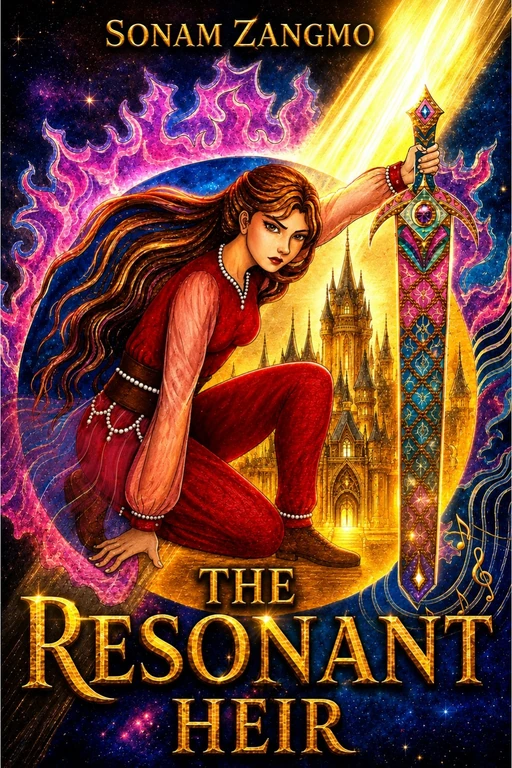
 Explore The Resonant HeirYA crossover royal fantasy · inherited magic · female heir · exile · adventure · Book I Complete
A Literary Commentary on Chapter Twenty of The Resonant Heir
What the Stones Reveal and Conceal: A Philosophical Reading of The Ametrine Keystone
On recognition without understanding, the power of hospitality, and the truths a princess must choose when to reveal.
Spoiler Notice: Contains spoilers for Chapter Twenty.
Explore the eighteen themes in this commentary
- Two Stones, Two Kinds of Knowledge
- Five Rings, and a Room Falls Silent
- Golden Plates Above a Mining Town
- Warm Milk, Real Kindness, Unequal Means
- One Girl Kneels; the Other Stands
- What Ten Gold Means to Two Different Lives
- A Feast That Has Never Been Ordinary
- A Kingdom Reduced to Colored Stones
- The Blade Has Already Spoken
- Inheritance That Travels in the Hand
- The Right Not to Give a Dinner Answer
- The Man Who Has Plenty of Dinners
- A Piece Taken Off the Board
- The Story a Princess Chooses to Tell
- Hospitality and the Unfinished Bargain
- Ametrine: Knowing the Name, Not the Whole Nature
- Tomorrow, Back to the Tower
- Conclusion: Recognition Is Not Understanding
Theme 01 · Philosophical commentary
Two Stones, Two Kinds of Knowledge
In Chapter Twenty of Sonam Zangmo’s The Resonant Heir, The Ametrine Keystone, two stones alter the course of a conversation.
The first is set in the hilt of Lyra’s sword. It allows the High Lord of Gemariel to recognize a royal identity the young traveler has tried not to disclose. The second is the Ametrine, the violet-and-brown stone in the northeast tower. Lyra has struck it with her blade and sensed that something lies inside. The High Lord knows its name. When he learns that she has hit it, his attention sharpens.
Neither character possesses all the knowledge the other might need. The High Lord knows what Lyra’s sword signifies and can identify an object she has only described. Lyra knows what happened at the tower and has experienced a response he has not yet explained.
Between those two revelations, the chapter asks a question more subtle than whether its powerful host is friend or foe: What does it mean to know someone—or something—when the evidence available to us reveals only part of the truth?
The High Lord offers real comforts. He also asks pointed questions. Lyra needs his help but cannot assume that every detail about her past is safe to share. The chapter’s tension grows not from a drawn sword but from the possibility that one answer might change the balance between them.
Lyra has just learned to survive through labor and combat. Now she faces another form of judgment: deciding what to say to someone who can read signs she did not know she was carrying.
Theme 02 · Philosophical commentary
Five Rings, and a Room Falls Silent
The High Lord enters our attention through an economical gesture. A soldier kneels to report Vespergnaw’s capture, and the lord raises one hand. Five rings catch the light. Music stops. The hall turns quiet.
He does not threaten the musicians or shout over the feast. He scarcely needs to speak.
The scene is an image of socially recognized authority. Power need not appear as force when everyone present already knows how to respond to its signals.
This authority is not, in itself, evidence of cruelty. Calling a crowded room to attention so that an urgent report can be heard is an ordinary act of governance. What matters is how effortlessly the room reorganizes itself around one individual.
The contrast with Lyra’s recent experience is striking. In the mine, her hands blistered around a pick. Work produced pain before it produced any income. In the Citadel, a jeweled hand can interrupt an entire gathering.
The images do not tell us that the High Lord has never labored, nor do they establish how his wealth was accumulated. They show the different ways effort and command appear at opposite ends of a social hierarchy.
The hand that must strike stone to earn a meal and the hand that can silence a banquet belong to the same human world, but they possess very different powers within it.
Lyra, who has lived on both sides of that contrast in a matter of days, is particularly well placed to notice it—even if she has not yet fully understood what it means.
Theme 03 · Philosophical commentary
Golden Plates Above a Mining Town
The Citadel’s feast gleams with abundance. Food covers golden plates; the air carries the richness of butter and honey.
Only two chapters earlier, Lyra stood among workers whose bodies bore the strain of mining. Sion spoke of poison, coughing families, and the aunt who had died when a shaft collapsed. These images now occupy the same geographical imagination as the lord’s sumptuous table.
It would be too simple to declare, from the banquet alone, that the High Lord personally caused the mine’s hazards. The novel has not shown who operates the shafts, sets their conditions, or receives their proceeds.
Nevertheless, juxtaposition creates a legitimate political question. What does prosperity mean when its visible grandeur exists alongside perilous work?
A ruler may display wealth without having demonstrated that the people who labor within the territory share in security or comfort.
The point is not that every sumptuous meal constitutes wrongdoing. It is that the splendor of a ruling household cannot serve as sufficient evidence for the health of the society around it.
A territory can look rich from its Citadel while remaining dangerous to the people whose working lives unfold below it.
For Lyra, the contrast is no longer abstract. She has known the comfort of royal dining and the exhaustion of trying to make a living in the mine. She carries both experiences into this room, where others may see only a princess unexpectedly returned to noble surroundings.
Theme 04 · Philosophical commentary
Warm Milk, Real Kindness, Unequal Means
The High Lord does not begin by interrogating the children. He has them taken to a side chamber and orders warm milk.
Sion drinks eagerly and falls asleep. Lyra remains standing, tired but guarded.
This hospitality deserves to be read fairly. Food, rest, and warmth are meaningful responses to the condition of two girls who have pursued a wanted thief through the night. We need not suspect a hidden trap in every decent gesture.
At the same time, the ease with which the High Lord provides these things reveals how differently he and his guests experience material need.
For him, help can be arranged through a brief command. For Lyra, acquiring food and shelter recently involved debt and the threatened loss of her horse. For Sion, even ordinary comforts have often required dangerous labor.
Generosity is valuable precisely because it changes someone’s immediate circumstances. But when access to necessities depends heavily on the choice of a powerful individual, the relationship is also asymmetrical.
That does not make the benefactor malicious. It means the guest may feel gratitude and vulnerability at once.
A kindness can be sincere without making the giver and receiver equally free.
The warmth of the milk does not erase the political circumstances of the visit. It allows them to unfold within a setting more complicated than simple hostility.
Theme 05 · Philosophical commentary
One Girl Kneels; the Other Stands
When the High Lord comes to meet the pair, a soldier orders them to kneel.
Sion obeys at once. Lyra does not move. Her fingers tighten around the hilt of her sword.
A lesser reading would call Sion submissive and Lyra courageous. The scene deserves more care.
Sion has spent years learning how to survive in environments where she has little formal authority. Kneeling may be customary respect, caution, or simply the safest response to an order. The narrative does not provide her private motive at that instant.
Lyra has been raised within a royal hierarchy in which High Lords are not her superiors in the same way. Her refusal may reflect learned protocol, pride, vigilance, or several of these together.
Two girls who have just shared danger respond differently to the same sentence because they have lived in different relationships to power.
The High Lord does not punish Lyra on the spot. He laughs and observes that her behavior helps explain how she caught Vespergnaw.
That response tells us he is observant. It does not yet prove that he has recognized her full identity at that precise moment; the sword provides the more explicit explanation later.
The freedom to remain standing is not felt equally by everyone who hears an order to kneel.
Rank is not merely what people know intellectually. It shapes the movements they perform before they have time to deliberate.
Theme 06 · Philosophical commentary
What Ten Gold Means to Two Different Lives
The High Lord asks what reward Lyra wants.
She does not ask for more than the wanted notice promised. She wants her horse redeemed. She wants the ability to leave Gemariel and continue her journey.
Sion’s answer is different. She smiles and admits that a little more would be welcome.
The contrast could be mistaken for one girl’s virtue and the other’s greed. It is better understood through their circumstances.
For Lyra, money has a specific instrumental purpose: recovering mobility. She does not need to remain in Gemariel to accumulate a fortune. She needs the means to depart.
For Sion, who has mined for years, unexpected wealth may mean opportunities and pleasures she has rarely possessed. Wanting more does not make her morally lesser.
The High Lord orders ten gold for Sion and offers to arrange the redemption of Lyra’s horse. Those are distinct benefits; the chapter does not establish that both girls receive identical cash payments, or allow us to calculate the comparative value of the arrangements.
This distinction matters because rewards do not become equivalent merely by being described as generous.
The value of a gift depends not only on its price but on the freedom it creates for the person receiving it.
Lyra wants a road. Sion may want the chance to enjoy something beyond the necessities of work. Both desires are intelligible, and neither requires apology.
Theme 07 · Philosophical commentary
A Feast That Has Never Been Ordinary
Sion later sits with food in both hands, eating chicken, cake, and berries with undisguised pleasure.
She says it is the first time in her life she has eaten like this.
The line changes how we look at the banquet. For its host, the abundance is a setting for conversation and ceremony. For Sion, it is an extraordinary event.
This is one of the quieter ways the novel makes inequality visible: not through a numerical inventory of wealth, but through the different emotional meanings of the same meal.
For Lyra in the palace, plentiful food was part of the expected fabric of daily life. Sion has worked through a long, dangerous childhood without that expectation.
Her delight is neither proof of foolishness nor something the reader must condemn. She has helped capture the gang; she has received a reward; she can enjoy the food before her.
Yet the meal should not be mistaken for the resolution of her material condition. The chapter does not tell us that her new coins will guarantee lasting security, or that the risks faced by other miners have been addressed.
A ruler’s generosity can create genuine happiness. It cannot, through one feast alone, settle the question of what conditions await people when they return to work.
The same table may be routine to the powerful and unforgettable to someone who has never been invited to it.
The difference matters not because joy is suspect, but because joy reveals what has so long been out of reach.
Theme 08 · Philosophical commentary
A Kingdom Reduced to Colored Stones
In another chamber, the High Lord shows Lyra a map of the kingdom rendered in gemstones. Different colors stand for the various fae clans.
It is a beautiful instrument of understanding. A ruler needs ways to imagine territory, relationships, and political divisions beyond what any single journey could reveal.
But every map is also a reduction.
A stone can represent a clan’s position without showing its harvest failures, old resentments, family histories, or the people who carry its obligations. A shining marker cannot contain the experience of Elena under pressure to marry, or the material costs imposed by inherited agreements.
The map therefore has two functions in the philosophical structure of the chapter. It conveys the reach of the High Lord’s knowledge while reminding us how much lived reality escapes a model.
This is not a criticism of cartography itself. The problem arises when the clear arrangement of symbols tempts those who govern to confuse representation with comprehension.
Lyra has recently learned what a mining town feels like from inside a dangerous shaft. A gemstone map would not have shown her the dust in Sion’s lungs or the unsupported ceiling.
To locate people on a map is not yet to know what living there requires of them.
The chapter’s stones repeatedly carry meanings beyond their surfaces. The map makes that pattern political: even accurate symbols leave something essential outside the frame.
Theme 09 · Philosophical commentary
The Blade Has Already Spoken
Lyra tells the High Lord that she comes from Thrudor. When he asks about her parents, she tries to dismiss the question.
He replies that the blade has already told him.
He points to the stone embedded in its hilt. According to him, only three such stones belong to swords in Tharion: one associated with Aethrador, one with Eryndar, and the third now carried by Lyra.
The sword has protected her, helped her capture Vespergnaw, and sustained her sense of competence when her magic was absent. Now it reveals what she would rather conceal.
The moment is a study in involuntary disclosure.
Lyra has not publicly introduced herself as heir. She has not chosen to offer a family history. Yet a knowledgeable observer can infer her identity from something she carries for entirely practical reasons.
Her answer—she is the princess—comes after the High Lord has already assembled the evidence.
This does not prove that every detail of his account of the three swords has been independently verified. It does demonstrate that he possesses an interpretive key Lyra did not expect him to use.
A person can control what she says without controlling everything another person is able to learn about her.
For someone in hiding, that difference can be dangerous. The things that keep us safe in one situation may make us recognizable in another.
Theme 10 · Philosophical commentary
Inheritance That Travels in the Hand
The sword creates a link across Aethrador, Eryndar, and Lyra.
Those names encompass the old kingdom, the present reign, and the heir whose future remains uncertain. Lyra has left the palace, hidden her title, worked in a mine, and fought for the chance to redeem a horse. Yet the dynasty’s history has traveled with her.
The detail resonates because the blade was chipped in the preceding chapter. Its fighting edge now bears damage from Lyra’s own action. The identifying stone remains.
We should not turn that juxtaposition into a claim about a concealed magical mechanism. Its significance is readily available on the human level.
One part of the weapon records what Lyra has recently done. Another part tells a stranger where she comes from.
Achievement and inheritance coexist in the same object.
The former is made through effort and sometimes leaves scars. The latter arrives before a person has chosen anything at all.
Lyra’s development cannot consist simply in denying either part. Her heritage can offer tools and obligations, while her actions determine what she does with them.
But the chapter reminds her that other people may continue to interpret her through her heritage before they know the life she has actually lived.
A person may leave an institution behind without becoming invisible to the signs by which that institution has marked her.
That is one of the uncomfortable conditions of Lyra’s attempted anonymity.
Theme 11 · Philosophical commentary
The Right Not to Give a Dinner Answer
Once her identity is known, the High Lord asks what brings her to Gemariel.
Lyra considers the implications of telling him about the interrupted wedding and the attempt on her life. She does not know enough about his interests to judge what he might do with such information.
So she holds back.
Some things, she says, do not fit into a dinner answer.
The phrase is poised between courtesy and refusal. She does not deny that there is a story. She declines to compress it into the account a powerful stranger has requested.
This is a meaningful change for a girl who has often demanded explanations from adults and rushed toward the truth when it was withheld from her.
Now she discovers the other side of disclosure: possessing information and deciding when another person should receive it are separate responsibilities.
Her caution does not prove that every past silence by her parents or advisers was justified. Adults can withhold truth for selfish reasons, and secrecy may protect wrongdoing.
But Lyra’s circumstances give her a substantial reason to protect herself. She has recently survived an armed intrusion and does not know whether the High Lord will be a friend.
Privacy is not always a refusal of truth. Sometimes it is the effort to retain agency over how and when one’s own experiences are told.
The ethical question is not whether all secrets are good or bad, but what the secrecy protects, whom it harms, and how much the listener is entitled to demand.
Theme 12 · Philosophical commentary
The Man Who Has Plenty of Dinners
The High Lord answers Lyra’s refusal with a smile. He has a whole Citadel, he reminds her, and plenty of dinners.
It is a charming line, and it can be read as patience. He is not forcing the complete story out of her at once.
But the remark also reveals something about the resources available to him.
He can make room for another meal, another conversation, another day of inquiry. His home is secure. Food is plentiful. Time is something he can afford to extend.
Lyra has a different relationship to time. She has left home under threat, hopes to continue her search for the Awakening Spring, and needs to decide how long it is safe to remain.
The difference need not make the High Lord manipulative. It is simply an asymmetry that shapes the conversation whether or not he intends to exploit it.
To the host, several dinners may be an effortless gesture of hospitality. To the guest, several days may mean postponed travel and further exposure to questions she cannot yet answer.
Time itself can become a form of advantage when one person can comfortably wait and the other cannot.
The High Lord’s composure is attractive. It is also one more reminder that the two participants have different margins of freedom.
Theme 13 · Philosophical commentary
A Piece Taken Off the Board
Looking at a princess who has arrived alone, without escort or money, the High Lord suggests that someone has wanted a piece removed from the board.
The metaphor recalls Syveris’s question in Beyond the Crown’s Reach: who has been playing on his board without permission?
The likeness in language is striking. It is not evidence that the High Lord and Syveris share a scheme, or that the former knows the identity of Lyra’s attackers.
Rather, it suggests a recurring political imagination. People become pieces. Their movements can be assessed through placement, advantage, and removal.
The metaphor is useful for understanding strategy. It is less adequate for conveying the life of the person who has been moved.
For a strategist, a princess without an escort may signify a change in the balance of power. For Lyra, exile has meant hunger, a stolen or missing coin pouch, a dangerous mine, a new friendship, and the uncertainty of whether she can safely return home.
The High Lord’s interpretation may be perceptive without being complete.
He also asks why King Eryndar is not looking for her. Readers know that Eryndar sought the Oracles and saw Lyra in their mirror. That does not establish that a public search has begun, but it does show the lord’s question contains an assumption that is not the whole truth.
Political inference can be sharp and still mistaken about the private actions or feelings of those it reduces to pieces.
Lyra has lived the cost of being such a piece. The reader must remember the person behind the metaphor.
Theme 14 · Philosophical commentary
The Story a Princess Chooses to Tell
Eventually Lyra offers a brief explanation. She says she broke the marriage pact with Aulith, and afterward someone tried to kill her.
These are revealing sentences partly because of what they leave out.
In The Ceremony Unmade, Lyra interrupted the wedding and defended Elena’s chance to refuse. Elena herself made the decisive declaration that she would not marry Luca.
Lyra’s summary captures her own intervention and the consequences she associates with it. It does not mean Elena’s agency has disappeared from the underlying event.
The assassination attempt is real as a threat Lyra has survived. Its full organization remains uncertain. Luca has spoken in a deeply incriminating manner in a subsequent scene, but the novel has not yet provided a complete account of who ordered every part of the attempt.
Lyra tells the High Lord enough to explain why she might be in danger. She does not rehearse every name she suspects or every possibility she fears.
A story told under pressure often becomes a compressed account shaped by the speaker’s needs. Compression is not automatically dishonesty. It can nevertheless leave out morally important participants and causal distinctions.
A truthful account of one’s own role may still be incomplete as an account of everything that happened.
The High Lord’s task as listener is to recognize that the first telling of a dangerous experience is rarely the final one.
Theme 15 · Philosophical commentary
Hospitality and the Unfinished Bargain
The High Lord promises to have Lyra’s horse redeemed and asks her to stay several days. He has questions.
The offer is meaningful. The horse represents the mobility she lost in Gemariel and the possibility of resuming her journey. A room, clean clothes, food, and practical help can make an enormous difference.
Nothing in the chapter establishes that the High Lord has imprisoned her or forbidden her to leave. It would be unfair to describe the invitation as proven coercion.
Yet hospitality does not erase dependence.
He controls the immediate surroundings and can provide resources Lyra lacks. She controls information about why she fled and what she discovered. Neither participant is wholly powerless, but their advantages are not equal.
The question of trust becomes especially subtle when a host gives something valuable before asking for sensitive knowledge. Gratitude can be entirely sincere while making refusal feel harder.
That is why the chapter’s moral interest lies not in proving that the High Lord is secretly malicious, but in showing how unequal bargaining positions may arise within courteous exchanges.
He may be an ally. He may have interests Lyra does not understand. The evidence does not yet allow a final verdict.
The presence of kindness should not make us blind to unequal leverage, just as the presence of leverage should not make us deny kindness.
Lyra’s growing judgment consists partly in learning to hold both possibilities in view.
Theme 16 · Philosophical commentary
Ametrine: Knowing the Name, Not the Whole Nature
The decisive shift comes when Lyra describes the tower where she encountered Vespergnaw.
The High Lord recognizes the place: the northeast tower. He also supplies a name for the large two-colored stone: Ametrine.
Lyra confirms that she struck it by accident. She tells him she sensed something within.
His reaction changes. He asks whether she struck it, and his attention fixes on her answer.
The contrast with the sword’s hilt is elegant.
The High Lord interpreted the mark on Lyra’s weapon and identified her. Now Lyra’s account of a mark upon Ametrine unsettles a man who knows the stone by name and location.
She has encountered something physically. He possesses a different kind of knowledge about it. The chapter ends before those forms of knowledge can be reconciled.
The word keystone in the chapter’s title need not be interpreted as an architectural object placed at the apex of an arch. Nor has the story established that Ametrine seals a throne, powers a protective system, or contains a particular magical being.
Those claims would give the mystery answers it has not supplied.
What is established is enough: the object has a name, an unusual form, a guarded location, a striking reaction to Lyra’s sword, and significance to the High Lord that he has not explained.
Knowing the name of a thing can help us recognize it. It does not mean we understand everything it is or does.
The chapter leaves that difference exposed like the seam between Ametrine’s two colors.
Theme 17 · Philosophical commentary
Tomorrow, Back to the Tower
The High Lord’s final instruction is direct. Tomorrow, Lyra is to take him to the tower.
The meeting has changed direction.
Lyra came to the Citadel as one of the captors of a wanted gang, seeking the reward that could restore her horse. She is now a guest whose royal identity has been recognized, and the person who can guide the High Lord toward a troubling discovery.
He retains greater command of the Citadel and its resources. But Lyra is no longer merely the recipient of his generosity.
She has seen and felt something about Ametrine that matters to him.
That does not put the two on equal footing or guarantee that the knowledge protects her. Information becomes useful only in relation to what others know, believe, need, and are willing to do.
Still, it gives Lyra a voice in a conversation whose terms once appeared to belong almost entirely to her host.
The plan to return to the tower is also a restrained ending. No hidden mechanism is revealed. No alliance is formally declared. The High Lord has not been unmasked as either a friend or an enemy.
What changes is the urgency of inquiry.
The man who could identify a princess from her sword now needs the princess to show him what her sword has done.
Their knowledge intersects without becoming complete. The next step will require them to stand before the object rather than rely on the stories they can tell about it.
Theme 18 · Philosophical commentary
Conclusion: Recognition Is Not Understanding
The Ametrine Keystone contains almost no combat, yet it places Lyra in a demanding confrontation.
The High Lord can quiet a feast with one gesture. He can feed exhausted children, distribute rewards, provide shelter, and recognize a royal blade. His wealth and knowledge allow him to act with ease where Lyra and Sion have struggled simply to obtain necessities.
These powers do not prove that he is unjust. His kindness is visible. So is the imbalance of resources and information through which that kindness is offered.
Lyra cannot safely tell him everything. Her sword, however, reveals something she had intended to keep hidden. She must distinguish between a person’s curiosity and entitlement to her story, between accepting help and surrendering every choice about what comes next.
Sion’s joy at an abundant meal reminds readers that privilege is not merely a political status. It is also the ease of assuming food, time, and safety will be there when needed.
The map of clans rendered in gemstones reminds us that knowledge of a territory is not knowledge of every life within it.
Finally, the Ametrine reminds us that even an object whose name is known can retain a mystery at its center.
The chapter resists two easy conclusions. It does not demand that Lyra distrust everyone who offers assistance. Nor does it suggest that hospitality is sufficient reason to disclose every dangerous truth.
To be recognized is not necessarily to be understood. To receive generosity is not necessarily to become free of dependence. And to know a name is not necessarily to know what lies beneath its surface.
Lyra arrived hoping to claim a reward. The High Lord can help her with that need, but he also sees the princess she has tried to conceal.
In return, she has witnessed something he urgently wants to understand.
Tomorrow they will go back to the tower together.
For now, each holds a piece of the truth. Neither holds it all.