
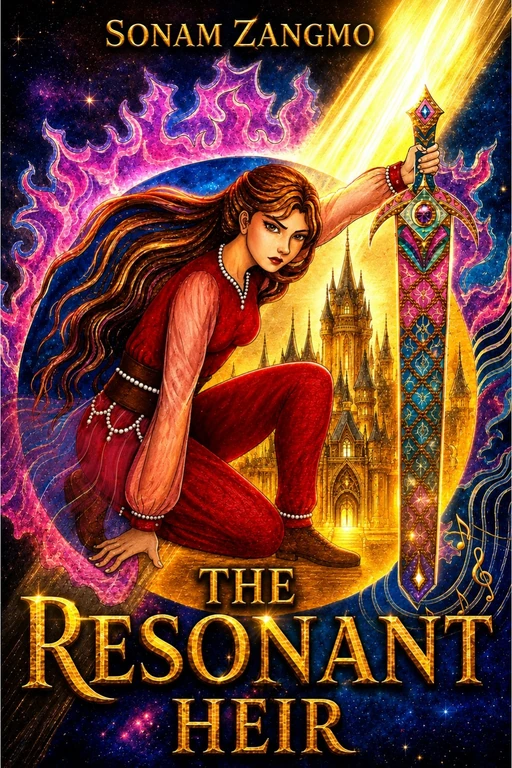
 Explore The Resonant HeirYA crossover royal fantasy · inherited magic · female heir · exile · adventure · Book I Complete
A Literary Commentary on Chapter Twenty-Four of The Resonant Heir
The Danger of an Easy Answer: A Philosophical Reading of The Bridge of Fire
On the weight of a warning, the courage to turn back, and the lives we entrust to one another above the flames.
Spoiler Notice: Contains spoilers for Chapter Twenty-Four.
Explore the nineteen themes in this commentary
- The Weight Hidden in a Single Word
- A Shattered Crown That Promises No Mercy
- Listening to the Mountain Before Moving
- Balance Is a Form of Courage
- The Heart of Fire Is Cold
- The Little Cake Lost to the Flames
- The Quest Is Complete Before the Crisis Begins
- “No.” The Danger of an Easy Answer
- Mistaking Another Person’s Survival for Safety
- Nathan’s Warning and the Burden of Rank
- A Higher Wall Is Not the Same Bridge
- The Warning That Arrives After the First Step
- When the Bridge Burns, Blame Is Not Simple
- She Has the Emberheart. She Could Leave.
- “No More Thinking” Is Not the End of Responsibility
- A Rescue That Does Not End at the Edge
- The Rescued Becomes the Protector
- The Riders Who Answer the Signal
- Conclusion: The Mountain Does Not Care. The People Do.
Theme 01 · Philosophical commentary
The Weight Hidden in a Single Word
A girl crosses a bridge over a sea of fire. She reads the mountain’s violent rhythm, nearly loses her footing, and crawls to safety with a shard of Emberheart in her pouch. Two strangers arrive and ask whether the crossing is difficult.
She answers no.
In Chapter Twenty-Four of Sonam Zangmo’s The Resonant Heir, The Bridge of Fire, the most revealing moment may be neither the blaze that consumes the ropes nor the rescue that follows. It may be this short reply, spoken by someone who knows how close she came to dying.
Lyra later risks her life to save Caelor when he falls with the collapsing bridge. Her intervention is brave, costly, and genuinely protective. But her first answer to his question leaves him with a far gentler picture of the crossing than the reader has been shown.
The chapter does not establish that she wishes him harm. Caelor has his own judgment, and Nathan explicitly urges caution. Nor can we know that a more honest warning would certainly have changed his choice.
Still, Lyra possesses knowledge Caelor lacks. What she says about the danger matters.
Courage may bring a person safely through an ordeal. Responsibility asks what that survivor owes the next person approaching it.
The moral difficulty is not solved by choosing whether Lyra is a hero or a fool. She is capable of insight, care, haste, understatement, and sacrifice. The story becomes richer when we allow those qualities to belong to the same person.
Theme 02 · Philosophical commentary
A Shattered Crown That Promises No Mercy
The Dead Crown appears as a vast hollow of fire encircled by black, jagged peaks. Their broken outline resembles a shattered crown. At its center rises a basalt pillar, and on the pillar glow the Emberhearts.
The imagery is particularly apt for Lyra. She has left the palace and buried the broken sword that once helped define her place within a royal family. She now faces a landscape whose very name evokes damaged sovereignty.
That resemblance is a literary interpretation, not a revelation about the mountain’s origins. The chapter provides no evidence that the Dead Crown is bound by magic to Lyra’s lineage, or that it knows why she has come.
The mountain does not welcome the worthy and turn away the unworthy. Its lava rises in bursts. Heat makes the bridge dangerous. A fall means death regardless of the traveler’s intentions.
That indifference matters in a fantasy world where other places and objects may possess strange wills. Here, the writing gives us force and peril without confirming a judging intelligence behind them.
A good purpose cannot make a dangerous place harmless.
Lyra seeks the means to defend the weak. Caelor seeks Emberheart for reasons the chapter does not reveal. Nathan accompanies his lord. Whatever moral differences may exist between them, the same fire threatens their lives.
The crater offers no verdict on which desire deserves to be fulfilled.
Theme 03 · Philosophical commentary
Listening to the Mountain Before Moving
Lyra does not rush onto the bridge as soon as she sees it.
She sits upon a warm rock and watches the eruptions. Columns of lava rise and subside, and the roaring is interrupted by moments of quiet. She counts the cycles, searching for a rhythm she can use.
This careful pause gives a needed complication to her character.
In the previous chapter, Lyra accepted Bramor’s perilous condition with unsettling speed. She brushed past Sion’s objections and rode away determined to prove that she had the nerve.
At the Dead Crown, however, she is capable of genuine patience.
She studies what the danger does before deciding when to enter it. She does not possess magic that can still the mountain. She has attention, judgment, and the willingness to wait.
The scene recalls her perception of the strange notes gathering near Ametrine’s seam in The Broken Blade. Both moments show Lyra noticing a pattern that more obvious displays of power might overlook.
Yet the knowledge remains partial. Counting several eruptions does not tell her everything that might happen later. The mountain may have rhythms without being safely predictable.
To recognize a pattern in danger is not the same as possessing mastery over it.
This distinction will matter immensely when Caelor mistakes the fact that Lyra survived for evidence that the bridge offers little difficulty.
Theme 04 · Philosophical commentary
Balance Is a Form of Courage
The crossing itself is an exercise in adjustments.
The boards creak. The ropes pull taut. Heat burns through Lyra’s boots. When the bridge tilts left, she shifts her body right; when it tips right, she corrects herself the other way.
She moves with her center low, stopping to let the bridge settle.
This is not the fantasy of a heroine conquering danger through sheer force. She cannot strike the lava with a sword or order the ropes to remain still. She must accept the bridge’s movement and respond with care.
Then she makes a mistake. She steps out of rhythm.
The bridge lurches. Fire rises. Lyra lowers herself onto her knees and hands, close enough to the heated planks that the wood itself burns beneath her.
She tries to hurry, and the bridge jerks violently once more. Her footing slips. Again she must lower herself and crawl.
The scene distinguishes understanding from maintaining discipline under pressure. Lyra has discovered the safer manner of proceeding, but heat, fear, and impatience make that method difficult to sustain.
Wisdom is not merely knowing the careful step. It is continuing to take it when every frightened impulse urges a faster one.
Her survival does not make her mistakes disappear. It shows how much thought and bodily effort lie behind the result Caelor will soon see from the crater’s edge.
Theme 05 · Philosophical commentary
The Heart of Fire Is Cold
On the basalt pillar, Lyra discovers an unexpected truth about Emberheart.
The crystal glows red, like flame trapped in stone. Yet when she touches it, the sensation is not scorching heat. It is a cold so deep it feels like winter water entering her skin.
The contradiction is striking because everything around the stone insists upon fire: lava below, burning planks behind, and air almost too hot to breathe.
Appearance has led the traveler to expect one experience. Contact reveals another.
The image can invite reflection upon Lyra’s own history. People have long judged her by the absence of an aura, treating that visible lack as proof of weakness. But the qualities they cannot see at a glance—attention, skill, loyalty, and resolve—are part of who she is.
This connection is symbolic rather than a claim that Emberheart has been designed to mirror the heroine. Its nature remains unexplained.
The chapter also makes a practical distinction easy to miss. Lyra does not remove an entire Emberheart from the pillar. She breaks off a small shard and places it in her pouch.
We do not yet know whether Bramor will accept that fragment as satisfying his demand.
What something seems to be can guide our first expectation without settling what it truly is.
The little red shard is tangible progress, not proof that every question about the stone or the smith’s condition has been answered.
Theme 06 · Philosophical commentary
The Little Cake Lost to the Flames
When the bridge throws Lyra off balance, the pouch at her hip comes loose. The cake Orin gave her before she left the forge tumbles out and falls into the lava.
She watches it disappear and regrets the trouble he went to preparing it.
In a scene dominated by mortal danger, the loss is small enough to seem almost comical. Lyra has nearly fallen into the fire herself, and she pauses to mourn a piece of breakfast.
But the cake is not only food.
It is evidence of a young boy’s consideration. Orin brought it as Lyra departed for an uncertain journey, just as he had earlier offered honey cakes and warm water when she and Sion waited outside Bramor’s forge.
The object connects this hostile landscape to a human kindness far away from the crater.
We need not claim that the cake carries a secret spell, foretells a sacrifice, or represents a destined relationship. Nothing in the chapter requires such a reading.
Its emotional significance is sufficient.
Lyra cannot save it; she must return her attention to survival. But she can still care that it was lost.
Small gifts do not cease to matter merely because a life is threatened by something larger.
The moment reminds us that the girl crossing the bridge is not simply a seeker of enchanted materials. She is also someone who remembers another person’s effort on her behalf.
Theme 07 · Philosophical commentary
The Quest Is Complete Before the Crisis Begins
Lyra reaches the cliff again, climbs off the bridge, and hurries away from the edge. She checks her pouch and finds the shard still there.
She has escaped.
The distinction is essential to the chapter’s structure. The main danger that follows is not required for her immediate goal of obtaining the material. She has already brought a fragment of Emberheart back across the bridge.
Whether that fragment will be sufficient for Bramor is still unknown. But Lyra has accomplished the dangerous crossing and regained the chance to leave the Dead Crown.
Then she encounters Caelor and Nathan at the entrance.
This interruption creates an ethical choice separate from the original quest. The lives of these strangers are not part of the bargain she struck with the smith. Her need for a new weapon does not require her to rescue them, and their identities offer her no established reward.
The story has placed success within her reach before bringing another person’s peril into view.
That order allows us to distinguish what Lyra came for from what she later chooses to do.
An act of compassion becomes particularly revealing when it interrupts a course of action the compassionate person could safely continue.
The second half of the chapter is therefore not simply another obstacle on the road to Bramor. It is a new test of what Lyra does when her own need no longer explains why she must remain.
Theme 08 · Philosophical commentary
“No.” The Danger of an Easy Answer
Caelor points toward the basalt pillar and asks whether the bridge is difficult.
Lyra answers no, then adds that he should be careful.
It is one of the most unsettling exchanges in the chapter because the reader knows how misleading the first word may be.
We have watched Lyra count eruptions, struggle against the bridge’s sway, burn her hand on the rope, make mistakes, crawl along hot planks, and narrowly regain solid ground. She herself has acknowledged how close the escape was.
Now the traveler who possesses that experience offers almost none of it to the newcomer.
There is no proof of deliberate malice. The narrator does not tell us whether Lyra wants to sound fearless, has begun to minimize her own ordeal, or simply assumes that Caelor will understand the danger.
Nor does the text establish that he acts solely because of her reply. Nathan raises his own objections, and Caelor dismisses them.
But Lyra knows something important, and her answer does not communicate it.
A statement need not be spoken with harmful intent to leave another person dangerously misinformed.
This is a more demanding measure of responsibility than judging only whether the speaker meant well.
Lyra’s later rescue does not erase this earlier moment. Her early understatement and subsequent self-sacrifice belong to the same moral story.
Theme 09 · Philosophical commentary
Mistaking Another Person’s Survival for Safety
Caelor looks at the bridge and takes confidence from Lyra’s success.
She made it across, he says in effect. Why should he not do the same?
The conclusion is tempting because a visible result feels like evidence that the task is manageable.
What Caelor cannot see is everything Lyra did to reach that result: her study of the eruptions, her shifting weight, the moments when she stopped, her burns, and the frightening mistakes from which she recovered.
He has seen the survivor, not the full ordeal.
This is one of the chapter’s clearest observations about the limits of learning from example.
A person may witness someone accomplish something dangerous and mistakenly assume that the accomplishment required little preparation. Even the successful traveler may struggle to explain how narrow the margin was.
Yet Caelor also has his own agency. Lyra’s answer does not compel his feet onto the planks.
Another person’s success can show that a feat is possible without proving that it is safe for whoever attempts it next.
The lesson extends beyond one bridge. It concerns the way people interpret strength in others: they see the completed deed and fail to see the vulnerabilities that accompanied it.
Caelor’s confidence rests upon a victory he does not fully understand.
Theme 10 · Philosophical commentary
Nathan’s Warning and the Burden of Rank
Before Caelor steps onto the bridge, Nathan suggests that they observe it first.
Caelor brushes aside the caution.
Nathan addresses him as “my lord,” and follows a half step behind. The terms and movements suggest a relationship marked by rank, although the chapter does not establish Nathan’s precise office or Caelor’s wider title.
The exchange resembles the one between Sion and Lyra in Into the Dead Crown.
Sion warned Lyra that she did not know what awaited her in the volcano and that going alone might kill her. Lyra decided to go anyway.
Now Nathan urges patience before a dangerous crossing, and Caelor advances.
The situations are not identical. Lyra made her journey without requiring Sion to follow her. Caelor takes his companion onto a bridge where both can be harmed.
What links the scenes is the challenge of hearing a warning from someone who may not possess equal authority.
The person entitled to make the decision is not necessarily the person who has noticed the risk most clearly.
A companion’s dissent may protect both the one who speaks and the one addressed.
Authority may give someone the right to decide without granting him a clearer view of danger.
For Lyra, a possible future ruler, the parallel is especially significant. Her own impatience with Sion is echoed in a young lord whose confidence places Nathan as well as himself in peril.
Theme 11 · Philosophical commentary
A Higher Wall Is Not the Same Bridge
Caelor insists that it is only a bridge; he has climbed walls higher than this one.
He invokes an achievement he knows to justify a new risk.
There is nothing inherently foolish about drawing on past experience. Confidence often grows from difficulties already overcome. The error lies in assuming that familiar skills answer every feature of an unfamiliar challenge.
A wall may require balance and courage. It does not necessarily sway above lava, burn the hand that grips it, or lose its ropes when a fiery surge passes overhead.
The danger of the Dead Crown is not measured only by height.
Caelor underestimates the difference between the obstacle he knows and the one before him.
The observation does not entitle us to declare him a cruel or arrogant person in every part of his life. We have only just met him. In this moment, however, he makes a boast that substitutes a narrow comparison for fuller observation.
And Nathan must share the result.
Experience becomes less useful when it teaches us to expect every new danger to resemble the last one we survived.
This is another point of contact with Lyra’s own story. Her swordsmanship has often served her well, yet the ancient guardian of Ametrine could not be defeated by ordinary attacks.
Having strength is not the same as knowing what kind of strength a new danger demands.
Theme 12 · Philosophical commentary
The Warning That Arrives After the First Step
Once Caelor and Nathan are well onto the bridge, Lyra notices the mountain’s rumble and recognizes the threat gathering beneath them.
She calls for them to wait.
Then she shouts for them to turn back.
As the bridge begins to sway harder, she tells them to get low.
The progression matters. Lyra is not indifferent to what she sees. The moment she recognizes the next danger, she attempts to help.
And the instructions are grounded in her own crossing. Lowering her body toward the planks had helped her regain balance when the bridge lurched.
But her useful knowledge is now being delivered in the midst of an unfolding crisis.
The difference between warning before someone enters danger and instructing that person while trapped within it is painful and practical.
An earlier explanation of the eruptions and the swaying bridge might have affected Caelor’s decision or preparation. The text cannot tell us whether he would have listened; he has already rejected Nathan’s advice.
Still, the uncertainty about the outcome does not make the timing irrelevant.
A warning can be true, generous, and too late to prevent the danger it describes.
Lyra is learning more than the challenge of crossing a deadly bridge. She is encountering the responsibility that comes from knowing what another traveler has not yet learned.
Theme 13 · Philosophical commentary
When the Bridge Burns, Blame Is Not Simple
The men turn toward safety, but the bridge’s motion throws them off balance.
Nathan reaches solid rock. Caelor is less fortunate.
A fierce surge sends heat across the bridge, the ropes catch fire, and the middle collapses. Caelor clings to a plank above the lava.
The catastrophe invites a search for the one decision that caused it.
Lyra understated the danger. Caelor ignored Nathan. Nathan followed despite his misgivings. The mountain erupted.
Each belongs to the chain of events, but the narrative does not license a simple verdict that one person alone made the bridge fail.
Nor can we claim that a sufficiently detailed warning would certainly have prevented the collapse. The ropes burn because an extraordinary force passes over them.
The distinction matters because responsibility is not the same as omnipotence. People can fail to act wisely without possessing control over everything that happens afterward.
At the same time, the unpredictability of lava does not excuse Caelor’s refusal to observe or render Lyra’s earlier answer fully adequate.
The presence of danger beyond human control makes sound judgment more necessary, not less.
A reader can consider what each character might have done differently without pretending that the mountain could be reduced to an instrument of punishment for a single mistake.
Theme 14 · Philosophical commentary
She Has the Emberheart. She Could Leave.
Caelor’s hand slips on the plank. Nathan reaches from above, unable to pull him clear.
Lyra watches.
The narrator reminds us that she already has Emberheart and could leave.
This is the precise point at which the original quest ceases to explain her actions.
She came because Bramor demanded the red core, and she believed a new sword might restore her ability to protect herself and others. She does not need to save Caelor to carry the shard back to the forge.
She does not know his circumstances or what he might later offer her.
She knows only that he is about to die.
This recalls the encounter with Orin in The Smith Who Refused. Lyra helped the boy before learning that his father was the very craftsman she sought.
In both scenes, the worth of another person precedes any known benefit to Lyra.
But the stakes are far greater here. Turning back means putting her body, and her horse, within reach of fire that nearly killed her earlier.
Helping a stranger can become a true moral choice when the helper has something important to lose.
That does not turn every risky rescue into an obligation that all people must fulfill. It shows why Lyra’s decision is difficult, admirable, and worthy of careful judgment rather than automatic applause.
Theme 15 · Philosophical commentary
“No More Thinking” Is Not the End of Responsibility
As Caelor’s grip fails, Lyra recognizes the immediacy of his danger.
Then comes the thought: no more thinking.
She turns the white horse toward the slope and drives it downward.
In a moment when a hand is sliding from the last support above a sea of fire, deliberation has a cost. A rescue planned too late is not a rescue.
Lyra’s urgency is understandable. She has no time to gather a council or search for someone better equipped.
Yet the need to act quickly does not grant control over the consequences of the chosen action. She must force the horse down treacherous rock. A hoof slips. The animal cries out and resists the descent.
The scene makes visible another being caught within the moral decision.
The horse cannot explain whether it accepts the risk for Caelor. It depends upon Lyra’s command, and its pain and fear matter even in the presence of a human life to be saved.
The chapter does not establish that the horse is permanently injured. It does show the danger into which Lyra leads it.
An urgent act of compassion may be justified by desperate circumstances without making every cost it imposes morally invisible.
The episode echoes The Broken Blade: a decisive intervention saves someone, but the act must still be seen in the full light of what it puts at risk.
Theme 16 · Philosophical commentary
A Rescue That Does Not End at the Edge
Lyra reaches the jut of rock where Caelor hangs. She leaps from the horse, catches his wrist, and hauls him up.
Her skin burns and tears under the effort.
For a moment, the rescue succeeds. Caelor is no longer suspended over the lava.
But there remains the task of escaping.
Lyra scrambles into the saddle and calls him to climb behind her. They attempt to regain higher ground, but the horse cannot gather enough momentum. It stumbles, and both riders are thrown.
Lyra lands on searing stone. Heat and fumes overcome her. Her clothing scorches, and she collapses.
The scene refuses the tidy shape of a heroic deed that ends when one person is pulled to safety.
Saving a life may require strength, but getting everyone beyond the danger may require more strength than the rescuer possesses.
Lyra does not become less courageous because she cannot complete the escape herself. Nor does her courage erase the terrible risk of the attempt.
A person may save another from immediate death and still need to be saved before the ordeal is over.
That reversal is especially meaningful for a girl who recently confessed that she does not feel like herself without a blade.
Here she has no sword and yet saves Caelor. Then she falls, and the ability to protect must pass into other hands.
Theme 17 · Philosophical commentary
The Rescued Becomes the Protector
Caelor’s armor shields him from some of the worst heat. He rises, kneels beside Lyra, and sees the blisters across her hands.
He lifts her into his arms.
The girl who reached for him above the fire is now the person unable to move.
Caelor orders Nathan to send a signal. A red flare climbs into the sky and bursts like a burning star.
The change in roles is moving because it denies any fixed division between strong and weak people.
Caelor was helpless on the collapsing bridge. Lyra reached him.
Minutes later, Lyra is helpless on the burning rock. Caelor can hold her and call for help, though he cannot alone remove everyone from the slope.
Nathan, whose warning was dismissed before the crossing, now possesses a practical means of summoning rescuers.
None is simply the brave one, the foolish one, or the dependent one for all time.
Vulnerability is not a permanent identity assigned to one character while protection belongs forever to another.
This matters to Lyra’s quest for a sword strong enough to defend the weak. The capacity to protect is valuable, but accepting protection is not evidence that one’s own life or character has failed.
The scene makes the truth physical. The rescued young lord holds the girl who saved him, and the next hope for survival rises in another man’s signal.
Theme 18 · Philosophical commentary
The Riders Who Answer the Signal
A unit of riders appears along the ridge. Soldiers descend with a stretcher and ropes. Some attend to the horses; others help bring Caelor up and carry the injured Lyra away.
The escape takes more people than the original crossing did.
Bramor had demanded that Lyra fetch Emberheart alone. She approached the Dead Crown by herself and made it across the bridge through her own attention and bodily skill.
But the end of the chapter reveals a broader reality: courage does not abolish the need for others.
Nathan notices danger and later raises the flare. Caelor protects the unconscious Lyra as far as he can. The soldiers bring the equipment and coordinated help the stranded pair lacks.
Caelor calls attention to her deed: she saved him. The commander orders the party back to the Citadel.
The chapter does not tell us which Citadel this is or establish Caelor’s full rank and allegiance. We know that people respond to his signal and act to preserve the survivors.
A rescue can begin with one person’s resolve and reach safety only through many people’s hands.
For Lyra, who has been struggling with the belief that a single blade must restore her lost worth, the scene offers another image of strength: several people accepting different tasks because a life matters more than any one person’s ability to act alone.
Theme 19 · Philosophical commentary
Conclusion: The Mountain Does Not Care. The People Do.
As the riders depart, the Dead Crown continues to send fire into the sky.
The narrator compares its eruptions to the indifference of a mountain that cares nothing for those who escaped.
We should not turn that comparison into an established fact that the volcano possesses a conscious will and deliberately withheld mercy. The force of the line lies in the absence of such an answer.
The mountain roared before Lyra arrived. It burned the bridge when Caelor and Nathan crossed. It continues after they leave.
Its fire does not praise Lyra for saving a stranger. It does not rebuke Caelor for ignoring a warning. It does not explain whether the shard of Emberheart was worth the danger.
The people must give the ordeal its human meaning.
Lyra could have left with what she came to find; instead she returned because someone was dying. Caelor, once saved, did not abandon her when she fell. Nathan sent the signal. Riders answered with ropes and a stretcher.
Yet care involves more than rescue after danger arrives.
Lyra’s earlier answer to Caelor—no, the crossing was not difficult—remains troubling precisely because she knew what surviving it had required. Caelor’s dismissal of Nathan remains troubling because confidence is not knowledge.
The chapter holds these failures of judgment beside its acts of compassion.
Courage can draw us toward someone in peril. Responsibility also asks whether our words and choices might help keep that person from reaching the peril in the first place.
Lyra crossed the bridge without a sword. She saved someone without a sword. She could not save herself without other people.
Beyond the shattered planks, the mountain remains indifferent.
The people do not.