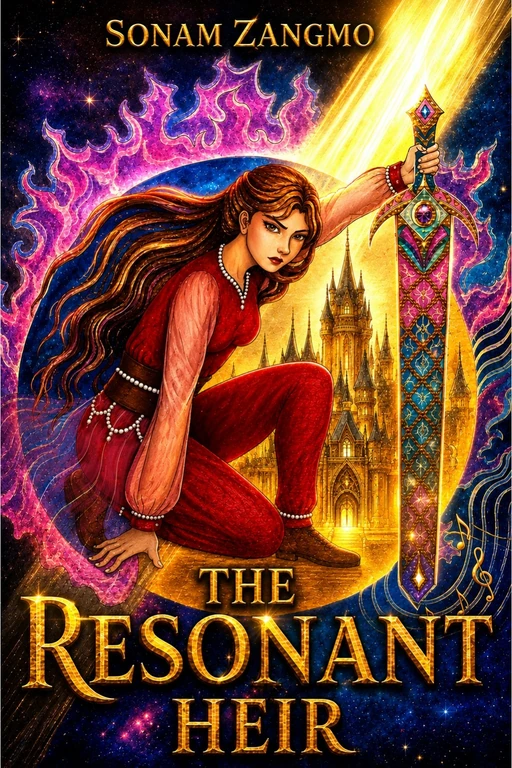
 Explore The Resonant HeirEpic Fantasy · High Fantasy · Royal Fantasy · Adventure Fantasy · Character-Driven Fantasy · Coming-of-Age Fantasy
Fiction Knowledge · 11
Why Do Good Books Get Rejected—and Published Books Still Disappoint?
Why can an editor love a manuscript that never gets published, while a book on the shelf can still leave readers wondering how it made it through editing?
Publishing is often treated as a test of quality: good manuscripts succeed, weaker ones are rejected. But acquiring a book, editing it, and satisfying its readers are three different things.
Understanding that distinction offers a more realistic view of traditional publishing—without dismissing the people who work in it or the writers who hope to enter it.
The selection
01. Why Do Good Manuscripts Get Rejected?
A rejection does not necessarily mean a manuscript lacks merit.
In its article 5 Reasons Why Good Writing Gets Rejected, Australian publisher Text Publishing acknowledges that it regularly passes on strong writing. A manuscript may fall outside its expertise, have no room on its planned list, lack clear sales potential, or differ from the editorial team’s vision. Sometimes, of course, the writing itself needs more work. [1]
The distinction matters. A rejection may reflect the manuscript, the publisher’s circumstances, or both.
Penguin offers a closer look at the decision-making process. When an editor wants to acquire a book, they typically bring it to an acquisitions meeting with colleagues from sales, marketing, publicity, production, and finance. Together, they consider its audience, comparable titles, estimated sales, and the offer they can make. [2]
An editor’s enthusiasm, then, does not always lead to a publishing deal.
In a February 2025 discussion on r/PubTips, one writer shared their experience of reaching an acquisitions meeting with a YA graphic novel. According to the writer, the editor supported the project, but the sales department had concerns about the market for YA graphic novels. The book was not acquired.
This is the writer’s account of a private process, not a statement from the publisher or an independently verified internal record. It illustrates how editorial enthusiasm and a final acquisition decision can differ. [3]
Uncertainty is part of that decision. In a study published in Poetics, Thomas Franssen and Giselinde Kuipers examined Dutch editors acquiring translation rights. They identified three recurring challenges: an abundance of titles, uncertainty about their quality and marketability, and competition for books. Although the study concerns the Dutch translation market, it helps explain why acquisitions cannot be reduced to a single judgment of literary quality. [4]
A publisher must believe in a book and see a viable way to bring it to readers. Sometimes those conditions do not meet.
The reading experience
02. Why Can Published Books Still Disappoint Readers?
For readers, the question looks different. Once a book has been professionally published, they expect it to have been carefully edited.
Yet some still encounter problems.
In a May 2025 discussion on r/Fantasy, one reader described misused words, repetitive phrasing, and continuity errors in a series they had otherwise enjoyed. Other participants shared their experiences, including problems they had noticed in traditionally published books. Some felt that editing had declined; others questioned that claim or pointed out that such errors were not new. These accounts reveal differing reader experiences, not an established industry-wide trend. [5]
Professional publishing does involve multiple editorial and production stages. Penguin Random House describes a workflow that includes copyediting, typesetting, proofreading, and successive checks of page proofs after an editor has completed their review of the manuscript. The precise process can vary by book and imprint. [6]
Those stages also serve different purposes. Correcting punctuation is not the same as improving a character arc. Catching a continuity error is not the same as making prose appealing to every reader.
The degree of editorial intervention can vary, too. In a December 2025 r/publishing discussion, people identifying themselves as managing and production editors described how they assign freelance editors according to expertise, availability, and the needs of each project. One explained that they might choose a lighter-touch editor when substantial changes would not suit the author’s or editor’s wishes—or the available schedule. This is an individual account of a working practice, not evidence that all publishers follow the same approach. [7]
Nor does every disappointing reading experience indicate an editorial failure. One reader may enjoy a book’s familiar tropes and emotional intensity while another dislikes its dialogue or pacing.
Those differences in taste can coexist with legitimate criticism of identifiable errors.
Traditional publishing brings professional resources and judgment to a book. It does not guarantee flawless execution—or universal enjoyment.
The perspective
03. What Does a Publishing Deal Really Tell Us?
A publishing deal tells us that a publisher has chosen to invest in a work. That decision matters, but it is not a universal verdict on literary worth.
A rejection is equally easy to misread. It might signal a weakness the writer should address, or it might reflect the publisher’s list, market expectations, or editorial vision. Without specific feedback, the author may never know.
This is why commercial potential, literary quality, editorial quality, and reader enjoyment should not be treated as interchangeable.
Understanding the pressures on publishers does not require readers to lower their expectations. Recognising the limits of a rejection does not require us to assume every declined manuscript is excellent.
Perhaps the fairest way to view publication is as a decision made by particular people, under particular circumstances, at a particular time.
What a book eventually means to its readers is another question.
Research & context
Sources & Further Reading
Publishing and research
- Text Publishing — 5 Reasons Why Good Writing Gets RejectedText Publishing · 17 May 2026
- Penguin — How to Get a Book DealPenguin · Official publishing guide
- Franssen & Kuipers — Coping with Uncertainty, Abundance and StrifePoetics 41(1), 48–74 · 2013
- Penguin Random House — How PRH Turns Your Manuscript into a Printed BookPenguin Random House · March 2023
Community discussions
- r/PubTips — February 2025 Check-inA writer’s account · February 2025
- r/Fantasy — D’you Ever Miss the Editing Days?Reader discussion · 6 May 2025
- r/publishing — How Production Editors Work with FreelancersFreelance and production editing discussion · December 2025
Research note: Publisher materials and academic research are used to explain documented processes. Community discussions illustrate individual experiences and are not treated as representative evidence of industry-wide trends. The Author’s Note reflects Sonam Zangmo’s personal experience and interpretation.